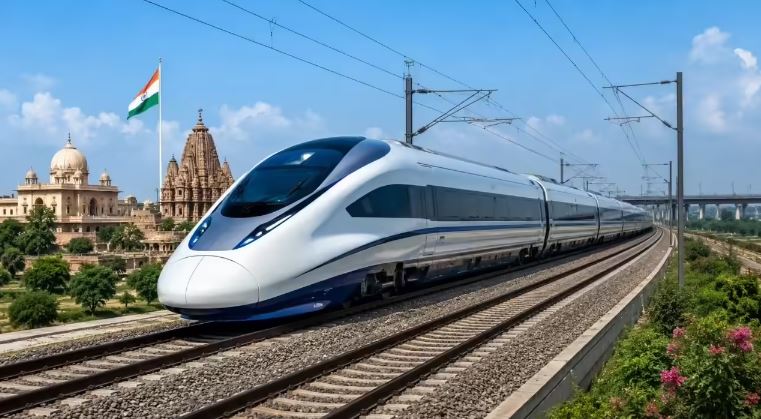
The Union Cabinet has approved the ₹20,667 crore Ahmedabad (Sarkhej)–Dholera semi high-speed double-line rail corridor, marking a major milestone in India’s railway modernisation programme and the country’s first indigenously developed semi high-speed rail project.
The project was cleared by the Cabinet Committee on Economic Affairs (CCEA) chaired by Prime Minister Narendra Modi and is being positioned as a prototype model for future semi high-speed rail corridors across India.
The proposed corridor will span approximately 134 kilometres and connect Ahmedabad with the rapidly developing Dholera Special Investment Region (SIR), the upcoming Dholera International Airport, and the Lothal National Maritime Heritage Complex. The line is expected to significantly improve regional connectivity while supporting industrial and economic growth in Gujarat’s emerging manufacturing and logistics ecosystem.
According to Railway Minister Ashwini Vaishnaw, the corridor is designed to support train operations at speeds of up to 220 kmph, making it one of the fastest rail systems planned on Indian Railways outside the dedicated bullet train network. Once operational, travel time between Sabarmati and Dholera is expected to reduce dramatically to around 48 minutes.
Officials stated that the project will be developed using indigenous technology under the government’s Atmanirbhar Bharat initiative. The corridor is also expected to become the world’s first semi high-speed rail system operating on a broad-gauge mixed-traffic network where passenger trains running at up to 220 kmph and freight trains operating at around 100 kmph will share the same rail infrastructure.
The Ahmedabad–Dholera line forms a critical part of the PM Gati Shakti National Master Plan and is aimed at improving multimodal logistics connectivity across Gujarat’s industrial corridors. The railway project is expected to support cargo movement linked to semiconductor manufacturing, solar equipment production, industrial clusters, ports, and export-oriented industries developing in the Dholera region.
The corridor will directly enhance connectivity for nearly 284 villages with a combined population of around five lakh people, improving passenger mobility and access to economic opportunities across the region. Authorities also expect the project to generate substantial employment during both construction and operational phases.
The semi high-speed rail corridor is strategically important for the development of Dholera Special Investment Region, which is being developed as one of India’s largest greenfield smart industrial cities under the Delhi–Mumbai Industrial Corridor (DMIC). The region has emerged as a major investment destination for semiconductor manufacturing, renewable energy equipment production, electronics, and advanced industrial infrastructure.
Railway officials said the project is targeted for completion around 2030–31 and will serve as a reference framework for future semi high-speed rail systems planned across India. The government has already announced plans for multiple high-speed and semi high-speed rail corridors under its long-term railway infrastructure expansion strategy.
Industry experts believe the Ahmedabad–Dholera corridor could become a transformative infrastructure project by combining high-speed passenger mobility with industrial freight connectivity, strengthening Gujarat’s position as a major manufacturing and logistics hub while showcasing India’s capability to develop advanced railway systems using domestic technology.