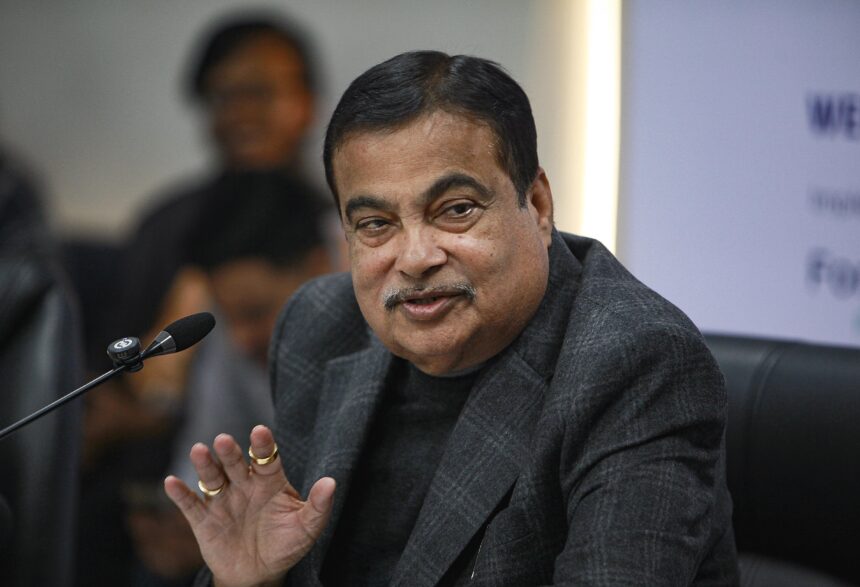
Union Road Transport and Highways Minister Nitin Gadkari has urged Indian automotive and manufacturing companies to form joint ventures with American firms as India intensifies efforts to emerge as the world’s leading automobile manufacturing hub.
Speaking during industry interactions focused on industrial cooperation and advanced manufacturing, Gadkari highlighted India’s rapidly expanding automotive ecosystem, large domestic market, improving infrastructure, and growing export capabilities as key strengths that could position the country among the world’s top automobile production centres over the coming decade.
The minister encouraged Indian manufacturers to collaborate with US companies in areas such as electric mobility, hydrogen fuel technologies, advanced automotive electronics, battery systems, autonomous mobility solutions, intelligent transportation systems, and high-end component manufacturing. According to Gadkari, technology partnerships and global-scale industrial cooperation will be critical for strengthening India’s competitiveness in future mobility sectors.
India has already emerged as one of the world’s largest automobile markets and currently ranks among the top global producers of two-wheelers, passenger vehicles, tractors, and commercial vehicles. Industry estimates indicate that the Indian automobile sector contributes nearly 7 per cent to the country’s GDP and supports millions of direct and indirect jobs across manufacturing and supply chains.
Gadkari stated that India’s improving highway infrastructure, logistics networks, industrial corridors, and policy reforms are creating strong conditions for large-scale automotive manufacturing expansion. The government has significantly accelerated investments in expressways, multimodal logistics corridors, EV charging networks, and industrial infrastructure under programmes such as Bharatmala, PM Gati Shakti, and the National Infrastructure Pipeline.
The minister also reiterated India’s ambition to become a global hub for electric vehicles, green mobility, ethanol-based fuels, biofuels, and hydrogen-powered transportation systems. He highlighted ongoing efforts to reduce fossil fuel imports and strengthen domestic clean mobility manufacturing capabilities through policy incentives and industrial investments.
India’s automotive sector is currently witnessing major transformation driven by electrification, connected mobility, advanced safety systems, localisation of supply chains, and growing export opportunities. Global manufacturers are increasingly expanding production capacities in India amid efforts to diversify international manufacturing bases beyond traditional automotive hubs.
Industry analysts noted that partnerships between Indian and US firms could help accelerate technology transfer, strengthen research and development capabilities, and improve access to advanced manufacturing processes. Areas such as semiconductor integration, battery chemistry, lightweight materials, software-defined vehicles, and autonomous driving technologies are expected to become major collaboration opportunities.
The government has also launched multiple incentive programmes including the Production Linked Incentive (PLI) schemes for automobiles, auto components, and advanced chemistry cell batteries to attract large-scale investments into India’s manufacturing ecosystem. Several global automotive companies and suppliers have announced expansion plans linked to India’s EV and export growth potential.
Gadkari further emphasised the importance of innovation, cost-effective manufacturing, and sustainable mobility solutions in helping India compete with established automobile manufacturing powers such as China, Japan, Germany, South Korea, and the United States. He stated that India possesses the engineering talent, market scale, and industrial ecosystem required to become a dominant force in the global automotive industry.
Industry experts believe deeper India-US automotive collaboration could play a major role in accelerating India’s transition into a global manufacturing and export hub for next-generation mobility technologies while strengthening supply chain resilience amid shifting global industrial dynamics.