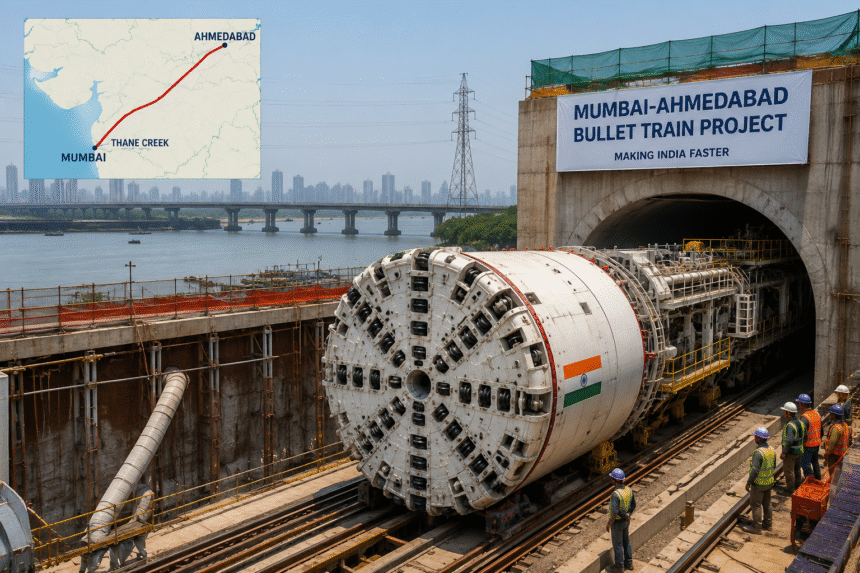
The Mumbai-Ahmedabad High-Speed Rail (MAHSR) project has reached another significant milestone with the second Tunnel Boring Machine (TBM) commencing excavation for the 10-km underground tunnel between Sawli (Ghansoli) and Vikhroli in Maharashtra. Of this stretch, 7 km will pass beneath Thane Creek, making it India’s first undersea railway tunnel.
The TBM, which began tunnelling on July 18, is one of two massive tunnel boring machines deployed for constructing the underground section of the country’s first bullet train corridor. Weighing around 3,200 tonnes and measuring approximately 99 metres in length, the machine is designed to excavate through varied geological conditions while simultaneously installing precast concrete tunnel segments to ensure structural stability.
The underground section forms part of the 21-km tunnel connecting Bandra Kurla Complex (BKC) in Mumbai with Shilphata. Besides the undersea stretch beneath Thane Creek, the alignment also includes sections being constructed using the New Austrian Tunnelling Method (NATM) and cut-and-cover techniques, depending on ground conditions.
The National High Speed Rail Corporation Limited (NHSRCL) said the deployment of the second TBM will accelerate tunnelling work on one of the most technically challenging portions of the project. The first TBM is already operational on another section of the tunnel, enabling parallel excavation and faster project execution.
The 508-km Mumbai-Ahmedabad High-Speed Rail corridor is India’s first bullet train project and is being developed with technical and financial assistance from Japan. Once operational, the corridor is expected to significantly reduce travel time between Mumbai and Ahmedabad while introducing high-speed rail technology to the country.