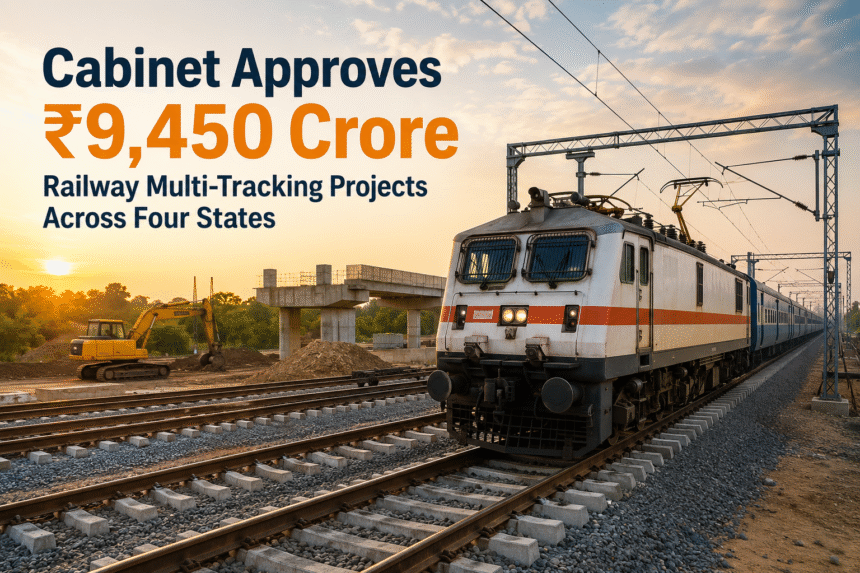
The Union Cabinet has approved four railway multi-tracking projects with a combined investment of ₹9,450 crore, adding approximately 410 km of new railway lines across West Bengal, Odisha, Andhra Pradesh and Tamil Nadu. The projects are aimed at expanding rail capacity, easing congestion and strengthening passenger and freight movement along important corridors.
The projects include the 173-km fourth line between Kharagpur and Bhadrak (Ranital), the 75-km fourth line between Bhadrak and Haridaspur, the 90-km third and fourth lines between Gummidipundi and Gudur, and 72 km of third and fourth lines between Cuttack and Paradeep (Badabandha). A significant portion of the investment is focused on the Howrah–Chennai coastal rail corridor, where additional tracks are expected to improve the movement of both passenger and freight trains. The projects are scheduled for completion by 2030-31.
The Kharagpur–Bhadrak fourth line will strengthen rail capacity across West Bengal and Odisha, while the Bhadrak–Haridaspur section will add another line on an important Odisha corridor. Together, these projects are expected to provide greater operational flexibility and help trains move more efficiently through sections where existing capacity is under pressure.
The Cuttack–Paradeep multi-tracking project is particularly relevant for freight transportation. Paradeep is an important industrial and port region, and stronger rail connectivity can support the movement of commodities and industrial materials to and from the port.
Similarly, the Gummidipundi–Gudur third and fourth lines, spanning Andhra Pradesh and Tamil Nadu, will add capacity to an important southern railway corridor connecting major industrial and commercial centres. The additional tracks are expected to improve train movement and reduce dependence on existing congested sections.
According to the government, the increased line capacity will improve operational efficiency, service reliability and mobility across the affected routes. Multi-tracking allows passenger and freight services to be operated with greater flexibility, particularly on corridors where traffic has increased substantially.
The projects have been planned under the PM GatiShakti National Master Plan, with emphasis on integrated infrastructure planning and improved multimodal connectivity. The approach is intended to ensure that railway investments complement road, port and other logistics infrastructure rather than being developed as isolated networks.
The expansion is also expected to support India’s freight movement objectives. Additional railway capacity can enable more goods trains to operate without competing as heavily with passenger services, potentially improving logistics efficiency and reducing pressure on road transportation.
For the infrastructure and construction sector, the Cabinet approval creates a substantial pipeline of opportunities across track construction, bridges, signalling, electrification, civil works and railway equipment. The projects will also generate demand for materials and engineering services during the execution phase.
The ₹9,450-crore investment forms part of the government’s continuing effort to expand railway capacity through multi-tracking rather than relying solely on new routes. By strengthening existing high-traffic corridors, Indian Railways can improve utilisation of established networks while addressing bottlenecks that affect both passenger and freight operations.
A 410 km of additional railway lines planned across four states, the latest approval represents another major capacity expansion for Indian Railways and is expected to strengthen connectivity along some of the country’s important eastern and southern transport corridors.