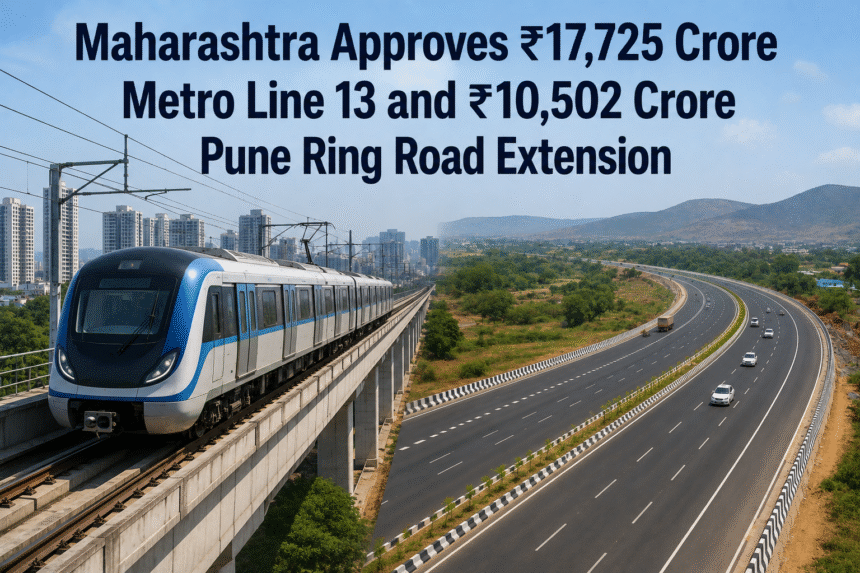
The Maharashtra government has approved two major urban infrastructure projects worth a combined ₹28,227 crore, clearing the way for Metro Line 13 connecting Mira-Bhayandar with Vasai-Virar and the eastern extension of the Pune Ring Road. The approvals are expected to provide a significant boost to regional connectivity and ease pressure on existing road networks.
The larger of the two projects is Metro Line 13, a proposed 25-km corridor with 16 stations linking Mira-Bhayandar with Vasai-Virar through the western suburbs of the Mumbai Metropolitan Region. The project has an estimated cost of ₹17,724.99 crore and is intended to improve connectivity between rapidly developing suburban areas. The corridor is expected to connect important areas including Mira Road, Vasai, Nalasopara, Naigaon and Virar, creating a new cross-regional public transport link. By connecting these urban centres through a dedicated metro corridor, the project is expected to provide commuters with an alternative to increasingly congested road routes.
The Mumbai Metropolitan Region Development Authority (MMRDA) will be responsible for implementing Metro Line 13. The corridor is part of the state’s broader effort to expand mass-transit infrastructure across the Mumbai Metropolitan Region and improve connectivity between peripheral urban centres.
The second major approval concerns the eastern extension of the Pune Ring Road, for which the state government has sanctioned a revised project cost of ₹10,502.36 crore. The extension will cover approximately 31.8 km, connecting Soratpawadi on the Pune-Solapur Road with Varve-Shivre on the Pune-Satara Road.
The ring-road extension is designed primarily to divert inter-state and intra-state traffic away from Pune’s core urban areas. By providing an alternative route around the city, the project is expected to reduce congestion on existing arterial roads and improve the movement of freight and long-distance traffic.
The Pune project will be implemented by the Maharashtra State Road Development Corporation (MSRDC). Its strategic importance extends beyond urban mobility, as the ring road can also improve connections between industrial areas, logistics centres and major highways around the Pune metropolitan region.
Together, the two projects represent a substantial expansion of Maharashtra’s infrastructure pipeline. They cover two complementary aspects of urban mobility high-capacity public transportation in the Mumbai region and road-based freight and traffic diversion around Pune.
The approvals are also expected to create opportunities for construction, engineering, civil infrastructure and metro-rail companies as the projects move towards tendering and execution. Companies such as L&T, J Kumar Infraprojects, NCC, Afcons Infrastructure and Titagarh Rail Systems are among the infrastructure and rail-sector players being watched in connection with the increased project pipeline.
For the Mumbai Metropolitan Region, Metro Line 13 could become particularly important as population and economic activity continue to spread towards peripheral areas. Better rail connectivity between Mira-Bhayandar and Vasai-Virar could support more balanced regional development while reducing dependence on private vehicles.
In Pune, meanwhile, the ring-road extension is expected to strengthen the city’s wider transportation network by separating through-traffic from local urban traffic. This could be particularly beneficial for commercial vehicles and freight movement passing through the Pune region.
The combined ₹28,227-crore infrastructure push therefore reflects Maharashtra’s continuing focus on expanding metropolitan transport capacity. As these projects progress from approval to implementation, their success will depend on timely land, clearances, tendering and construction, but the latest sanctions establish a sizeable new pipeline for the state’s urban infrastructure sector.