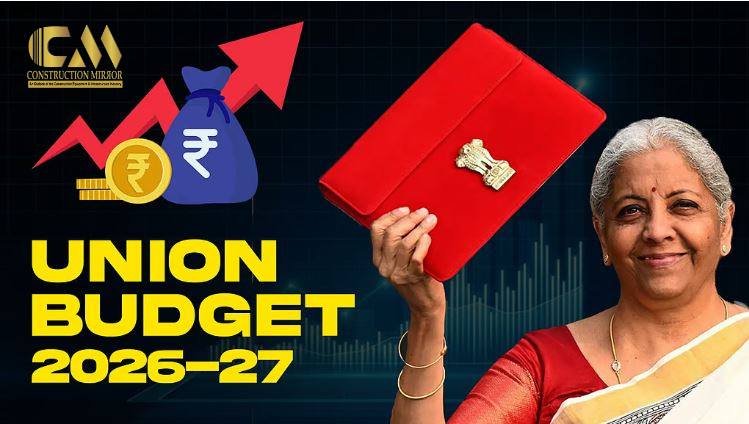
The Union Budget 2026–27 reinforces the central role of construction and infrastructure in India’s economic expansion, positioning the sector not merely as a growth enabler but as a growth driver in itself. Presented by Finance Minister Nirmala Sitharaman on 1 February 2026, the Budget continues the government’s multi-year strategy of sustained capital investment, with clear implications for EPC contractors, road developers, urban infrastructure players and allied industries.
The Union Budget 2026–27 marks a defining moment in India’s infrastructure journey, a phase where the focus shifts from announcing intent to delivering impact. Presented at a time when India’s aspirations are closely tied to the strength of its physical assets, the Budget reinforces a simple but powerful idea: nation-building is, at its core, an act of construction. With public capital expenditure raised to ₹12.2 lakh crore, the Budget signals confidence in infrastructure as the most effective catalyst for economic growth. This is not a short-term stimulus, but a deliberate continuation of a long-range investment strategy that recognises roads, railways, cities and logistics networks as the foundation of productivity, competitiveness and social mobility. The emphasis is no longer just on building more, but on building better, faster and smarter.
Infrastructure in this Budget is also deeply linked to geography and inclusivity. The renewed focus on City Economic Regions and non-metro urban centres reflects a recognition that India’s next growth wave will emerge from beyond its largest cities. As economic activity decentralises, construction becomes the bridge between policy vision and on-ground transformation shaping cities, enabling mobility and improving quality of life.
The Budget also reflects a maturing infrastructure ecosystem. Financing reforms, asset monetisation and improved institutional mechanisms indicate a shift towards more resilient project structures. Execution challenges that once constrained large developments are now being addressed through better capital access and risk-sharing frameworks. This evolution is critical as projects become larger, more complex and more interconnected.
Equally important is the integration of infrastructure with manufacturing and supply chains. By strengthening domestic capabilities in equipment, materials and technology, the Budget reinforces a construction ecosystem that is less dependent on imports and more aligned with global standards. This convergence of infrastructure and industrial policy represents a strategic step toward long-term self-reliance.
Fiscal discipline remains the silent strength of the Budget. By maintaining a clear consolidation path while prioritising capital expenditure, the government has chosen sustainability over populism. This balance is essential for preserving investor confidence and ensuring that infrastructure growth remains durable rather than debt-driven.
Ultimately, the Union Budget 2026–27 is a statement of intent not through rhetoric, but through allocation, structure and continuity. It recognises that India’s ambitions for the next decade will be realised not only in boardrooms and policy documents, but on construction sites, city streets and transport corridors. In that sense, the Budget is not just about numbers; it is about the physical shaping of India’s future.
Let’s dive deeper into the minds of industry leaders as they decode what Union Budget 2026–27 means for construction and infrastructure.
Mr. Deepak Shetty, MD & CEO JCB India, “We warmly welcome Budget 2026, which charts a transformative course to accelerate India’s economic growth and advance the vision of a ‘Viksit Bharat’. The focus on scaling up manufacturing across seven strategic sectors and promoting champion MSMEs is a decisive step toward strengthening India’s domestic capabilities while establishing the country as a global manufacturing hub.
A significant boost comes for the construction equipment industry, with a focus on domestic manufacturing of high-value capital goods such as tunnel boring machines, earthmoving equipment, and crane systems. This initiative is set to drive demand for advanced, locally produced equipment, fuel innovation, and elevate India’s position as a globally competitive hub in the construction ecosystem. The strong emphasis on infrastructure, particularly the development of seven high-speed rail corridors as growth connectors, will further enhance regional integration, improve urban mobility, and boost productivity, making India an attractive destination for global investment.
Complemented by reforms such as a review of the Foreign Exchange Management framework, measures to deepen the corporate bond market, and enabling non-resident investors to participate in equities through the Portfolio Investment Scheme, the Budget creates a robust environment for long-term capital flows and enterprise growth. Overall, Budget 2026 strikes the perfect balance between growth, structural reforms, and long-term competitiveness, paving the way for India to emerge as a world-class manufacturing and infrastructure hub while generating opportunities that benefit countries across the globe.”
Mr. Bhuvan Anandakrishnan, India Country Manager and Vice President, Caterpillar,
“We welcome initiatives to further grow private investment and drive business growth. Continued emphasis on infrastructure development, export promotion, and digital transformation closely resonates with Caterpillar’s aim to deliver advanced technology solutions that help build a better, more sustainable world. A stable and predictable operating environment strengthens resilience and enables long-term growth.”
Mr. Deepak Garg, VC & MD Sany India, “Union Budget 2026 sends a strong and positive signal for the construction equipment industry by firmly reinforcing India’s infrastructure-led growth vision. The increase in capital expenditure to ₹12.20 lakh crore, along with continued investments in highways, railways, freight corridors, waterways, urban infrastructure, and mining, provides long-term demand visibility for construction and mining equipment.
The Budget’s emphasis on Viksit Bharat and Make in India is equally encouraging. Measures aimed at localisation, import reduction, MSME enablement, skilling, and strengthening domestic supply chains will enhance manufacturing competitiveness and help India emerge as a global hub for construction equipment and heavy machinery.
At the same time, there is scope for further momentum through targeted interventions. Rationalisation of GST on construction equipment, clearer incentives for adoption of green and electric machinery, an explicit PLI framework for heavy equipment, and sharper sector-specific financing mechanisms would have accelerated adoption and fleet modernisation.
Overall, Budget 2026 sets the right direction for infrastructure development and manufacturing growth. With a few industry-specific refinements, it has the potential to significantly strengthen the construction equipment ecosystem and support India’s long-term economic and infrastructure ambitions.”
Mr. Harinder Singh, Managing Director & CEO, Yokohama India Pvt. Ltd., “The Union Budget’s continued emphasis on manufacturing depth, infrastructure expansion, critical mineral ecosystems and clean energy value chains sends a strong and progressive signal for India’s industrial future. Enhanced support for electronic components manufacturing, battery storage, lithium-ion cells and critical minerals creates long-term policy visibility for EV platform localisation, battery assembly and advanced power electronics manufacturing, thereby strengthening investment confidence across emerging mobility ecosystems.
For the tyre industry and the broader automotive sector, sustained capital expenditure of ₹12.2 lakh crore, expansion of highways, freight corridors, ports and multimodal logistics networks will significantly improve supply chain resilience, logistics efficiency and last-mile connectivity. Improved infrastructure access across Tier-II and Tier-III markets further enhances market reach and demand potential.
Additionally, customs duty rationalisation and exemptions on select capital goods and advanced components help improve cost competitiveness by lowering initial capex and operational costs for high-technology manufacturing investments in India.
At Yokohama India, where we continue to expand our domestic production footprint with a strong focus on localisation, sustainability and high value-added products, this policy direction reinforces confidence to accelerate investments in capacity, technology and next-generation manufacturing aligned with India’s long-term growth trajectory.”
Mr. Puneet Vidyarthi, Head of Brand Marketing, CASE Construction India & APAC and President, Rural Marketing Association of India, “The Budget’s continued focus on infrastructure-led growth beyond metros is a positive signal. Greater emphasis on connectivity and localised development can help accelerate economic activity across semi-urban and rural markets. As development expands closer to these regions, building skills at the grassroots level becomes equally important to support efficient execution and long-term impact. Together, these measures can contribute to more balanced growth while strengthening local economies and market potential.”
Mr. Shalabh Chaturvedi, Managing Director, India & SAARC region, CASE Construction Equipment, “We strongly welcome the Union Budget 2026–27’s decisive push for infrastructure, reflected in the increase of public capital expenditure to ₹12.2 lakh crore. The announcement of the Scheme for Enhancement of Construction and Infrastructure Equipment is a landmark step for the industry. For CASE Construction, this reinforces the vision of manufacturing in India for an Aatmanirbhar Bharat by promoting domestic production of high value, technologically advanced equipment. The planned development of City Economic Regions, new freight corridors, and expansion of national waterways under the PM Gati Shakti programme will drive demand for advanced construction equipment. The Budget’s broader policy support for manufacturing and industrial ecosystems will help accelerate supply chain migration into India and create large scale employment opportunities. With a continued focus on ease of doing business and exports, this Budget lays a strong foundation for industrial growth aligned with the vision of Viksit Bharat.”
Mr. Harsh Pareek, Vice President, Direct Sales, Asia-Pacific at Trimble, “The ₹12.2 trillion allocation for the Infrastructure and construction sector announced in this Budget sends a clear signal that infrastructure remains central to India’s growth agenda, even in a challenging global environment. Sustaining this level of investment will be important, not just to keep projects moving, but to ensure long-term economic impact.
What stands out is the focus on expanding infrastructure development into Tier-2 and Tier-3 cities, which are fast emerging as key growth centres. As construction activity spreads across more regions, the project complexity will increase and so execution and quality on the ground will matter more than ever. The continued push for advanced technologies is a positive step towards building infrastructure that is dependable, scalable and built to last.”
Mr. V. G. Sakthikumar Convener – ICEMA
Manufacturing and Supply Chain Panel & Chairman & Managing Director Schwing Stetter India Pvt. Ltd., “This budget announcement is a welcome and timely development for the construction equipment manufacturing and supply chain ecosystem. Incentivising domestic manufacturing of construction equipment and critical components has been a key agenda of ICEMA’s Manufacturing and Supply Chain Panel, and it is heartening to see this sustained policy advocacy culminate in a concrete budget announcement. This initiative will significantly enhance localization of equipment and components that are currently imported, help reduce import dependency, and strengthen supply
chain resilience and global competitiveness. Coupled with the government’s continued thrust on unhindered infrastructure development, these measures will further support demand, investment, and sustained growth of the construction equipment
industry.”
Mr. Sitaram Ganeshan, Treasurer, ICEMA &
President – Wipro Hydraulics, Wipro Infrastructure Engineering, “The Union Budget is highly encouraging for both the construction equipment and precision component manufacturing sectors. The budget proposals provide a strong opportunity for developing high- precision components in India such as hydraulics, high-capacity engines, transmission systems, undercarriage parts and other critical sub-systems
that are currently largely imported. Local manufacturing of these technologies will help construction equipment OEMs improve localisation levels, lower production costs and
enhance global competitiveness.”
Mr. Ramesh Palagiri President Designate, ICEMA & Managing Director & CEO, Wirtgen India Pvt Ltd, “The Union Budget’s continued emphasis on infrastructure is a strong signal of confidence in India’s growth story and will help revive domestic demand for construction equipment at a time when the industry has been facing a slowdown. The announcement of an incentive scheme for construction and infrastructure equipment manufacturing further strengthens this momentum by supporting domestic capacity and technology adoption. Together, these measures will create long-term growth for the sector and reinforce the foundation of India’s infrastructure-led economic
development.”
Mr. Manish Mehan, Managing Director & CEO, TK Elevator India,“The Union Budget 2026’s emphasis on housing, urban infrastructure and real estate-led growth is encouraging for the vertical mobility ecosystem. As cities expand vertically, safe and reliable elevator systems become essential urban infrastructure. The inclusion of advanced lifts within construction and infrastructure enhancement initiatives underlines the sector’s growing relevance and the need for harmonised regulations to support productivity, safety and quality across the real estate value chain.”
Mr. Amit Gossain, Chairman and Managing Director, KONE Elevators India & South Asia, “We welcome Budget 2026 and its clear focus on strengthening India’s infrastructure-led growth. The emphasis on urban development, particularly across tier-2 and tier-3 cities, will play an important role in advancing smart urbanisation and modern vertical construction. This creates meaningful opportunities for companies like KONE India to support the next phase of India’s city-building journey.
The proposed capital expenditure of ₹12.2 lakh crore for FY27, along with continued focus on R&D and digital capabilities, sends a strong signal towards innovation, efficiency, and long-term competitiveness. These measures will help accelerate infrastructure creation, improve logistics, support employment, and contribute to more sustainable and future-ready cities.
At KONE India, we look forward to contributing to this momentum by bringing safer, smarter, and more sustainable mobility solutions to India’s growing urban landscape. Budget 2026 provides a positive and enabling roadmap for the infrastructure sector and reinforces confidence in India’s long-term growth story.”
Mr. Parth Jindal, President, Cement Manufacturers’ Association (CMA), “As India advances towards a Viksit Bharat, the three kartavyaarticulated in the Union Budget provide a clear context for the Nation’s growth and aspirations, combining economic momentum with capacity building and inclusive progress. The Cement Manufacturers’ Association (CMA) appreciates the Union Budget 2026-27 for the continued emphasis on manufacturing competitiveness, urban development and infrastructure modernisation, supported by over 350 reforms spanning GST simplification, labour codes, quality control rationalisation and coordinated deregulation with States. These reforms, alongside the Budget’s focus on Youth Power and domestic manufacturing capacity under Atmanirbharta, stand to strengthen the investment environment for capital intensive sectors such as Cement. The Union Budget 2026-27 reflects the Government’s focus on infrastructure led development emerging as a structural pillar of India’s growth strategy.
The ₹20,000 crore CCUS outlay for various sectors, including Cement, fundamentally alters the decarbonisation landscape for India’s emissions intensive industries. CCUS is a significant enabler for large scale decarbonisation of industries such as Cement and this intervention directly addresses the technology and cost requirements of the Cement sector in context. The Cement Industry, fully aligned with the Government of India’s Net Zero commitment by 2070, views this support as critical to enabling the adoption and scale up of CCUS technologies while continuing to meet the Country’s long term infrastructure needs.”
Dr Raghavpat Singhania, Vice President, CMA, “The Government’s sustained infrastructure push supports employment, regional development and stronger local supply chains. Cement manufacturing clusters act as economic anchors across regions, generating livelihoods in construction, logistics and allied sectors. The Budget’s focus on inclusive growth, execution and system level enablers creates a supportive environment for responsible and efficient expansion offering opportunities for economic growth and lending momentum to the Cement sector. The increase in public capex to ₹12.2 lakh crore, the focus on Tier 2 and Tier 3 cities, and the creation of City Economic Regions stand to strengthen the growth of the Cement sector. We welcome the Budget’s emphasis on tourism, cultural and social infrastructure, which should broaden construction activity across regions. Investments in tourism facilities, heritage and Buddhist circuits, regional connectivity in Purvodaya and North Eastern States, and the strengthening of emergency and trauma care infrastructure in district hospitals reinforce the Cement sector’s role in enabling inclusive growth.
CMA notes positively the Government’s continued commitment to fiscal discipline, with the fiscal deficit estimated at 4.3% of GDP for fiscal year 2026-27, reinforcing macroeconomic stability and investor confidence. As India progresses towards Viksit Bharat 2047, the Cement Industry reaffirms its commitment to working closely with the Government to build resilient, sustainable and inclusive infrastructure that supports long term national development.”
Mr. Rinkesh Roy, Joint Managing Director and CEO, JSW Infrastructure Ltd., “We congratulate the Honourable Finance Minister and the Government of India on a decisive and forward-looking Budget that firmly positions infrastructure as the foundation of India’s growth. The thought through push towards port modernisation, inland waterways, coastal shipping, and logistics corridors will make India competitive and marks a structural change. The additional focus on expanding national waterways, strengthening east coast connectivity, container manufacturing, and digitalisation of ports aligns closely with our vision of building integrated, port-led logistics ecosystems. Creating seamless linkages between ports, evacuation infrastructure, and industrial clusters is a must to achieve uninterrupted growth. Equally encouraging is the emphasis on green ports, sustainability-linked financing, ship repair, and smart-port technologies, which will enhance India’s maritime competitiveness while supporting long-term, sustainable growth. Overall, Budget 2026–27 reinforces India’s ambition to emerge as a global maritime and logistics hub and provides strong momentum to port-led industrial development.”
Mr. Vinod Kumar Gupta, Managing Director, Dollar Industries Limited, “We warmly welcome Union Budget 2026’s decisive push for manufacturing, particularly the ₹10,000 crore credit boost for MSMEs, also for introducing the National Fibre Scheme, a transformative step towards achieving self-reliance in both natural and man-made fibres. This initiative directly boosts domestic supply and competitiveness for the hosiery sector, addressing our core raw material needs. It lays a strong foundation for sustainable growth and robust employment generation in our labour-intensive industry.”
Mr. Sahil Saharia, CEO, Bengal Shristi Infrastructure Development Ltd., “The Union Budget 2026-27 sends a positive signal for the real estate sector by reinforcing the government’s commitment to affordable housing and infrastructure-driven urban growth in Tier 1 and Tier 2 cities. The proposed Infrastructure Risk Guarantee Fund is a timely move that can de-risk projects, improve funding access and enable faster delivery of quality housing for end users.”
Mr. Rishi Jain, Managing Director, Jain Group, “Budget 2026 is reassuring in intent but offers little immediate relief for the real estate sector. While the ₹12.2 lakh crore capex push and City Economic Regions signal long-term planning, they do not address today’s liquidity challenges. Key industry demands such as infrastructure status and higher Section 24(b) deductions remain unaddressed, with the focus shifting to structural measures like REIT monetisation and PMAY. Overall, the Budget favours long-term urban planning over the short-term fiscal support needed to revive real estate growth amid global uncertainty.”
Mr. Sanjay Jain, Managing Director, Siddha, “Budget 2026’s sustained emphasis on infrastructure supports long-term real estate growth by strengthening connectivity and urban development. The ₹12.02 lakh crore capital expenditure allocation and expansion of high-speed rail corridors are expected to improve commute efficiency and unlock housing demand across emerging and peripheral micro-markets. As infrastructure continues to influence urban living, buyer priorities are moving from tax-driven choices to lifestyle and liveability considerations, with a continued focus on transparent pricing, timely delivery and consistent execution across markets.”
Mr. Manish Mohnot, Managing Director & CEO, Kalpataru Projects International Limited, “The Budget sustains India’s infrastructure momentum by improving both funding visibility and execution certainty without compromising on fiscal deficit for long term sustainability/ impact. Increasing the FY27 public capital expenditure to ₹12.2 lakh crore (₹12.2 trillion), coupled with the setting up of Infrastructure Risk Guarantee, will bolster lender confidence and de-risk bank financing, particularly during high-risk early development phases.
The stress on infrastructure – investments in new railway freight corridors, high-speed rail corridors, and 20 national waterways – will significantly enhance multimodal logistics. Additionally, the restructuring of the Power Finance Corporation (PFC) and Rural Electrification Corporation (REC) is a timely move; it expands financing capacity for large-scale power projects while accelerating rural electrification.
For EPC players, these reforms translate to a steadier project pipeline, fewer funding-related delays, and renewed confidence in long-term growth. Furthermore, scaling InvITs will unlock critical capital and encourage private sector participation. Together, these measures ensure execution clarity for firms delivering complex, future-ready infrastructure at scale.”
Mr. Parag Munot, Managing Director, Kalpataru Limited., “The increase in public capital expenditure to ₹12.2 trillion (₹12.2 lakh crore) for FY27 will indirectly drive demand for residential and commercial space across the country. Furthermore, the Budget’s focus on Tier-II and III cities and temple towns supported by a ₹5,000 crore annual allocation through city economic region mapping will provide vital support to the sector.
The introduction of seven high-speed rail corridors, including Mumbai-Pune, will reduce travel times and unlock land parcels, creating new micro-markets for integrated townships. Additionally, enhanced municipal bond financing provides ₹100 crore incentives for issuances exceeding ₹1,000 crore, while higher NRI investment limits will channel long-term capital into real estate where infrastructure-led growth is strongest.”
Mr. Ashok Kumar Bhaiya, Chairman & Managing Director at Aludecor Lamination Pvt. Ltd., “The Union Budget 2026, presented by Hon’ble Finance Minister, is aimed at further accelerating the momentum of the construction and building materials sector in India. The sustained growth in public capital expenditure to ₹11.2 lakh crore, and the development of Tier II and Tier III cities with a population of over 5 lakhs as growth centers and City Economic Regions, will help sustain demand for quality construction materials, where quality and compliant façade solutions are becoming increasingly important. The Scheme for Enhancement of Construction and Infrastructure Equipment is especially important, as it promotes the use of modern and safety-driven construction practices. This will lead to a natural increase in the demand for engineered, fire-rated, and performance-oriented façade materials, which will provide greater opportunities for organized manufacturers.While the direction outlined in the Budget is encouraging, the pace of on-ground implementation will be key in determining its real impact on the sector. We remain optimistic and look forward to these measures translating into consistent project execution and sustained industry growth.”
Mr. Sunil Nair, CEO of Ramky Infrastructure Ltd, “The Union Budget 2026 underscores a clear continuity of confidence in India’s infrastructure growth story. The proposal to establish an Infrastructure Risk Guarantee Fund is a particularly forward‑looking intervention, it directly addresses one of the biggest hurdles in the sector: risk perception during the early stages of project development and construction. By offering partial credit guarantees to lenders, the Fund will not only ease financing bottlenecks but also embolden private players to invest in new, large‑scale projects with greater assurance.Equally significant is the government’s move to accelerate asset monetisation through dedicated Real Estate Investment Trusts (REITs) for Central Public Sector Enterprise (CPSE) owned real estate. This will unlock dormant capital, enhance liquidity in the system, and catalyse a new wave of investments across allied sectors like logistics, housing, and industrial infrastructure.
Complementing these reforms, the Budget’s thrust on industrial infrastructure through the Chemical Park and bulk drug park, Biopharma Shakti schemes enhances India’s manufacturing and innovation ecosystem. The Chemical Park and bulk drug park will create plug‑and‑play clusters to boost domestic chemical production and reduce imports, while the ₹10,000 crore Biopharma Shakti initiative aims to build a globally competitive biopharma ecosystem through new NIPERs, clinical trial networks, and upgraded regulatory standards. Finally, with a proposed capital expenditure of ₹12.2 lakh crore for FY 2026‑27, the Budget reaffirms infrastructure as the backbone of India’s economic momentum. These measures together create a balanced ecosystem, de‑risked, capital‑efficient, and geared towards sustainable, high‑velocity growth. For developers like Ramky Infrastructure, this paves the way for deeper partnerships in nation‑building.”
Mr. Pradeep Aggarwal, Founder & Chairman, Signature Global (India) Ltd, “The Union Budget 2026 provides a strong and credible roadmap for India’s next phase of growth, led by a sharp focus on infrastructure, urban development, and financial reforms. The government’s decision to raise public capital expenditure to ₹12.2 lakh crore in FY27, a 9% increase over FY26, will play a critical role in accelerating project execution and crowding in private investment.
The creation of the Infrastructure Risk Guarantee Fund, along with the rollout of seven high-speed rail corridors and the operationalisation of 20 new national waterways over the next five years, will significantly enhance connectivity, reduce logistics costs, and improve the overall efficiency of the real estate and infrastructure ecosystem.
Urban development receives a sustained boost with an allocation of ₹5,000 crore per year for five years for City Economic Regions, alongside a continued focus on Tier-2 and Tier-3 cities as emerging growth centres. These measures will enable planned urbanisation, support civic infrastructure, and unlock housing demand across new geographies. Further, accelerated recycling of CPSE real estate assets through dedicated REITs and continued emphasis on InvITs will deepen capital markets, improve liquidity, and strengthen investor confidence across the sector. On the consumption side, income tax reforms— including no tax liability up to ₹12 lakh under the new tax regime, rationalised TDS and TCS rates, and reduced TCS on overseas tour packages to 2%, will enhance disposable incomes and ease compliance, providing indirect yet meaningful support to housing demand. Overall, the Budget aligns strongly with the long-term vision of Viksit Bharat by 2047 and lays the foundation for sustainable, inclusive, and future-ready economic growth.”
Mr. Rahul Munjul, CMD, Hero Future Energies, “I would like to congratulate the Hon’ble Finance Minister for rolling out a pragmatic yet visionary Union Budget, aimed at building a developed and self-reliant India. It sets a roadmap for inclusive, sustainable and accelerated economic growth, with a clear focus on robust infrastructure and connectivity, domestic manufacturing excellence, balanced regional growth and creation of a future ready workforce. The government’s reform agenda marks a decisive shift from improving the ‘ease of doing business’ to accelerating ‘the speed of doing business’, through simplified regulations and technology-enabled approvals.
Targeted customs duty exemptions for lithium-ion cells, battery energy storage systems and key clean-energy manufacturing inputs will help scale domestic capacity and improve project viability. The commitment to carbon capture, utilisation and storage acknowledges the need for credible transition pathways for sectors such as power, steel, cement and refining, while long-term support for nuclear energy creates a stable framework for capital-intensive energy investments.”
Mr. Neeraj Akhoury Managing Director, Shree Cement Limited, “The Union Budget’s strong focus on infrastructure and balanced regional growth is encouraging. The proposed Infrastructure Risk Guarantee Fund will boost lender confidence and help attract private investment. Increased allocations for high speed rail, Tier II and Tier III cities, and temple towns will drive sustained demand across the construction sector. The support for CCUS is timely and reinforces the importance of clean technologies in decarbonizing hard to abate industries.”
Mr. Devansh Jain, Executive Director, INOXGFL Group, “We thank the Government of India led by Hon’ble Prime Minister Shri Narendra Modi, and Hon’ble Finance Minister Shrimati Nirmala Sitharaman for presenting the Union Budget. The Union Budget 2026–27 underscores the Government of India’s sustained commitment to building a resilient, low-carbon energy system, an approach that closely aligns with INOXGFL Group’s integrated clean energy strategy across renewables, manufacturing and infrastructure.The continued policy support for battery energy storage systems, including customs duty exemptions for lithium-ion cell manufacturing, along with duty relief for key solar manufacturing inputs, will play a critical role in strengthening grid stability and accelerating large-scale renewable integration. These measures are particularly relevant for developers and manufacturers working to build end-to-end domestic clean-energy value chains.
The Budget’s ₹20,000 crore allocation for carbon capture, utilisation and storage (CCUS) further complements India’s transition by offering a pragmatic decarbonisation pathway for energy-intensive industries, while preserving industrial competitiveness and energy security. Overall, the Budget reflects a balanced and forward-looking energy vision, one that combines clean energy deployment with infrastructure expansion, manufacturing depth and self-reliance. We commend the government for laying a strong and credible foundation to support India’s long-term clean energy growth and industrial transformation.”
Mr. Rajiv Ranjan Mishra, Managing Director, Apraava Energy, “Union Budget 2026 reflects a balanced and forward‑looking approach to strengthening India’s energy ecosystem, with a clear focus on reliability, sustainability and long‑term system resilience. Policy support for battery energy storage directly addresses priority requirements of grid reliability and renewable integration. The extension of customs duty exemptions on capital goods used for lithium‑ion cells to include battery energy storage systems (BESS), along with duty relief on key inputs such as sodium antimonate for solar glass, will help improve cost structures and support the scale‑up of grid‑level storage infrastructure that is essential for a flexible power system.
The proposed ₹20,000 crore outlay over five years for Carbon Capture, Utilisation and Storage (CCUS) further strengthens the transition pathway for emission‑intensive sectors such as power, steel, cement, refineries and chemicals. Enabling CCUS at scale allows critical infrastructure to decarbonise while continuing to meet growing energy and industrial demand. Complementing these measures, the launch of India Semiconductor Mission 2.0, with an outlay of ₹40,000 crore, reinforces the development of enabling technologies and domestic manufacturing capabilities that underpin modern energy systems. Taken together, the Union Budget 2026 provides a coherent and investment‑ready framework for building a reliable, future‑ready and competitive energy infrastructure.”
Mr. Tanuj Shori, Founder and CEO, Square Yards,“The Budget’s continued focus on capital market deepening and asset recycling, including monetisation of public sector real estate through REIT structures, reinforces the role of REITs and InvITs as mainstream investment vehicles. We are likely to see a steady rise in new REIT and InvIT listings over the medium term, covering office assets, retail centres, logistics parks, data centres and infrastructure portfolios. For retail investors, this expands access to high-quality, income-generating real assets that were earlier largely available only to institutions. They offer the dual benefit of regular yield visibility and participation in long-term asset appreciation, while providing liquidity through listed markets. Over time, these investment engines in the market will also improve transparency, valuation discipline and governance across the real estate ecosystem, strengthening overall investor confidence.”
Mr. Tanuj Shori, Founder and CEO, Square Yards, “The Budget’s continued focus on capital market deepening and asset recycling, including monetisation of public sector real estate through REIT structures, reinforces the role of REITs and InvITs as mainstream investment vehicles. We are likely to see a steady rise in new REIT and InvIT listings over the medium term, covering office assets, retail centres, logistics parks, data centres and infrastructure portfolios. For retail investors, this expands access to high-quality, income-generating real assets that were earlier largely available only to institutions. They offer the dual benefit of regular yield visibility and participation in long-term asset appreciation, while providing liquidity through listed markets. Over time, these investment engines in the market will also improve transparency, valuation discipline and governance across the real estate ecosystem, strengthening overall investor confidence.”
Mr. Shrinivas Rao, FRICS, CEO, Vestian, “The Union Budget 2026 outlines a clear roadmap towards achieving Viksit Bharat by 2047, with a strong emphasis on accelerating the digital economy, upskilling the future workforce, strengthening infrastructure, promoting tier-2 and tier-3 cities, and reforms to ease financing from foreign investors. The budget aims to strengthen the growth ecosystem of the real estate sector by enhancing connectivity between emerging and established urban centers and by promoting the development of economic regions. These measures are expected to attract GCCs to tier-2 and tier-3 cities, enabling them to leverage cost efficiencies and long-term growth opportunities. Additionally, the data centre industry is poised for heightened traction following the announcement of a tax holiday till 2047. The budget also charts a clear growth trajectory for the hospitality sector through focused initiatives aimed at boosting tourism.”
Mr. Ajitesh Korupolu, Founder and CEO of ASBL, “As a developer rooted in Hyderabad’s growth journey, ASBL sees the Union Budget 2026 as a clear signal that the city is being positioned as a strategic anchor in India’s next phase of connectivity-led development. The proposed high-speed rail network linking Hyderabad with Bengaluru, Chennai, and Pune is not merely about faster travel, it establishes Hyderabad as the central convergence point of India’s most powerful economic ecosystems.
Bengaluru may lead in IT, Chennai in manufacturing, and Pune in industrial-technology integration, but Hyderabad already integrates all three at scale and more. As India’s largest pharmaceutical hub, a rapidly expanding GCC powerhouse, and a growing centre for aerospace and advanced manufacturing, the city is uniquely placed to extract maximum economic value from this tri-city connectivity. This infrastructure will not distribute growth evenly, it will compound it where capability already exists, and Hyderabad stands to gain the most.
With over 355–360 Global Capability Centres employing more than 3,00,000 professionals, the addition of 35 Fortune 500 GCCs in 2025 alone, and sustained investment momentum across life sciences and technology, enhanced rail connectivity will further accelerate capital inflows, high-quality job creation, and GDP expansion for the city.
At a national level, the Budget’s emphasis on improved credit access, asset monetisation, and REIT-driven capital participation reinforces long-term confidence in real estate and infrastructure. As India’s real estate sector advances towards a $1 trillion valuation by 2030, cities like Hyderabad where economic depth, infrastructure readiness, and livability already converge, will lead the next cycle of urban and investment growth.”
Mr. Karteesh Reddy, CEO of GHR Infra,“The Union Budget 2026 certainly charts a forward-looking roadmap for India’s and especially Hyderabad’s real estate industry. While high‑speed rail connectivity across key growth corridors (announced in the budget) will clearly strengthen Hyderabad’s realty, the extended tax holiday till 2047 for foreign companies establishing cloud service data centres in India will likely have significant and positive impact on the city’s realty developers, home buyers, and residents as well.
Major companies with data centers in Hyderabad already include global technology giants, Amazon Web Services (AWS), Microsoft Azure, and Google Cloud, alongside major colocation providers, such as CtrlS, and NTT. Considering that the tax holiday would mean over 20 years of tax-free operations for global cloud businesses, this will attract many more global companies to Hyderabad. This surge will likely drive ancillary demand for high-quality housing and integrated urban ecosystems.
At GHR Infra, we see this as an additional cushion that will aid Hyderabad’s next growth chapter. Also, our focus remains on crafting sustainable, wellness-driven communities that align with the government’s vision, creating spaces that foster livability, inclusivity, and resilience, while positioning Hyderabad as India’s model city for future-ready living.”
Ms. Aparna Reddy, Executive Director, Aparna Enterprises Ltd, “We welcome the Union Budget 2026–27, which reinforces infrastructure as a key pillar of India’s growth journey. The enhanced capital expenditure allocation of ₹12.2 lakh crore signals continued support for large-scale construction and connectivity projects, helping sustain momentum across the infrastructure ecosystem. The proposed Infrastructure Risk Guarantee Fund addresses an important challenge in project execution by helping mitigate risks during the construction and early development phases. By improving financing confidence for developers and lenders, this measure can contribute to stronger project viability and more predictable execution timelines.
The Budget’s emphasis on planned urban development through City Economic Regions, along with continued infrastructure expansion in Tier II and Tier III cities, reflects an approach that supports more balanced urban growth beyond traditional metropolitan centres. As these emerging cities continue to grow, improved connectivity and infrastructure are expected to drive demand for housing, commercial real estate, and supporting urban amenities. This expansion will translate into sustained construction activity and steady demand for high-quality building materials such as cement and concrete. The scale and spread of infrastructure initiatives outlined in the Budget create a conducive environment for long-term capacity building in the construction sector, supporting the development of resilient cities and addressing the evolving needs of a rapidly urbanising population.”