
1. Procurement Excellence: The Foundation of Timely and Cost-Effective Project Delivery
Every successful construction project is governed by three fundamental objectives: timely completion, cost control, and quality assurance. While considerable attention is often given to engineering design, construction methodology, and project execution, procurement remains the backbone of project success. It ensures that the right materials, equipment, contractors, and specialized services are available at the right time, in the right quantity, at the required quality, and at the most competitive price. Even the most meticulously planned project can suffer significant setbacks if procurement is delayed, poorly coordinated, or lacks transparency.
Construction activities are highly interdependent, where every stage depends upon the timely availability of materials and equipment. Delays in procuring critical items such as structural steel, cement, transformers, electrical equipment, heavy machinery, or long-delivery imported components can disrupt the entire construction sequence. Such interruptions result in idle manpower, underutilized machinery, contractor claims, contractual disputes, financing costs, schedule slippages, and substantial cost overruns. In contrast, procurement excellence achieved through advance planning, accurate technical specifications, competitive sourcing, vendor development, and digital procurement ensures uninterrupted project execution and significantly improves productivity, resource utilization, and project performance.
In today’s competitive construction environment, procurement should no longer be viewed as merely a purchasing function. It is a strategic project management discipline that directly influences project schedules, cash flow, risk management, quality, and overall profitability. Organizations that integrate procurement planning with project scheduling from the very beginning are far better positioned to complete projects on time, within budget, and to the desired quality standards.
Illustrative Example: One of the India’s largest integrated steel plant Blast Furnace project experienced severe schedule overruns because several critical long-delivery equipment packages and imported materials were neither procured nor sequenced in accordance with the construction schedule. Delays in procurement created a cascading effect across multiple construction activities, resulting in idle resources, repeated rescheduling, and contractual complications. A project originally targeted for completion in approximately 36 months ultimately required nearly six years, accompanied by substantial cost escalation. This example clearly demonstrates that deficiencies in procurement planning and execution can be as damaging to a project as deficiencies in engineering or construction itself.
The lesson is unmistakable: construction projects are not delayed only at the construction site; they are often delayed much earlier in the procurement office. Procurement excellence is therefore one of the most powerful enablers of timely, economical, and successful project delivery.
2. Strategic E-Auctions: Accelerating Procurement While Ensuring Transparency and Competition
In today’s fast-paced construction environment, the success of a project depends not only on sound engineering and efficient execution but also on the speed, transparency, and effectiveness of procurement. Traditional procurement methods are often characterized by lengthy tendering processes, extensive paperwork, limited competition, prolonged negotiations, and delays in commercial decision-making. These inefficiencies frequently become one of the primary reasons for project delays and cost escalation. Strategic e-auctions have emerged as a powerful digital procurement tool that addresses these challenges by making procurement faster, more transparent, and highly competitive.
An e-Auction is much more than an online bidding process. It is a structured procurement strategy that enables qualified suppliers and contractors to compete simultaneously on a secure digital platform under predefined commercial and technical conditions. Since all participating bidders receive identical information and compete in real time, the process ensures fairness, transparency, equal opportunity, and complete auditability. It minimizes human intervention, reduces subjective decision-making, and strengthens confidence among buyers, suppliers, auditors, and other stakeholders.
One of the greatest advantages of strategic e-auctions is the significant reduction in procurement cycle time. Activities that traditionally required several weeks or even months, including commercial negotiations and price discovery, can often be completed within a few hours after technical evaluation. Faster procurement enables earlier placement of purchase orders, timely manufacturing, prompt delivery of critical materials, and uninterrupted execution of construction activities. This is particularly important for long-delivery equipment, imported components, and critical construction materials whose delayed availability can adversely affect the entire project schedule.
Strategic e-auctions also expand supplier participation by providing equal access to vendors located across different regions and countries. Increased competition leads to more competitive pricing, improved commercial terms, better supplier performance, and greater value for project owners without compromising quality or technical specifications. At the same time, complete digital documentation and real-time transaction records enhance governance, reduce procurement disputes, discourage unethical practices, and simplify post-award audits.
Based on extensive industrial experience, the author has observed that organizations adopting well-planned e-Auction strategies consistently achieve substantial reductions in procurement lead time while improving transparency and commercial efficiency. The greatest benefit is not merely obtaining lower prices but ensuring the timely availability of materials and services required for uninterrupted project execution. In major construction and infrastructure projects, every day saved during procurement contributes directly to earlier project completion, lower financing costs, improved contractor productivity, and enhanced overall project profitability.
Strategic e-auctions, therefore, should not be viewed simply as a cost-saving mechanism. They are a comprehensive procurement management tool that accelerates decision-making, strengthens competition, improves transparency, mitigates procurement risks, and significantly contributes to the timely completion of construction projects within budget.
3. Optimizing Project Costs Without Compromising Quality
One of the greatest misconceptions in construction procurement is that obtaining the lowest price automatically results in the lowest project cost. In reality, successful projects are delivered not by selecting the cheapest bidder but by achieving the best value for money. Strategic procurement focuses on balancing cost, quality, delivery schedule, technical capability, reliability, and long-term performance. An apparently low purchase price can ultimately become the most expensive decision if it results in delayed deliveries, poor workmanship, frequent failures, contract disputes, or premature replacement of equipment.
The foundation of cost optimization lies in preparing clear technical specifications, realistic qualification criteria, and comprehensive bid documents. Only technically competent and financially sound vendors should be invited to participate in competitive bidding. Technical evaluation must always precede commercial evaluation to ensure that every bidder meets the required engineering, quality, safety, and performance standards. Once technical compliance is established, competitive e-auctions become an effective mechanism for discovering the most competitive market price while maintaining complete fairness and transparency.
Another critical aspect of procurement is the concept of Life Cycle Cost (LCC) rather than merely the initial purchase price. Equipment with a slightly higher acquisition cost may prove significantly more economical over its operating life because of lower maintenance requirements, higher energy efficiency, longer service life, better reliability, and reduced downtime. Procurement decisions based solely on the lowest quoted price often overlook these long-term economic benefits and may ultimately increase the total cost of ownership.
Equally important is effective contract management after the award of the contract. Clearly defined delivery schedules, quality assurance plans, inspection procedures, performance guarantees, liquidated damages for delays, warranty obligations, and regular progress monitoring ensure that suppliers fulfil their contractual commitments. Procurement excellence therefore extends beyond price discovery; it encompasses complete commercial and contractual discipline throughout the project lifecycle.
From extensive experience in industrial procurement and e-auctions, the author has consistently observed that organizations achieve the greatest savings not by purchasing the cheapest materials but by selecting competent suppliers who deliver the right quality, at the right time, and at competitive prices. Timely deliveries eliminate costly project interruptions, reduce idle manpower and equipment, minimize contractual claims, and prevent schedule overruns, thereby generating savings that often exceed the initial purchase price advantage.
The objective of strategic procurement is therefore not to identify the lowest bidder, but to identify the most economically advantageous bidder who offers the optimum combination of price, quality, reliability, delivery performance, technical competence, and lifecycle value. This approach enables construction projects to be completed on schedule, within budget, and with the desired standards of quality, safety, and long-term operational performance.
4. Integrating E-Auctions with Digital Project Management
In the era of digital transformation, e-auctions deliver their maximum value when they are integrated with the organization’s overall digital project management ecosystem rather than functioning as an isolated procurement activity. Modern construction projects involve thousands of materials, hundreds of suppliers, multiple contractors, and highly interdependent activities. Effective coordination among procurement, engineering, construction, finance,
logistics, and project management is therefore essential to achieve timely completion within budget. Digital integration enables all these functions to operate on a common platform, ensuring real-time visibility, faster decision-making, and better project control.
The integration of e-auctions with Enterprise Resource Planning (ERP) systems creates a seamless flow of information from material planning to purchase requisitions, tendering, purchase orders, inventory management, supplier performance, invoice processing, and payment. Once a purchase order is finalized through an e-Auction, the information is automatically reflected in the ERP system, eliminating duplicate data entry, minimizing errors, improving traceability, and accelerating procurement execution. This digital continuity significantly enhances operational efficiency and governance.
Equally important is the integration of procurement with project scheduling tools such as Primavera and Microsoft Project. Every procurement package should be linked to the construction schedule so that tendering, order placement, manufacturing, inspection, transportation, and site delivery are synchronized with the planned sequence of construction activities. This approach enables project teams to identify long-delivery items well in advance, prioritize critical procurements, and prevent material shortages that could interrupt construction. Procurement thus becomes an integral part of project planning rather than a reactive support function.
Digital supply chain management further strengthens project execution by providing end-to end visibility of material movement from suppliers to construction sites. Real-time tracking of manufacturing progress, inspections, dispatch status, transportation, customs clearance for imported equipment, and site receipts enables proactive intervention whenever delays are anticipated. Early identification of supply chain bottlenecks allows project managers to take corrective actions before they affect the project schedule.
The emergence of Artificial Intelligence has further enhanced procurement and project management capabilities. AI-powered systems can analyse historical procurement data, forecast material requirements, predict supplier performance, identify procurement risks, recommend optimal sourcing strategies, and generate early warnings for potential schedule slippages. Real-time dashboards supported by AI analytics enable project managers to monitor procurement status, inventory levels, contractor performance, budget utilization, and project milestones through a single integrated platform, facilitating informed and timely decision making.
Based on extensive experience in industrial automation, maintenance, procurement, and project execution, the author strongly believes that the future of construction lies in the convergence of Strategic E-Auctions, ERP systems, Digital Supply Chain Management, Artificial Intelligence, and Real-Time Project Monitoring. Organizations that successfully integrate these technologies not only achieve faster procurement and greater transparency but also minimize project risks, optimize resource utilization, strengthen contractual compliance, and significantly improve the probability of completing projects on time, within budget, and to the highest standards of quality. Digital integration is no longer an option; it is becoming a strategic necessity for successful project delivery in the modern construction industry.
Your conclusion is strong. I would refine it slightly to avoid making a universal quantitative claim (such as guaranteeing a one-fifth schedule reduction or a fixed 5% cost saving), because those figures depend on the project, market conditions, and procurement strategy. Instead, present them as results demonstrated in the case study or potential outcomes, which is more credible for a professional journal.
5. Best Practices, Case Study, and the Road Ahead
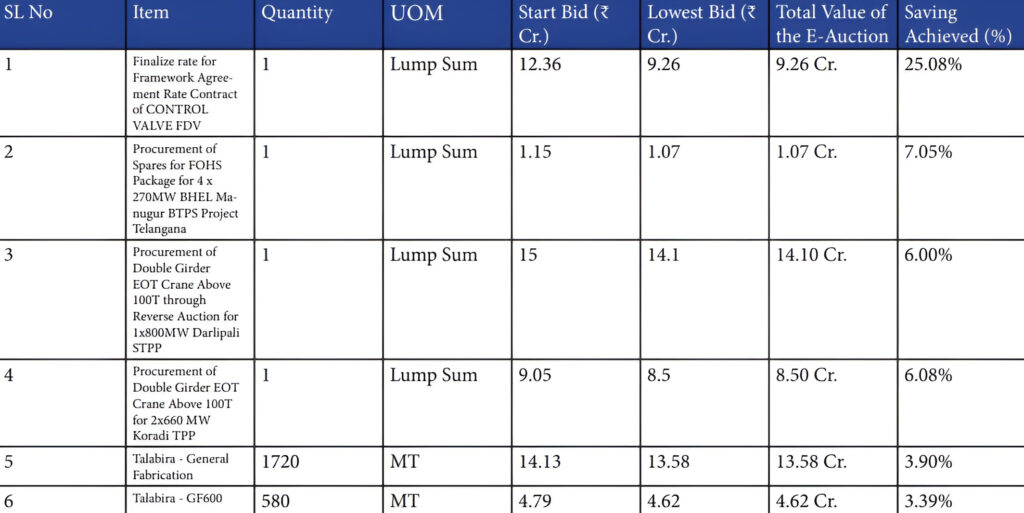
One of the largest engineering organizations in India has successfully integrated e auctions into its procurement system for project materials, equipment, contracts, and services. The following case study demonstrates how strategic e-auctions have transformed procurement by significantly reducing procurement cycle time, improving transparency, and achieving highly competitive prices. In the illustrated case, after completing the technical evaluation and obtaining the vendors’ No Regret Prices, a reverse e-Auction was conducted. Within a single day, the commercial bidding was completed, the final prices were discovered in a transparent and competitive environment, and the procurement process was ready for order placement. The here below table highlights the substantial price reductions achieved beyond the already competitive No Regret Prices.
LET’S NOT UNDERMINE THE PROJECT PROCUREMENT THROUGH E AUCTIONS
The experience clearly demonstrates that strategic e-auctions are equally effective for procurement of project equipment and materials, EPC and construction contracts, annual rate contracts, maintenance contracts, Annual Maintenance Contracts (AMC), service contracts, and subcontract packages. Besides optimizing procurement costs, e-auctions substantially reduce procurement lead time, eliminate unnecessary commercial negotiations, enhance transparency, minimize human intervention, improve auditability, reduce inventory requirements at project sites, and ensure that critical materials are procured in the sequence required by the construction schedule.
Conclusion: The case study confirms that e-auctions are not merely a tool for price discovery but a strategic enabler of project excellence. When integrated with proper planning, technical evaluation, and digital project management, they enable faster procurement, competitive pricing, improved governance, and timely availability of critical resources. Organizations seeking to accelerate project execution and optimize project costs should adopt e-auctions as a standard procurement practice for materials, contracts, services, and maintenance activities. The demonstrated results indicate that, depending on the nature of the project and procurement strategy, strategic e-auctions can contribute significantly to reducing project schedules and achieving measurable savings against budgeted procurement costs while maintaining the highest standards of quality, fairness, and transparency.