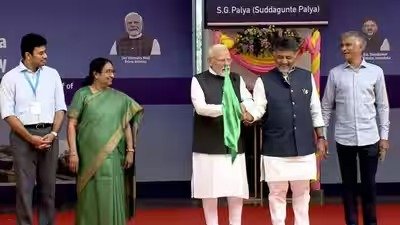
Prime Minister Narendra Modi on November 13 inaugurated Bengaluru Metro’s Pink Line and launched a series of infrastructure projects worth more than ₹15,600 crore across Karnataka, covering urban transportation, renewable energy, power transmission, petroleum infrastructure, waste management and railways. The programme also included the flag-off of the Bengaluru-Mangaluru-Madgaon Vande Bharat Express and the dedication of major railway and energy infrastructure facilities.
A key highlight was the inauguration of the 7.5-km elevated section of Namma Metro’s Pink Line between Kalena Agrahara and Tavarekere, developed at an investment of approximately ₹3,470 crore. The stretch forms part of the 21-km Pink Line corridor connecting Kalena Agrahara in south Bengaluru with Nagawara in the north. The remaining underground section is under construction. Its opening takes Bengaluru’s operational metro network beyond 100 km, strengthening connectivity across the city.
In the renewable energy sector, Modi inaugurated the Transmission Scheme for Integration of Renewable Energy Zones (Phase-II) at Koppal-II and Gadag-II, developed at a cost of around ₹4,450 crore. The system will facilitate the evacuation of approximately 2 GW of renewable energy from the Koppal and Gadag regions. He also inaugurated the ₹1,370-crore transmission scheme for the Solar Energy Zone in Bidar, which will enable the evacuation of 2.5 GW of solar power through a new pooling station.
The Prime Minister laid the foundation stone for two additional transmission projects. The first, involving an investment of more than ₹3,450 crore, will integrate renewable energy zones across Davanagere, Chitradurga and Ballari. The second, costing over ₹1,100 crore, will strengthen the transmission system to accommodate additional renewable energy potential in Davanagere and Ballari.
In the petroleum sector, Modi dedicated to the nation India’s largest underground LPG storage cavern at Mangaluru, constructed at a cost of more than ₹850 crore. The facility has a storage capacity of 80,000 metric tonnes and is connected to New Mangalore Port through a 9.4-km LPG pipeline. He also dedicated the Devangonthi Marketing Terminal of Mangalore Refinery and Petrochemicals Limited (MRPL), developed at an investment of ₹330 crore to strengthen petroleum product storage and distribution.
For waste management and clean energy production, the Prime Minister laid the foundation stone for GAIL’s Compressed Biogas (CBG) plant at Haralakunte in Bengaluru. The facility is designed to process approximately 300 tonnes of municipal solid waste daily and produce 12.6 tonnes of compressed biogas.
Railway infrastructure also featured prominently in the programme. Modi inaugurated four redeveloped stations under the Amrit Bharat Station Scheme: Chamarajanagar, Chikkamagaluru, Sakleshpur and Subrahmanya Road. He also dedicated the 45-km Bagalkot-Wandal railway doubling section, part of the 284-km Gadag-Hotgi Doubling Project, which is expected to improve passenger and freight movement and facilitate coal transportation to the Kudgi NTPC plant.
The Prime Minister further dedicated the electrification of the 55-km Sakleshpur-Subrahmanya Road Ghat railway section. Its completion has made the entire Bengaluru-Mangaluru railway route fully electrified. He also flagged off the Bengaluru-Mangaluru-Madgaon Vande Bharat Express, which will connect Bengaluru with Hassan, Sakleshpur, Mangaluru, Udupi, Murdeshwar, Gokarna and Karwar before reaching Madgaon in Goa.
Earlier in the day, Modi participated in the Golden Jubilee celebrations of Prashanti Kutiram, the residential headquarters of Swami Vivekananda Yoga Anusandhana Samsthana (S-VYASA), in Bengaluru. Established in 1975, the institution is marking 50 years of its work in yoga education and research under the theme ‘Towards Viksit Bharat 2047’. The Prime Minister laid the foundation stone for its Golden Jubilee Administrative Block and launched the university’s off-campus centre at Thiruvananthapuram, Kerala. The programme also commemorated the birth centenary of H.V. Sheshadri.
The Karnataka visit also included a programme in Mysuru, where Modi was scheduled to inaugurate COSMOS-Mysuru Planetarium, India’s first LED dome planetarium. Developed by the Indian Institute of Astrophysics on the University of Mysore campus, the facility features a 15-metre tilted dome with approximately 6,150 panels containing 4.2 crore individual LEDs. It will house a sky theatre, astronomy museum, exhibition halls, lecture hall and training centre, with programmes available in Kannada, English and Hindi.