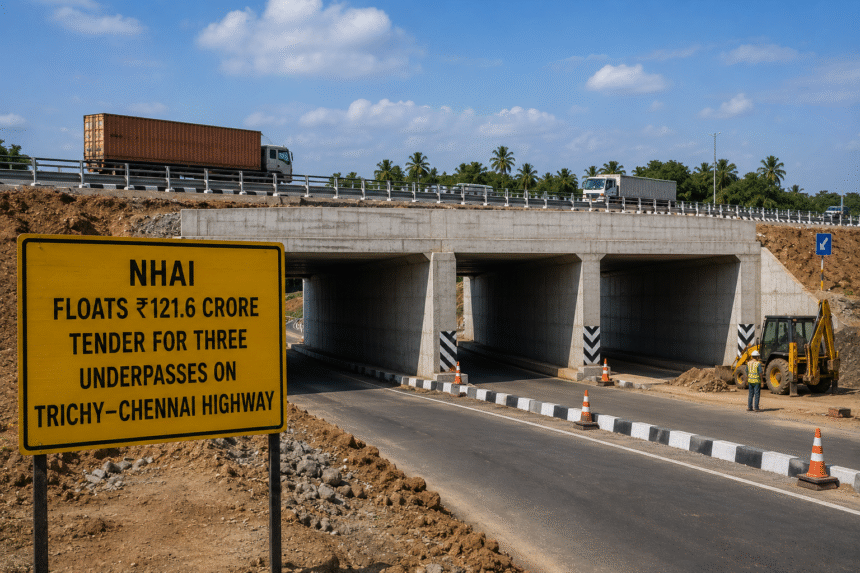
The National Highways Authority of India (NHAI) has floated a ₹121.6 crore tender for construction of three vehicular underpasses (VuPs) along the Trichy–Chennai National Highway, targeting some of the city’s most accident-prone junctions. The proposed structures will come up at Sanjeevi Nagar, Kollidam Y Road and Maruti Nagar in Trichy.
The intervention is aimed at separating through traffic from local movements at locations where residential roads and city traffic intersect the highway. According to officials, the underpasses are expected to provide a six-lane passage for vehicles travelling towards Chennai and Madurai, while traffic entering the city can use service roads to cross the highway without directly interacting with high-speed traffic.
The need for the project is underscored by the accident history of the corridor. Trichy city police have identified eight accident hotspots, including the Sanjeevi Nagar and Kollidam Y Road junctions. Together, these two locations and G Corner have recorded at least 50 fatalities since 2021. Maruti Nagar, meanwhile, is among the accident hotspots identified within the Trichy rural police jurisdiction.
The common tender is scheduled to be opened in September, with NHAI officials indicating an 18-month construction period for the three underpasses. A separate tender is also expected for an elevated rotary at G Corner junction, near the Ponmalai railway workshop, adding another grade-separation intervention to the same highway corridor.
The works form part of a broader effort to address the safety and traffic conflicts created by the highway’s passage through densely settled parts of Trichy. Rather than relying solely on traffic management measures at surface-level junctions, the proposed grade-separated infrastructure is intended to remove crossing points from the main carriageway and create a clearer distinction between long-distance highway traffic and local urban movement.