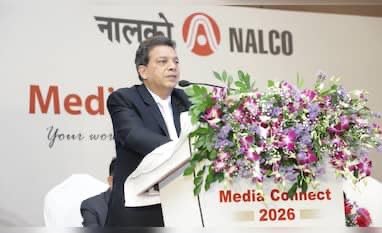
National Aluminium Company Limited (NALCO) is set to commission India’s first gallium recovery plant at its alumina refinery complex in Damanjodi, Koraput district, this month. The development was announced by NALCO Chairman and Managing Director Brijendra Pratap Singh during a media interaction in Bhubaneswar on November 13.
The pilot facility is being jointly developed by NALCO, the Bhabha Atomic Research Centre (BARC) and the Heavy Water Board. The plant is nearly ready for commissioning, following a delay of one to two months caused by disruptions in the procurement of specialised spares and consumables from overseas. Singh said the facility would begin operations within November and provide the technological basis for scaling up gallium recovery in the country.
Gallium is a critical mineral used in semiconductors, advanced electronics, telecommunications, aerospace and defence technologies. Recovering the metal from industrial process streams is expected to support efforts to establish a domestic supply chain and reduce India’s dependence on imports of strategic minerals.
NALCO has also planned an investment of ₹2,000 crore to commercially recover critical and high-value minerals from red mud and fly ash. The gallium pilot project at Damanjodi forms part of the company’s broader efforts to extract value from industrial residues.
On the company’s aluminium expansion programme, Singh reaffirmed the plan to add 0.5 million tonnes per annum (MTPA) of smelting capacity at Anugul, Odisha, involving an investment of ₹30,000 crore. The project is targeted for commissioning by December 2030. Land acquisition for the expansion is at an advanced stage, with around 80 acres of private land remaining to be acquired out of the approximately 300 acres required. The state government has indicated that the process is expected to be completed by February-March 2027.
NALCO has made licensing arrangements with technology supplier Emirates Global Aluminium (EGA). The detailed project report is expected to be approved early next year, followed by the ordering of major project packages. Construction is planned to begin in January 2028, with commissioning expected after three years. Singh also ruled out shifting the Anugul expansion to Andhra Pradesh, reiterating the company’s commitment to the Odisha project.
The company’s alumina refinery expansion at Damanjodi is expected to raise annual capacity from 2.1 million tonnes to 3.1 million tonnes. NALCO currently produces around 2.3 million tonnes of alumina and is targeting production of 2.3 million tonnes in FY27. It is also working towards commissioning a new 150,000-tonne refinery unit from January, which could take annual alumina production to around 2.4-2.5 million tonnes during the year.
For FY27, NALCO has set an aluminium production target of 488,000 tonnes, compared with approximately 472,000 tonnes in the previous financial year. The company expects greater pressure on earnings in the second half of FY27 due to softer international aluminium prices. It is banking on higher production, operational efficiencies and cost reduction to cushion the impact, while using sensorisation and artificial intelligence and machine learning interventions to improve plant performance.
Singh also outlined NALCO’s overseas critical mineral exploration plans through Khanij Bidesh India Limited (KABIL), in which NALCO holds a 40 per cent stake. KABIL has secured five lithium exploration blocks in Argentina’s Catamarca province, where preliminary non-invasive exploration has indicated the presence of lithium. Drilling is expected to begin within a month and continue until the end of 2027. A pilot plant is also planned to assess the grade of the deposits and establish the processing technology required to produce lithium carbonate for transportation to India.
KABIL is additionally pursuing discussions for lithium blocks in Argentina’s Salta province and exploring equity partnerships in operating lithium mines in Argentina, Chile and Australia, in collaboration with other public sector entities, including IREL and ONGC Videsh.