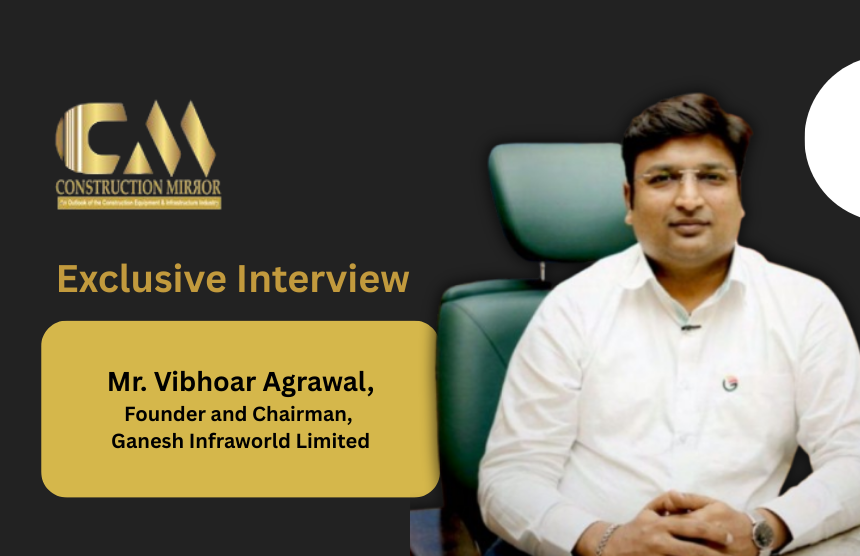
At Ganesh Infraworld, our immediate focus is on Water Infrastructure, where we have already achieved a tenfold increase in our order book in FY26, anchored by projects worth over ₹300 crore across Madhya Pradesh and West Bengal. Domestically, we are strengthening our presence in highcapex states such as Odisha, Madhya Pradesh, Bihar, Maharashtra, Uttar Pradesh and West Bengal, leveraging government missions and initiatives.
Q. Among your diverse portfolio — from residential towers to transmission and power infrastructure — which project stands out as the most technically challenging, and what innovations did you deploy to meet those challenges?
Among our diverse portfolio, one of the most technically challenging and impactful projects has been the Adani Energy Smart Meter Installation Project. Executing large-scale smart metering across multiple urban and semi-urban clusters demanded precision planning, real-time data integration, and seamless coordination between on-ground teams, utilities, and technology partners.
To address these challenges, we deployed an IoTenabled Smart Meter Management System (SMMS) supported by GIS-based asset tracking, enabling live monitoring and automated fault detection. Our teams leveraged AI-driven analytics to optimize installation routes, forecast load patterns, and ensure data accuracy across lakhs of connections.
Safety and reliability were enhanced through the adoption of RF mesh communication, remote disconnect–reconnect protocols, and zero-manualintervention testing. The project not only improved energy efficiency and billing transparency but also set new benchmarks in smart infrastructure execution, reaffirming our expertise in integrating digital technology with field-scale power infrastructure.
Q. How do you ensure quality and safety across such varied project types (civil works, electrical engineering, warehousing, infrastructure), especially when operating in different states with differing local regulations?
Ganesh Infraworld employs a standardized quality assurance and safety management system across all project types—whether civil, electrical, warehousing, or infrastructure works—guided by national codes alongside compliance with local regulations.
Experienced teams and engineers (with 15–20 years’ expertise) are deployed to adapt procedures to regional requirements, and regular audits or reviews are held to maintain high standards. Ganesh Infraworld operates under a unified Quality, Health, Safety & Environment (QHSE) framework aligned with national standards and adapted for state-wise compliance. Our 80-member engineering team—each averaging 15–20 years’ experience— drives project-specific QA plans and EHS protocols.
We invest in training our site teams and subcontractors regularly to ensure uniform adherence to best practices, regardless of geography. A combination of digital reporting tools, periodic audits, and thirdparty quality checks ensures that we maintain
consistent standards even across diverse regulatory environments.
Q. Can you share how your project execution timelines are impacted by supply chain constraints, for example, procurement of materials or skilled labour, and how you mitigate such risks?
Infrastructure execution inevitably faces challenges such as raw-material volatility and skilled-labour availability. To address these, we have developed a strategic vendor ecosystem across multiple states, ensuring dual sourcing for critical materials like transmission hardware, steel, and concrete.
On the manpower front, we maintain a trained deployment pool across projects and complement it with local hiring through our regional offices in Kolkata, Bhubaneswar, and Mumbai. Our digital project-management systems provide real-time tracking of material inflow and workforce productivity, allowing proactive course corrections.
This resilient supply-chain and workforce strategy enabled us to complete the Nucleus Residential Project a full month ahead of schedule, despite the broader industry-wide challenges.
Q. For residential and commercial projects like The 33, Central Kolkata, Ozone, or Jessore Road, what sustainability or greenbuilding measures are you incorporating (e.g., energy efficiency, water conservation, waste management)?
local regulations. E(with 15–20 years’ Projects such as The 33, Central Kolkata, Ozone, and Jessore Road embody Ganesh Infraworld’s commitment to sustainable and responsible development. Each project integrates green-building principles through the use of eco-friendly construction materials, energyefficient façades and lighting, rainwater harvesting, wastewater recycling, and scientific solid-waste management systems.
Ganesh Infraworld also prioritizes natural ventilation, solar power integration, and low-emission construction processes to minimize environmental impact. Across its broader EPC and infrastructure portfolio, the Company implements smart metering,
leak-detection, and AI-based water management systems, aligning with India’s sustainability objectives under initiatives such as the Jal Jeevan Mission and the National Green Building Code.
Q. In infrastructure or utility-type projects (roads, rail, water infrastructure, rural electrification), what is your strategy for
stakeholder engagement, land acquisition, or environmental clearances to keep timelines and budgets on track?
Our approach is rooted in proactive engagement and transparency. Before mobilization, we map all key stakeholders—government departments, local authorities, and communities—to build a clear communication and coordination framework.
Land and environmental aspects are addressed early through diligent liaison and documentation. We have dedicated teams that focus on statutory compliance and stakeholder coordination, ensuring that approvals and clearances don’t become bottlenecks. Our credibility with public sector clients also helps expedite these processes.
Our reputation with PSU clients and adherence to transparent reporting have helped us secure timely approvals and avoid cost overruns. The recent Odisha freshwater project, for instance, was mobilized within six weeks of LOA thanks to early coordination and digital documentation.
Q. How does Ganesh Infraworld measure and manage client satisfaction across different project segments, especially
when delivering projects with unique specifications like electrical substations or large industrial warehouses?
We believe client satisfaction is not just about meeting specifications—it’s about responsiveness and reliability. Every project has defined KPIs for quality, timeline, and cost adherence, which are tracked through a centralized project management
system.
We hold joint-review meetings at predefined milestones to capture real-time feedback and implement corrective actions immediately. Postcompletion, our maintenance and O&M support teams ensure smooth handover and reliability. This
responsive, transparent approach has led to repeat orders from EPC majors and state utilities, reinforcing our execution credibility.
Q. Looking ahead, which project type or geographic area does Ganesh plan to expand into that you believe offers the most growth potential or competitive advantage?
India’s EPC sector is entering what I would call a golden era, with sustained infrastructure momentum expected to continue until at least 2045. Government spending in the sector is projected to grow at a CAGR of around 25%, creating a once-in-a-generation opportunity for EPC companies to scale, diversify, and build lasting stakeholder trust. Favorable policy measures increasingly support domestic players, enhancing competitiveness and enabling Indian firms to win a larger share of projects compared to global counterparts.
At Ganesh Infraworld, our immediate focus is on Water Infrastructure, where we have already achieved a tenfold increase in our order book in FY26, anchored by projects worth over ₹300 crore across Madhya Pradesh and West Bengal. Complementing
our domestic growth, our subsidiary in Dubai, GRV Global LLC-FZ, will move towards marking our strategic entry into the Middle East EPC market, initially focusing on water, electrical, and civil works in order to capitalise on the opportunities in the
international market.
Domestically, we are strengthening our presence in high-capex states such as Odisha, Madhya Pradesh, Bihar, Maharashtra, Uttar Pradesh and West Bengal, leveraging government missions and initiatives. While roads and power have seen remarkable
progress, the water and civil infrastructure segments remain underpenetrated, offering substantial growth potential.
Additionally, the mining sector is poised for expansion, with rising coal demand prompting focused policy interventions to improve output and efficiency. If L&T has long been the benchmark for scale in Indian infrastructure, we believe the next decade will see the emergence of two to three new multi-vertical EPC leaders. Ganesh Infraworld is strategically positioned to be among them, aiming to build panIndia scale, sustainable growth, and a reputation for execution excellence across sectors.