Ammann’s sustainability vision is centred on developing technologies and solutions that enable the creation of road infrastructure in a more environmentally responsible and economically viable way. The aim is to ensure that both the construction process and the resulting roads have a lower environmental footprint, extended durability, and reduced lifecycle costs which can be achieved through lower wear and tear, decreased reliance on virgin materials, and improved operational efficiency.
Q. With the recent launch of the ‘Green Roads for India’ initiative, what specific outcomes are you targeting in the short term in aspects of emissions, waste, or policy influence, and how do you plan to measure them?
The ‘Green Roads for India’ campaign uses public reporting and particular metrics to aim for quantifiable sustainability improvements in highway construction. Despite a 20% increase in construction, it has decreased the intensity of greenhouse gas emissions from 1.0 to 0.8 MTCO₂e/km. With seven tonnes of plastic used per kilometre for four-lane highways, more
than 63 million tonnes of waste materials, including fly ash, plastic waste, and reclaimed asphalt, were recycled last year. By 2027, the Ministry promises to use all solid waste. Since 2015, the program has planted 4.69 crore trees and incorporates ESG principles into infrastructure policy. In order to meet India’s climate commitments, performance is monitored through yearly sustainability reports, material usage logs, and third-party audits that measure emissions per kilometre, recycled materials, and sapling survival rates.
Q. Sustainability is clearly central in your product roadmap which is lowering dust, odour, noise, reducing fluid waste, enhancing asphalt recycling. Which of these areas do you believe will deliver the biggest return like environmental & economic for your customers, and why?
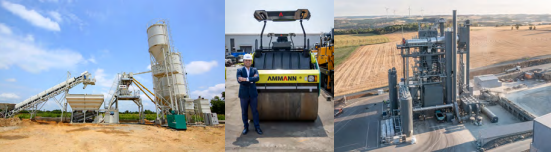
Ammann’s sustainability vision is centred on developing technologies and solutions that enable the creation of road infrastructure in a more environmentally responsible and economically viable way. The aim is to ensure that both the construction process and the resulting roads have a lower environmental footprint, extended durability, and reduced lifecycle costs which can be achieved through lower wear and tear, decreased reliance on virgin materials, and improved operational efficiency. Within this broader framework, Ammann’s top sustainability offering is asphalt recycling, which yields excellent financial and environmental results. In terms of the environment, using large amounts of Reclaimed Asphalt Pavement (RAP) significantly lowers landfill waste, greenhouse gas emissions from extraction and transportation, and the demand for virgin aggregates. Up to 60% RAP usage is achieved by modern Ammann plants, converting outdated road surfaces into brand-new ones.
Because RAP feedstock is less expensive than virgin bitumen and aggregates, recycled mixes are more cost-effective, increasing profit margins while lowering transportation costs. With modular designs, you can make small improvements without breaking the bank. Recycling offers the most obvious dual benefit: significant waste diversion and emissions reduction combined with lower operating costs and increased market competitiveness, making it crucial for long-term success. Dust control, noise suppression, and odour containment also improve urban compliance.
Q. Circular economy principles are gaining momentum in construction. How is Ammann working with contractors, regulators, and technology partners in India to build a truly closed-loop ecosystem for asphalt production and reuse?
Ammann is working with multiple stakeholders to create a closed-loop asphalt ecosystem in India. The company offers more than 20 training courses per year on advanced recycling techniques and hosts workshops and seminars for contractors on RAP integration and material management.
Ammann promotes standardized specifications and circular economy policies by
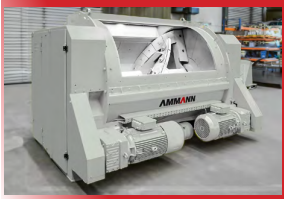
collaborating with CSIR-CRRI scientists and IIT Bombay professors to develop regulations that allow for higher recycling rates with quality assurance. Technology partnerships provide up to 60% RAP usage through indigenous manufacturing that includes digital AS1 controls, modular retrofit kits, hydrogen burners, foam bitumen processes, and IoT-based maintenance
systems. Ammann is positioned as the leader in converting India’s road construction industry toward sustainable, circular asphalt production methods through this ecosystem approach, which combines technology deployment, contractor education, regulatory advocacy, and demonstration projects.
Q. Digitalisation is often discussed, but adoption at the contractor level remains slow. From Ammann’s perspective, what barriers are holding back widespread use of telematics, predictive maintenance, and analytics in India and how can they be overcome?
High costs, gaps in skills and just the mere diversity of infrastructure requirements for each region have made the adoption of telematics, analytics, and predictive maintenance slow in India. Many contractors perceive these technologies to be expensive and complicated, with uncertain RoI and investing in skilling local labour which may be on contract basis or may come with very limited local expertise. There are several solutions that can help. First, telematics systems should be modular and easy
to upgrade. They need to work across different types of equipment, which helps lower costs. Second, the industry can work together along with government support to create standardised mandates and digital protocols. Third, we need proper training. Ammann Academy offers structured programs that teach people digital diagnostics and predictive maintenance. Fourth, the technology itself should be easy to use. The A-Cloud IoT ecosystem makes remote monitoring simple and sends maintenance
alerts when needed. Finally, we need real proof that this works. Scaling effective digitalization in India’s road construction industry requires these interventions, which combine ecosystem partnerships, accessible technology design, contractor training, and dependable data systems.
Q. How is Ammann demonstrating not just product innovation, but also its long-term commitment to sustainability,
localization, and customer partnerships in the Indian road construction ecosystem?
Ammann shows its long-term dedication to India through customer partnerships, localization, and sustainability leadership. The company, which offers products that enable 60% Reclaimed Asphalt Pavement (RAP) usage, hydrogencapable burners, and emission-reduction technologies, won the Gujarat State Leadership Awards 2025’s “Best Sustainable Strategies” award. Its “Make in India for the World” initiative set up factories in Gujarat that produce CEV V compliant equipment, supporting over 10,000 projects with over 300 engineers and vast dealer networks. Localized goods take into account the climate, topography, and legal requirements of India. IoT platforms like A-Cloud, training academies, frequent equipment rollouts, retrofit kits, and cooperative R&D with research institutes are all examples of our long-term commitment. Sustainable infrastructure foundations are created through investments in automation, renewable energy, IIoT storage, and workforce development.
Ammann is positioned as India’s reliable partner in sustainable road construction thanks to this multifaceted approach, which combines environmental responsibility, deep customer alignment, and pioneering innovation.