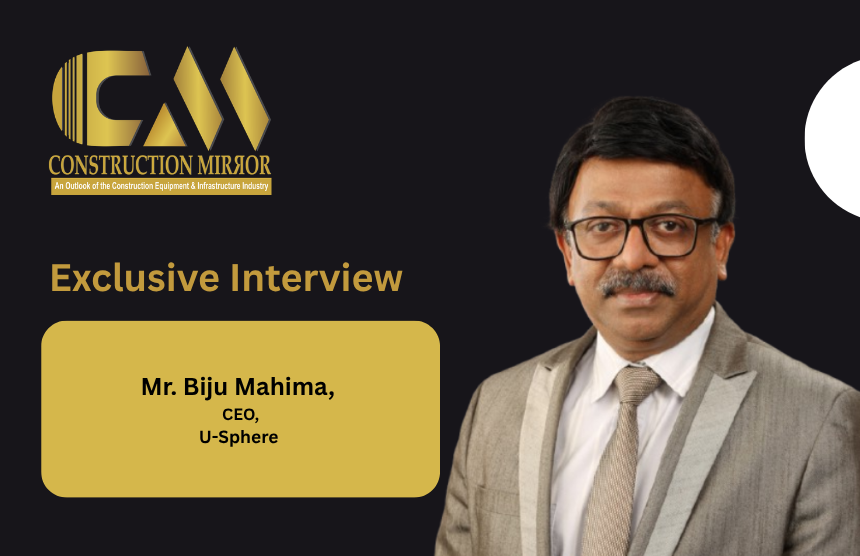
Through U-Sphere, we are carrying that legacy into a new era of smart, sustainable, high-tech construction, built on advanced, pre-engineered, precision-built structures that significantly outpace conventional methods, while remaining grounded in the people-centric ethos that has defined this cooperative since 1925.
1. The construction industry has traditionally been associated with long project cycles and fragmented execution. Do you believe the future competitive advantage will belong to companies that can industrialize construction itself, and how is U-Sphere approaching this transformation?
Industrialization will define competitive advantage in this sector over the next decade. The traditional construction model has separated design, fabrication, and execution into disconnected stages, and that fragmentation is the single largest source of cost overrun, delay, and quality inconsistency in our industry. The companies that move ahead will be those that treat construction as a manufacturing discipline, where components are engineered and produced with industrial precision, and the site becomes a place of assembly rather than improvisation.
At U-Sphere, this is the foundation our model is built on. We take a solution-oriented rather than a single-methodology approach, evaluating each project on its specific requirements and deploying the optimal combination of steel structures, pre-engineered systems, and modular components to deliver on speed, sustainability, and cost efficiency. Our current priority is strengthening market presence and achieving scale across our target regions. Once that foundation is established, we will take concrete steps toward setting up latest integrated manufacturing processes with latest and most innovative technology. That sequencing presence, scale, then production is, in practical terms, what industrializing construction looks like.
2. Your vision revolves around the concepts of Speed-Build, Smart-Build, and Sustain-Build. How do you translate these principles from strategic vision into measurable outcomes on project sites?
Each of these three pillars corresponds to a distinct operational lever, not a marketing framework. Speed-Build is engineered through pre-fabricated and precision-built structures that compress project timelines well beyond what conventional, sequential on-site construction allows. Smart-Build is operationalised through AI-driven analytics, IoT-enabled monitoring, and digital project management systems that give us continuous visibility into resource utilisation and construction progress, allowing course correction in real time rather than after the fact. Sustain-Build is embedded as a design parameter from inception, not a retrofit encompassing material efficiency, reduced wastage through factory-made components, and ESG compliance built into project planning from day one.
We assess every project against all three pillars, regardless of scale or geography, measuring not just whether a project was completed, but whether it was delivered faster, more intelligently, and more sustainably than the conventional alternative would have permitted.
3. The conversation around AI in construction often remains theoretical. From U-Sphere’s perspective, where can artificial intelligence create the most immediate and meaningful impact across design, planning, execution, and asset management?
The gap between Artificial Intelligence (AI) potential and its practical application in construction exists because the industry has often tried to apply it broadly rather than to specific, persistent problems. For us, the most immediate and quantifiable value lies in planning and execution monitoring. Construction has historically suffered from a visibility deficit by the time delays or cost overruns become apparent, the impact has already compounded. AI-driven analytics combined with IoT-enabled monitoring closes that gap, providing continuous, real-time insight into project status rather than periodic assessment, enabling early intervention rather than reactive correction.
Beyond execution, we see substantial value in integrating AI with Building Information Modelling (BIM) to improve design accuracy and reduce rework before fabrication begins a critical consideration given how much of our work is engineered off-site, where late-stage design errors carry significantly higher correction costs than in conventional construction. As our manufacturing capabilities mature, we expect AI’s role to extend into predictive maintenance and asset performance management, supporting clients well beyond project handover. Our approach to AI mirrors our approach to construction methodology: every application is evaluated on whether it solves a genuine operational problem, rather than adopted for its own sake.
4. U-Sphere has emphasized steel-based, pre-engineered, and precision-built structures as part of its growth strategy. How do you see advanced construction systems reshaping the economics and timelines of infrastructure delivery in India?
Pre-engineered building technology replaces unpredictable on-site activity with factory-made steel components assembled on location, and that substitution fundamentally changes project economics faster completion, higher structural precision, and substantially lower material wastage compared to traditional reinforced concrete construction. In a market like India, where infrastructure demand continues to intensify across both public and private sectors, this combination of speed and precision is becoming a baseline expectation rather than a differentiator.
This shift underpins our strategic direction through U-Sphere. ULCCS’s century-long legacy has centred on government-led infrastructure within Kerala roads, bridges, IT parks, and public institutions. Through U-Sphere, we are extending into high-growth private-sector segments, including data centres, warehousing, commercial properties, and industrial infrastructure, where pre-engineered building technology offers a distinct advantage. We have committed approximately ₹1,000 crore over the next three years to our Karnataka entry on this basis, alongside continued expansion in Tamil Nadu. Advanced construction systems will not merely accelerate individual projects they will progressively reset delivery-timeline expectations across Indian infrastructure, consistent with what we have already observed in more mature global construction markets.
5. U-Sphere has outlined ambitious expansion plans across South India while targeting significant project growth over the coming years. As you scale operations, how do you ensure innovation and execution excellence remain aligned?
We have approached scale deliberately rather than opportunistically, because the two priorities pace of expansion and consistency of execution can pull in opposing directions without disciplined sequencing. Kerala remains our foundation, where ULCCS has built deep expertise and credibility over a century, and we are extending that model into Karnataka and Tamil Nadu as priority markets, given the strength of infrastructure growth in both states through U-Sphere
Our sequencing is intentional: we are first establishing market presence and scale in these new regions, with manufacturing infrastructure to follow around 2027–28. This phased approach ensures execution capability is never stretched ahead of the quality systems and talent required to sustain it. Ultimately, alignment between innovation and execution rests on our people. We are investing significantly in professional training, building a strong in-house team, and developing robust production systems, because technology and process design alone cannot compensate for execution gaps on the ground. ULCCS’s century-old principle that the workforce is the institution, not separate from it continues to guide how we scale U-Sphere.
6. For more than a century, ULCCS has contributed to building physical infrastructure. Through U-Sphere, are you now attempting to redefine how infrastructure itself is conceived, designed, and delivered for the next generation?
This is best understood as an evolution of ULCCS’s legacy rather than a departure from it. For over a century, ULCCS has been at the forefront of Kerala’s infrastructure development, delivering more than eight thousand projects spanning buildings, roads, bridges, and IT parks, anchored consistently in a mission of job creation and improved livelihoods through disciplined, honest execution. That mission remains unchanged; what has evolved is the toolkit available to deliver on it.
Through U-Sphere, we are carrying that legacy into a new era of smart, sustainable, high-tech construction, built on advanced, pre-engineered, precision-built structures that significantly outpace conventional methods, while remaining grounded in the people-centric ethos that has defined this cooperative since 1925. In that sense, we are redefining how infrastructure is conceived and delivered, but we view this as a continuation of ULCCS’s founding conviction rather than a reinvention of it. The same resolve that established this cooperative a century ago with virtually no capital is the resolve driving us today as we bring manufacturing-grade precision to India’s next generation of infrastructure.