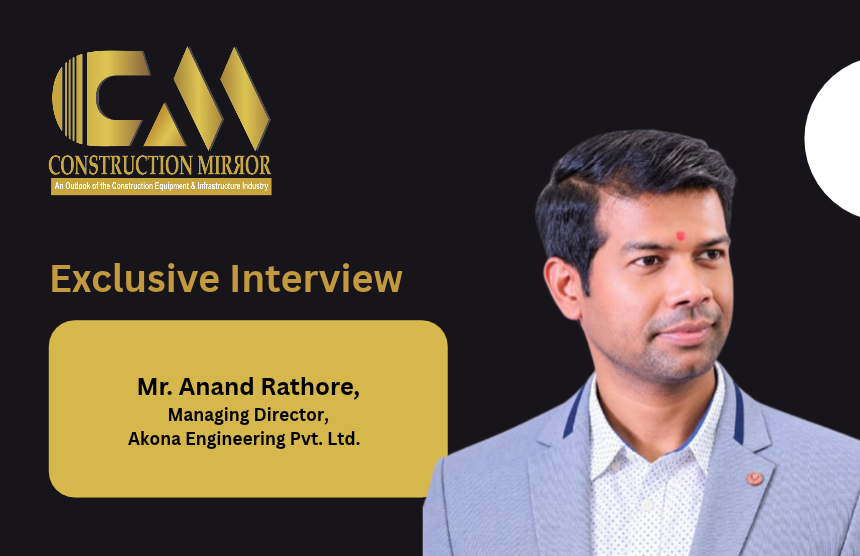
“For me, good engineering is not about adding technology for the sake of it. It is about making the customer’s work easier, more productive and more dependable. Our aim is not just to give a customer a machine that performs well on paper, but one that continues to perform well at the site.”
Akona’s journey has closely followed the changing way India builds from conventional concrete and road-making requirements to increasingly automated, high-output and application-specific plants. What has this journey taught you about the kind of equipment today’s Indian construction industry actually needs?
One thing our journey has taught us is that customers are not simply looking for bigger machines or higher capacity. They want equipment that works reliably at the site, is easy to operate and gives them good value over the long term.
The way projects are being executed in India has changed significantly. Timelines are tighter, projects are larger and there is much more focus on quality and productivity. At the same time, the equipment still has to handle the realities of Indian working conditions.
That is how we look at product development at Akona. We try to understand what contractors are actually facing at their sites and then build equipment around those requirements. For me, good engineering is not about adding technology for the sake of it. It is about making the customer’s work easier, more productive and more dependable.
Today, the performance of a batching or hot-mix plant is being judged on much more than rated capacity. Accuracy, consistency, fuel consumption, automation, ease of mobilisation and downtime are all becoming part of the purchasing decision. Which of these parameters has become the biggest differentiator for customers in the Indian market?
I would say reliability and consistency. A plant may have a very high rated capacity, but what matters to the customer is whether it can deliver that performance consistently, day after day.
Customers today are also looking beyond the initial purchase price. They are thinking about fuel consumption, maintenance, downtime, quality of output and the overall cost of running the plant.
We see this very clearly in our discussions with contractors. They want equipment that they can depend on when a project is running against a tight deadline. At Akona, that is something we take seriously.
Our aim is not just to give a customer a machine that performs well on paper, but one that continues to perform well at the site.
Akona manufactures a wide range of equipment across concrete batching, asphalt production, WMM and CTSB applications, with several solutions designed around compact or modular configurations. How important is flexibility becoming for contractors who may need to shift plants between projects or establish production facilities in locations with limited site infrastructure?
Flexibility has become very important. Projects today can change quickly, and contractors don’t always know how long a plant will remain at one location. So, being able to mobilise, relocate and set up equipment without too much difficulty has real value.
This is where compact and modular plants make a difference. They can be easier to transport, quicker to install and more practical for sites where space or infrastructure is limited.
We have seen that contractors increasingly want to use the same equipment across different projects rather than treat every plant as a permanent installation. So, when we design a plant, we also think about what happens after the current project is completed. If the equipment can move with the contractor and continue to earn for them, that is a much better investment.
With Bauma CONEXPO India 2026 bringing greater attention to productivity, localisation and technology-led construction equipment, what aspect of Akona’s capabilities or product development would you most like the industry to discover at the exhibition, and what does it say about the company’s direction going forward?
For us, Bauma CONEXPO India 2026 is a good opportunity to show the industry what we have been working on and, more importantly, how we think about the future of construction equipment.
I would like visitors to see that Indian engineering has come a long way. We can build equipment that combines automation and technology with the practical requirements of our own market.
But at the same time, I don’t believe technology should make a machine unnecessarily complicated. It has to solve a problem, improve productivity or make the operator’s job easier.
That is the direction we want to follow at Akona—better engineering, useful technology and equipment that customers can actually depend on at their sites.
Akona’s equipment is being used across highways, bridges, railways, airports, irrigation, urban infrastructure and renewable-energy projects. Does working across such varied applications influence product development, particularly when the same basic requirement for material production can come with very different site conditions and operating constraints?
Definitely. Working across different types of projects has taught us that there is no single solution that works equally well everywhere.
A highway project, for example, can have very different requirements from an urban project or a railway project. The available space, logistics, climate, mobility requirements and working conditions can all be different.
That experience has influenced the way we develop our equipment. We don’t look only at the output capacity. We also ask where the plant will be installed, how it will be operated and what kind of challenges the customer is likely to face there.
For us, the objective is to make the equipment fit the project, rather than expect the customer to change the project around the equipment. I think that practical approach is very important in a market as diverse as India.
Akona has built its business around being close to the practical requirements of contractors and project sites. As India’s infrastructure programme becomes more demanding in terms of speed, quality, efficiency and sustainability, where do you see the next significant opportunity for Akona and what would you like the company to be known for in the next phase of its growth?
For me, the next big opportunity is to keep understanding what our customers actually need and improve our equipment around those needs.
I have seen that contractors today are under a lot of pressure. They have to complete projects faster, maintain quality and, at the same time, keep their costs under control. So, they need plants that are dependable, efficient and simple to operate.
There is certainly a lot of scope for automation, energy efficiency, modular plants and better monitoring. But personally, I believe technology only makes sense when it solves a real problem for the customer. We should not make equipment complicated just to make it look advanced.
As Akona grows, I would like us to be known as a company that keeps its word. If a customer trusts our equipment, trusts our team and knows that we will stand by them when they need us, I would consider that a real success.
That, for me, is more important than simply becoming bigger. I want Akona to grow by building long-term relationships and by earning the trust of the people who use our equipment.