BF60.1 crusher bucket on an excavator converts basalt debris into reusable aggregate at the point of demolition , eliminating transport, reducing cost, and turning waste into a construction input.
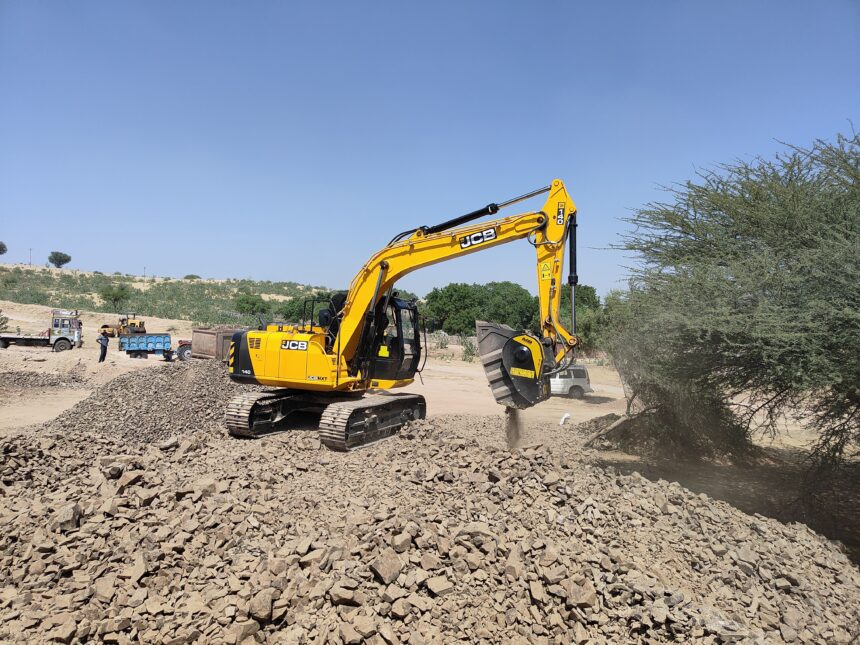
We have deployed its BF60.1 S4 crusher bucket on a JCB 140 excavator at a construction and demolition waste recycling operation in western India, processing basalt debris into reusable aggregate directly on site.
The deployment demonstrates a practical, decentralised approach to circular construction: instead of hauling demolition debris to external processing plants or landfills, the contractor converts basalt rubble into graded aggregate at the point of generation using equipment already in the fleet. No additional carrier machine, no additional fuel source, no additional operator.
India’s C&D Waste Challenge: Scale and Urgency
India generates an estimated 150 to 500 million tonnes of construction and demolition waste annually, according to multiple government and independent assessments. Recycling rates remain critically low, the Centre for Science and Environment (CSE) estimates that barely 1 per cent of this waste is currently recovered and reprocessed.
The Environment (Construction and Demolition) Waste Management Rules, 2025, which take effect from April 2026, introduce mandatory recycling targets, starting at 5 per cent in 2026–27 and rising to 25 per cent for construction projects and 15 per cent for road projects by 2030–31. Extended Producer
Responsibility (EPR) provisions now place accountability on developers and contractors to manage waste in an environmentally sound manner.
The regulatory direction is clear, but the infrastructure gap is real. Most Indian cities lack adequate centralised C&D waste processing capacity. Decentralised, on-site processing offers an immediate, scalable alternative and that is the space MB Crusher operates in.
The Deployment: BF60.1 S4 on a JCB 140 Excavator
The BF60.1 S4 is a compact jaw crusher bucket designed for carriers in the 10–18 tonne excavator class. It mounts on the boom of the excavator, a machine class widely available across Indian construction and recycling sites.
At this site in western India, the attachment processes basalt debris, a hard, abrasive volcanic rock common across the Deccan Trap geology that extends through Maharashtra, Gujarat, Karnataka, and parts of Rajasthan. Basalt, with a bulk density of approximately 2.8 tonnes per cubic metre and compressive strength exceeding 180 MPa, is among the more demanding materials for any crushing system. The BF60.1 handles it in a single pass, producing graded aggregate suitable for road sub-base, backfill, and construction applications.
Why On-Site Processing Matters for Indian Contractors
The economics are direct. A contractor producing recycled aggregate on site using an existing backhoe loader eliminates three cost lines simultaneously: outbound transport of debris to a dump or processing plant, inbound transport of purchased aggregate from a quarry or crusher, and the purchase cost of the aggregate itself. In regions where the nearest external crusher may be 50 to 100 kilometres away, transport alone can account for ₹25–40 per tonne, a cost that compounds across thousands of tonnes over a project lifecycle.
Equally significant is the operational independence. The contractor is no longer dependent on an external supplier’s schedule, pricing, or availability. Material that was previously a disposal liability becomes a construction input, processed on the contractor’s own timeline, at the contractor’s own site, using a machine already on the books.
Circular Construction: From Concept to Job-Site Reality
Guido Azzolin, CEO, MB Crusher, commented: “Circular construction in India will not scale through policy mandates alone. It will scale when contractors see that recycling material on site saves them money and time compared to the alternative. That is what our attachments demonstrate not in a laboratory, but on active construction sites with the machines contractors already own. The BF60.1 on an excavator is a practical entry point: it shows that on-site recycling does not require heavy capital expenditure or specialised equipment. It requires a shift in approach.”
Product and Market Context
MB Crusher holds approximately 90 per cent of the global market share in the crusher bucket category, all MB products are designed and manufactured at the company’s headquarters in Fara Vicentino, Italy, across a facility exceeding 45,000 square metres.
MB Crusher India has maintained a direct presence in the Indian market for over a decade, with full commercial coverage across the country. The India product range spans crusher buckets, screening buckets, shaft screeners, drum cutters, sorting grapples, and the recently launched demolition pulverizer series. All attachments are compatible with standard excavator and backhoe loader hydraulics across major OEM brands operating in India.
India’s C&D waste recycling market was valued at USD 245.4 billion in 2024 and is projected to reach USD 362.9 billion by 2033, reflecting the growing intersection of infrastructure expansion, regulatory pressure, and circular economy adoption.