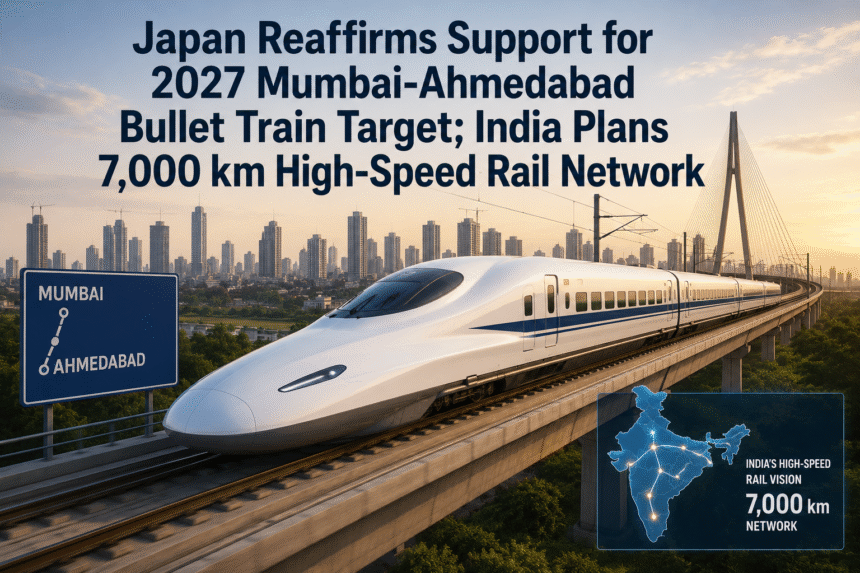
Japan has reaffirmed its commitment to the timely completion of the Mumbai–Ahmedabad High-Speed Rail (MAHSR) project by 2027, while expressing support for India’s long-term vision of developing a 7,000-km high-speed rail network across the country. The assurance came during Japanese Prime Minister Shigeru Ishiba’s visit to India, underscoring the growing strategic partnership between the two nations in transport infrastructure and advanced rail technology.
The Mumbai–Ahmedabad Bullet Train project, being implemented by the National High Speed Rail Corporation Limited (NHSRCL) with technical and financial assistance from Japan, is progressing steadily with civil works, station construction, bridge development, and track laying advancing across multiple sections. Japan reiterated its continued cooperation through technology transfer, engineering expertise, and concessional financing for the landmark project.
India has also outlined an ambitious roadmap to expand high-speed rail connectivity beyond the Mumbai–Ahmedabad corridor. The government is evaluating new bullet train corridors that could collectively extend the network to nearly 7,000 km, connecting major metropolitan cities and high-growth economic regions. The expansion is expected to significantly reduce travel time, enhance regional connectivity, and support economic development.
The collaboration between India and Japan extends beyond infrastructure financing and includes the introduction of advanced Shinkansen technology, high safety standards, operational excellence, and capacity building for Indian engineers and railway professionals. The MAHSR project is also expected to accelerate the development of a domestic ecosystem for high-speed rail manufacturing and maintenance under the ‘Make in India’ initiative.
Both countries reaffirmed their commitment to deepening cooperation in high-speed rail, recognising the sector as a key pillar of the India–Japan Special Strategic and Global Partnership. Once operational, the Mumbai–Ahmedabad Bullet Train is expected to transform intercity mobility while laying the foundation for a modern, technology-driven high-speed rail network across India.