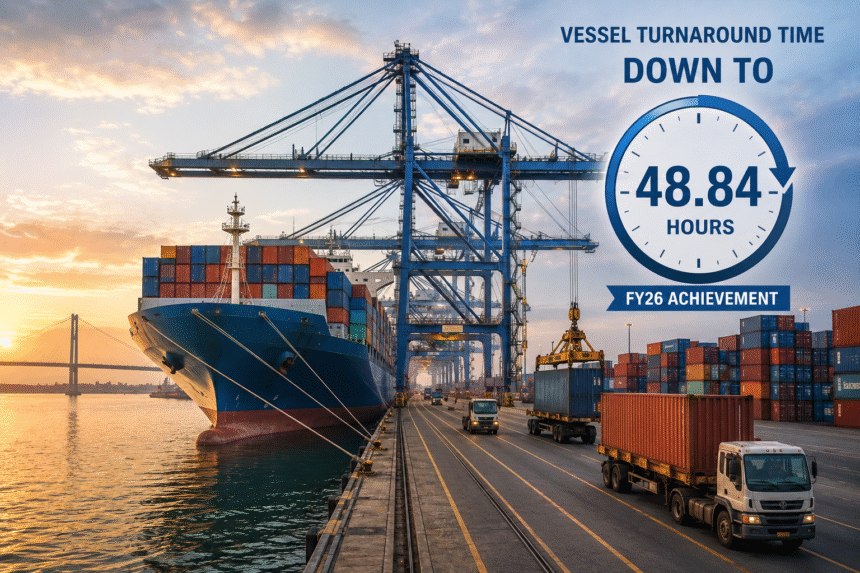
India’s major ports recorded a marked improvement in operational efficiency during FY2025-26, reducing the average time taken by a vessel to complete its port call to 48.84 hours, from 52.87 hours in FY2021-22. The improvement reflects sustained investment in port infrastructure, cargo-handling systems and logistics connectivity as India seeks to reduce trade costs and improve the competitiveness of its maritime gateways.
The reduction is significant because vessel turnaround time directly affects berth availability, cargo evacuation and the number of ships a port can handle with its existing infrastructure. Faster vessel movement allows ports to increase throughput without relying solely on additional berths, while also reducing waiting and operating costs for shipping lines.
The gains have been supported by a broader modernisation drive across India’s major ports. Measures under the Sagarmala programme, capacity augmentation, mechanisation of cargo handling, improved berth productivity and better hinterland connectivity have progressively shortened vessel stays. Government data shows that average turnaround time across major ports had already declined to 49.47 hours in FY2024-25, before reaching the latest FY26 level.
Performance, however, continues to vary considerably between individual ports and cargo categories. Ministry data for the April-September 2025-26 period, for instance, showed average turnaround times ranging from around 27.57 hours at Jawaharlal Nehru Port to more than 60 hours at several bulk-oriented ports. This variation underlines the operational differences between container terminals, dry-bulk facilities, liquid-cargo terminals and ports handling more complex cargo mixes.
The efficiency improvement is taking place alongside a substantial expansion in the capacity and cargo-handling scale of India’s port sector. According to government data, combined capacity at major and non-major ports increased from 1,561 million tonnes per annum in FY2014-15 to 2,817 MTPA in FY2025-26, while cargo handled rose from 1,052 million tonnes to 1,668 million tonnes over the same period. At major ports alone, capacity nearly doubled to 1,728 MTPA, while cargo handled reached 915 million tonnes.
The improvement in turnaround time therefore represents more than a single operational metric. For India, where maritime transport carries the overwhelming share of international merchandise trade by volume, reducing the time a vessel spends in port can have a direct bearing on logistics efficiency and the overall cost of moving goods. The next challenge will be to sustain these gains as cargo volumes rise and ensure that efficiency improvements extend consistently across all major ports and cargo segments.