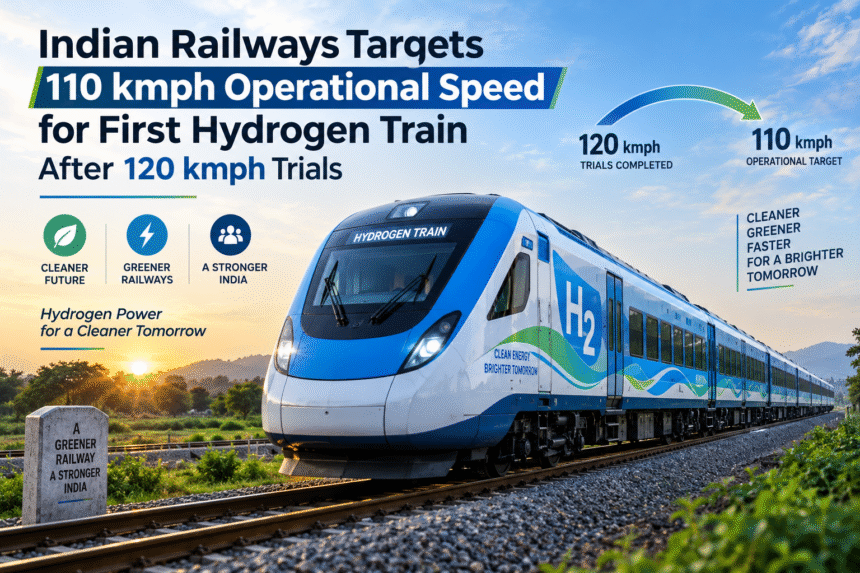
Indian Railways is working to raise the operational speed of the country’s first hydrogen-powered train to 110 kmph, following successful high-speed trials in which the train reached 120 kmph.
The hydrogen train is currently operating at a capped speed of 75 kmph on the 89-km Jind-Sonipat route in Haryana. Railway Board Chairman and CEO Satish Kumar said efforts are now focused on achieving a consistent operational speed of 110 kmph.
Officials are consulting stakeholders to identify suitable railway sections for the train’s deployment while also assessing the technical modifications and fuelling infrastructure required for higher-speed operations.
Hydrogen-Powered Rail Technology
The train, which was flagged off by Prime Minister Narendra Modi on July 17, uses hydrogen fuel cells to generate electricity onboard rather than relying on external power through overhead electric lines. Electricity is produced through a chemical reaction between hydrogen and oxygen, with water vapour and heat generated as by-products.
The technology eliminates tailpipe emissions and does not involve conventional fuel combustion, positioning hydrogen-powered trains as an alternative for cleaner rail transportation.
The successful 120 kmph trials mark an important step in validating the train’s higher-speed operating capability, while the proposed 110 kmph operational speed will depend on the availability of suitable routes, technical requirements and fuelling infrastructure.