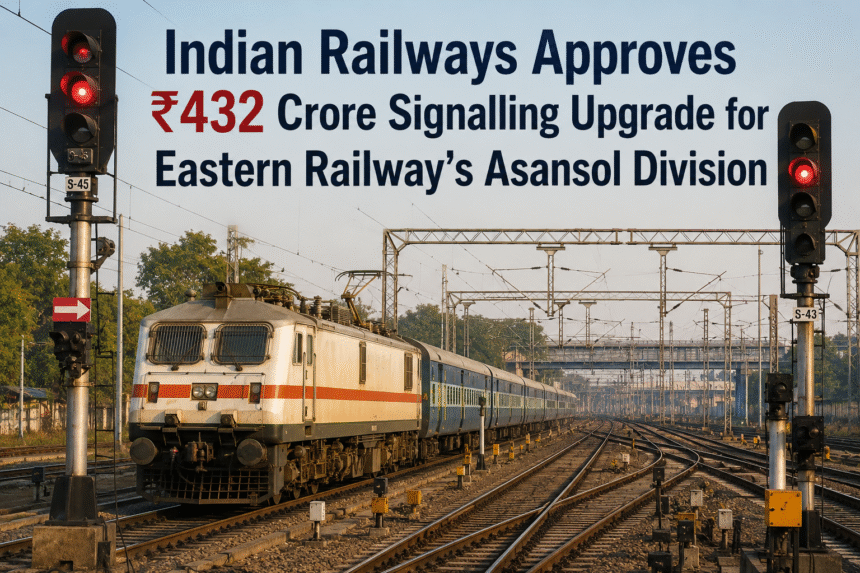
Indian Railways has sanctioned a ₹432 crore project to modernise signalling infrastructure in the Asansol Division of Eastern Railway by replacing ageing relay-based interlocking systems with advanced Electronic Interlocking (EI) technology. The initiative is aimed at enhancing railway safety, improving operational reliability, and increasing line capacity on some of the country’s busiest rail corridors.
The approved project covers 27 stations and cabins, including one Intermediate Block Signalling (IBS) location, on the High Density Network (HDN) and Highly Utilised Network (HUN) routes. A total of 28 relay-based interlocking installations—comprising 27 Panel/Route Relay Interlocking (PI/RRI) systems and one IBS installation—will be replaced with state-of-the-art computer-based Electronic Interlocking systems.
Electronic Interlocking technology offers several operational advantages over conventional relay-based systems, including faster route setting, quicker fault detection, easier maintenance, greater operational flexibility, and enhanced reliability. The upgrade is expected to improve the efficiency of train operations while strengthening safety standards across the busy Asansol Division.
The project forms part of Indian Railways’ broader signalling modernisation programme on HDN and HUN routes, where advanced technologies such as Kavach, Automatic Block Signalling (ABS), and Centralised Traffic Control (CTC) are also being introduced to improve network performance and operational safety.
The replacement of legacy signalling infrastructure, the Asansol Division is expected to handle higher passenger and freight traffic more efficiently while reducing system failures and improving punctuality. The investment underscores Indian Railways’ continued focus on adopting modern technologies to build a safer, more reliable, and future-ready rail network.