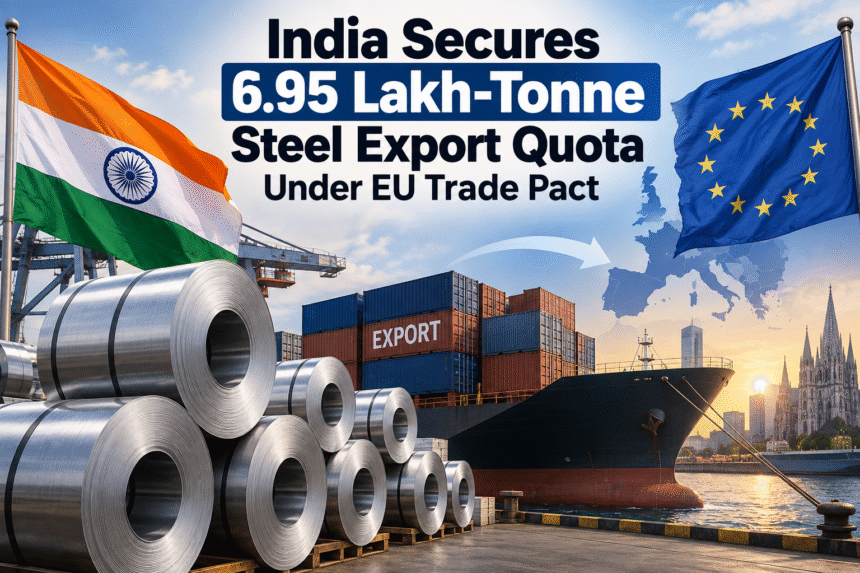
India has secured a country-specific tariff-rate quota of 6,94,853 tonnes annually for steel exports to the European Union under the proposed India-EU Free Trade Agreement (FTA), providing Indian steel producers with preferential access to the European market amid tighter restrictions on global steel imports.
The overall country-specific quota available to India stands at 16,41,470 tonnes per year. Of this, 9,46,616 tonnes will be available under the Most Favoured Nation (MFN) component, while 6,94,853 tonnes has been allocated specifically under the FTA.
The quota covers a broad range of steel products, including non-alloy and alloy hot-rolled sheets and strips, cold-rolled sheets, metallic-coated sheets, organic-coated sheets, tin mill products, stainless steel products, merchant bars and light sections, rebars, wire rods, pipes and tubes.
The largest country-specific allocation is for non-alloy and other alloy hot-rolled sheets and strips, with a total quota of 5,09,605 tonnes. This includes 2,99,197 tonnes under the MFN component and 2,10,408 tonnes under the FTA component.
Cold-rolled sheets have been allocated a total quota of 2,18,658 tonnes, while metallic-coated sheets have a quota of 1,97,860 tonnes. Other significant allocations include 1,86,038 tonnes for organic-coated sheets, 1,81,835 tonnes for non-alloy and other alloy quarto plates, 85,157 tonnes for another category of metallic-coated sheets, and 79,278 tonnes for stainless steel bars and light sections.
The quota arrangement comes against the backdrop of the European Union’s new Steel Overcapacity Regulation, which came into force on July 1, 2026. The regulation caps duty-free steel imports into the EU at 18.3 million tonnes annually, while imports beyond the applicable quota face a 50% tariff. The measure is aimed at protecting the European steel industry from the impact of global overcapacity.
India currently exports around four million tonnes of steel to the European Union annually, making the bloc an important market for Indian steel producers. The revised quota mechanism is therefore significant for exporters seeking continued access to the EU market as the region tightens controls on steel imports.
The FTA framework also provides India with access to additional quota volumes in product categories where it has a country-specific allocation. These additional volumes will be distributed through competition among EU FTA partners that have country-specific quotas in those categories. For categories without an India-specific quota, Indian exporters will also be able to access applicable residual quotas.
The European Union will administer the tariff-rate quotas in a transparent, objective and non-discriminatory manner and is expected to make relevant information on quota administration publicly available. The agreement also provides for periodic reviews, with the first review to be initiated one year after the FTA comes into force and subsequent reviews every five years.
The India-EU FTA negotiations were concluded on January 27, 2026. The agreement is expected to be signed by the end of this year and implemented next year, subject to the completion of the required approval and ratification processes. The published EU agreement texts are still subject to legal revision and will become binding only after the necessary internal procedures are completed.
For Indian steelmakers, the country-specific FTA quota provides a more predictable channel into the European market at a time when tighter safeguards and global steel overcapacity are putting pressure on export opportunities. However, exporters will continue to face the EU’s regulatory requirements and competition within the allocated quota framework.