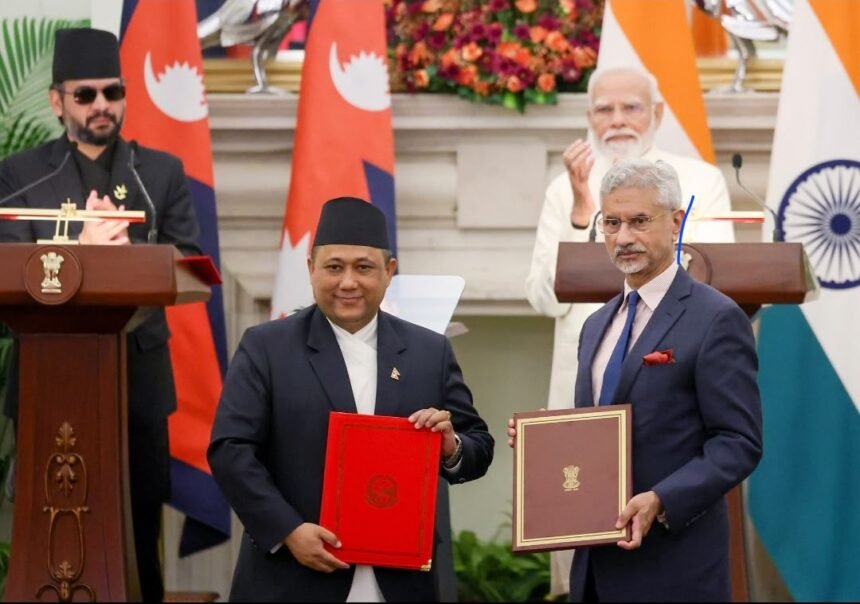
India will extend development assistance worth ₹15,000 crore to Nepal, comprising grants for post-disaster reconstruction and infrastructure development, along with a rupee-denominated line of credit for energy projects. The announcement followed bilateral talks between Prime Minister Narendra Modi and Nepalese Prime Minister Balendra Shah during the latter’s state visit to India on November 22-23, 2026.
The assistance package includes ₹3,500 crore in grant support for post-disaster reconstruction and new infrastructure projects, while ₹11,500 crore will be provided through a line of credit for energy sector projects. The specific projects and implementation arrangements will be finalised through mutual consultations. The support comes after devastating floods in Nepal’s Rasuwa-Bhotekoshi basin and other areas in August 2026, which caused significant loss of life and damage to infrastructure and property.
The two leaders also adopted a Joint Vision for a “Viksit Bharat and Samunnat Nepal”, setting out a roadmap for cooperation across economic development, physical and digital connectivity, energy, water resources, climate resilience, disaster management, technology and people-to-people exchanges.
Major push for cross-border infrastructure and connectivity
Connectivity emerged as a key area of cooperation, with India announcing a new transit trade route for Nepal through Deendayal Port at Kandla in Gujarat. Access to Paradip Port in Odisha will also be made available once the required infrastructure is in place. The two countries further agreed to make the existing Kathmandu-Bhairahawa-Lucknow B345 air route bidirectional, subject to technical consultations.
The Prime Ministers virtually flagged off the Sarayu-Kamala Express, an inaugural direct rail service connecting Ayodhya in Uttar Pradesh with Janakpur in Nepal. The service is expected to strengthen cross-border passenger connectivity and promote religious and cultural tourism along the Ramayana Circuit.
Both sides welcomed the completion of the Field Location Survey for the proposed Raxaul-Kathmandu electrified broad-gauge railway line and agreed to cooperate in developing Nepal’s East-West Railway. Priority will be given to the Bardibas-Nijgadh and Birgunj-Nijgadh sections. The two countries also agreed to expedite work on ongoing railway links, including Jayanagar-Bardibas and Jogbani-Biratnagar.
The leaders virtually laid the foundation stone for an Integrated Check Post at Banbasa and inaugurated a cross-border motorable bridge connecting Dharchula in India with Darchula in Nepal across the Mahakali River. Work on other integrated check posts, including those at Bhairahawa, Sunauli and Dodhara Chandani, will also be taken forward.
Energy and water resource cooperation
In the energy sector, the two Prime Ministers dedicated Phase II of the Motihari-Amlekhgunj petroleum pipeline to the people of Nepal. They also virtually laid the foundation stone for a petroleum terminal at Jhapa and called for the early commencement of the Siliguri-Jhapa pipeline project.
The leaders laid the virtual foundation stone for the 669 MW Lower Arun Hydroelectric Project and called for expediting work on the Pancheshwar Multipurpose Project. They also stressed the need to accelerate the preparation of detailed project reports for the Saptakoshi and Sunkoshi multipurpose projects, which are intended to support the development of water resources and flood mitigation.
The two countries also reviewed progress towards establishing joint ventures for two high-capacity cross-border transmission lines connecting Inaruwa in Nepal with New Purnea in India, and Dododhara in Nepal with Bareilly in India.
Investment, technology and institutional cooperation
India and Nepal agreed to encourage cross-border special economic zones and industrial parks near the border to support export-oriented manufacturing and strengthen regional supply chains. India will also encourage investment in Nepal’s priority sectors through arrangements aimed at improving investor confidence and the ease of doing business.
An Agro-Industrial Park will be established in Chitwan with grant assistance from India to support value addition to Nepal’s agricultural produce. The two sides also agreed to expand cooperation in agricultural research, livestock development and fisheries.
India will establish an offshore IIT campus in Nepal to strengthen higher education, technical capacity and employment opportunities. Cooperation will also be expanded in start-ups, digital services, space technology and financial connectivity.
During the visit, the two countries exchanged eight Memoranda of Understanding covering academic and forensic research, police training, civil servant capacity building, Ayurveda and traditional medicine, satellite communication, sustainable urban development, healthcare, and livestock and fisheries development.
The agreements and joint initiatives are intended to deepen economic and infrastructure cooperation between the two neighbouring countries and provide a framework for implementing cross-border projects. A High-Level Monitoring Group will oversee progress and meet at least once every six months, with its findings reported to the India-Nepal Joint Commission.