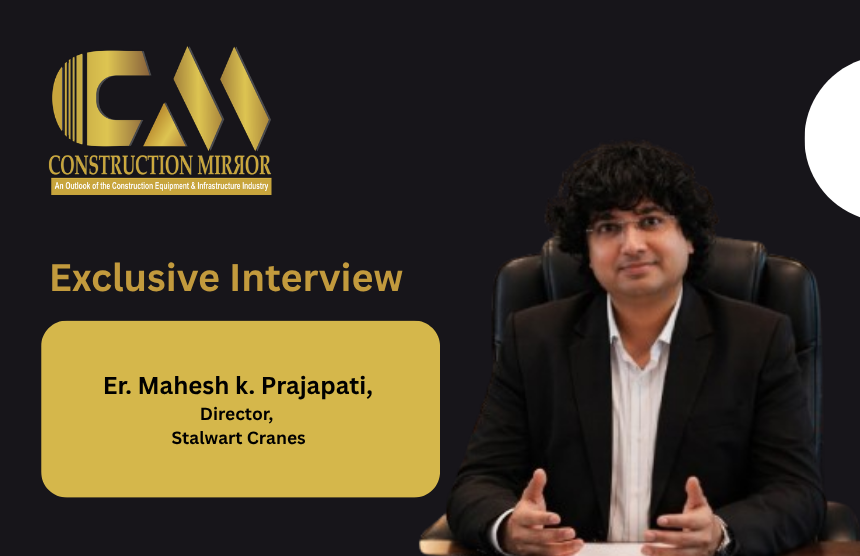
“At Stalwart Cranes, we therefore look at the application holistically. Duty cycle and load spectrum are among the most important parameters. We assess not only the maximum rated load, but also how frequently the crane lifts, travels, accelerates, decelerates and operates at different load levels.”
Stalwart Cranes has developed a strong presence in heavy-duty overhead lifting, particularly for applications where the crane becomes an integral part of the production process rather than simply a material-handling asset. How has this specialised approach shaped the company’s capabilities and the kind of projects it undertakes today?
At Stalwart Cranes, we have always believed that a heavy-duty crane should be designed around the production process it supports—not treated as a standalone material-handling equipment. This philosophy has played a major role in shaping our capabilities and the projects we undertake today.
Over the years, our focus has evolved from supplying cranes to developing application-specific lifting solutions that become an integral part of our customers’ manufacturing and operating processes. This requires us to understand the complete application—load characteristics, duty cycle, production flow, operating environment, safety requirements, maintenance philosophy and the level of reliability expected from the equipment.
This specialised approach has strengthened our engineering capabilities across areas such as heavy-duty EOT cranes, process cranes, high-capacity lifting systems, specialised handling solutions and automation-oriented crane applications. We increasingly work on projects where crane performance directly influences production efficiency, plant availability and overall operational safety.
As a result, the nature of our projects has also become more complex and application-driven. We are particularly involved in demanding industries where cranes operate under intensive duty cycles and where precision, reliability, safety and uptime are critical to the production process. In such environments, even a small improvement in crane performance can have a significant impact on the customer’s productivity.
Our approach is therefore not simply to ask, “What crane does the customer need?” but rather, “What lifting solution will make the customer’s process safer, more reliable and more productive?” That mindset has helped Stalwart Cranes build deeper technical expertise, develop long-term customer relationships and establish itself as an engineering partner for mission-critical lifting applications.
Going forward, we see this specialised approach becoming even more important as industries demand higher levels of automation, operational efficiency, safety and lifecycle performance from their lifting systems.
In sectors such as steel, cement and heavy engineering, cranes routinely operate under demanding load cycles and production schedules. When designing a Class IV/M8 crane for such environments, which engineering parameters become critical in ensuring dependable performance over the machine’s working life?
When designing a Class IV/M8 crane for industries such as steel, cement and heavy engineering, the first priority is to recognise that the crane is a high-duty, mission-critical machine. Its reliability cannot depend on any single component; it has to be engineered as an integrated system capable of consistently performing under demanding load cycles, frequent starts and stops, harsh operating conditions and long production schedules.
At Stalwart Cranes, we therefore look at the application holistically. Duty cycle and load spectrum are among the most important parameters. We assess not only the maximum rated load, but also how frequently the crane lifts, travels, accelerates, decelerates and operates at different load levels. This determines the appropriate selection and sizing of the structural members, hoisting mechanism, motors, gearboxes, brakes, wheels and other critical components.
The structural integrity and fatigue life of the crane are equally important. For high-duty applications, the bridge, trolley frame and supporting structures must be designed to withstand repeated dynamic loading over the intended service life. Appropriate consideration of stress concentrations, deflection, wheel loads, load combinations and fatigue-critical areas is essential.
Another critical area is the selection of mechanical and electrical components. Hoisting machinery, gearboxes, brakes, ropes, drums, wheels, bearings and motors need to be selected with the actual operating duty and environmental conditions in mind. Thermal performance, starting frequency, braking requirements and component life all have a direct bearing on long-term reliability.
We also place significant emphasis on controlled acceleration and deceleration. Smooth motion is not only about operator comfort; it helps reduce shock loading, mechanical stress, load swing and wear on the crane structure and drive system. Where appropriate, variable-frequency drives and modern control systems can significantly improve the operating behaviour of the crane.
For industries such as steel and cement, the operating environment is another major consideration. High temperatures, dust, scale, humidity and other contaminants can have a substantial impact on component life. Protection levels, cooling arrangements, lubrication, sealing, material selection and accessibility for maintenance therefore become integral parts of the design.
Finally, we believe that a high-duty crane should be designed with maintainability and lifecycle reliability in mind from the beginning. Critical components should be accessible for inspection and servicing, and the design should facilitate preventive maintenance and early identification of potential failures.
In short, designing an M8 crane is not simply a matter of increasing capacity. It is about achieving the right balance between load spectrum, fatigue strength, dynamic behaviour, component selection, safety, environmental protection, maintainability and lifecycle performance. Our objective at Stalwart Cranes is to engineer the crane so that it delivers dependable performance not just on the day of commissioning, but throughout its working life.
Many industrial lifting requirements cannot be addressed effectively through an off-the-shelf crane. Stalwart’s projects include customized arrangements involving tandem hoists, synchronized movements and application-specific configurations. How do you translate a customer’s site constraint or handling requirement into a practical crane design?
At Stalwart Cranes, we believe that customization should begin with understanding the customer’s process, not with modifying a standard crane. In many heavy industrial applications, the lifting requirement is closely linked to the plant layout, production sequence, available headroom, load geometry, access limitations and operating conditions. Our role is to convert these practical requirements into an engineered, reliable and maintainable lifting solution.
The process typically starts with a detailed understanding of the application. We study the load characteristics, centre of gravity, lifting points, required capacity, lifting frequency, travel path, available space, headroom, runway arrangement, production cycle and operating environment. Site conditions and existing infrastructure are equally important, particularly when the crane has to be integrated into an operating plant.
For specialized applications, we then develop the appropriate mechanical and electrical architecture. For example, where a load needs to be handled using tandem hoists or multiple lifting points, the design has to ensure proper load sharing and coordinated movement. The synchronization philosophy, hoist selection, drive configuration, braking system and control logic are developed around the actual handling requirement rather than simply adding additional lifting capacity.
We also pay close attention to the interaction between the crane and the customer’s existing infrastructure. Wheel loads, runway capacity, clearances, structural interfaces, power supply, maintenance access and installation constraints are evaluated early in the design process. This helps us avoid situations where an otherwise technically sound crane becomes difficult to install or operate because of a site limitation.
Engineering tools and calculations play an important role in this process. Depending on the complexity of the application, we evaluate structural loading, mechanical forces, dynamic effects, deflection, fatigue considerations and drive performance before finalising the configuration. For critical movements, the control philosophy is developed with particular emphasis on precision, safety and repeatability.
Another important aspect is communication with the customer. We believe the best customized solutions emerge through close interaction between the customer’s process team and our engineering team. The customer understands the production challenge; we bring the lifting-system expertise required to solve it. By working together at the design stage, we can often identify a better solution than what was initially envisaged.
Ultimately, our approach is to treat every customized crane as an application-engineering project. We ask three fundamental questions: What does the customer need to lift? How does the load need to move? And what conditions must the crane operate under? Once these are clearly established, we engineer the structure, machinery, controls and safety systems around those requirements.
That is how we convert a site constraint or a complex handling requirement into a practical crane design—one that is technically sound, operationally efficient, safe and capable of delivering consistent performance throughout its service life.
The conversation around industrial automation is increasingly moving from fully automated production lines to smarter individual equipment. Where do you see the greatest scope for automation in overhead cranes, whether through VFD-based motion control, remote operation, load monitoring or other intelligent features?
We see significant potential for automation in overhead cranes, particularly when it is applied with a clear understanding of the production process. At Stalwart Cranes, our view is that the future of crane automation is not necessarily about making every crane fully autonomous. The greater opportunity lies in making individual cranes smarter, safer, more precise and more responsive to the needs of the operation.
One of the most practical areas is VFD-based motion control. Variable-frequency drives allow smoother acceleration and deceleration, better speed control and improved positioning accuracy. This can reduce mechanical shock, minimize load swing and improve the overall life of critical components. In repetitive production applications, controlled motion can also make crane operations more consistent and efficient.
Remote operation is another area with strong potential, particularly in hazardous, high-temperature, dusty or otherwise difficult operating environments. Moving the operator away from the immediate lifting zone can significantly improve safety while also providing a better working environment. With suitable cameras, sensors, communication systems and control interfaces, the operator can manage lifting operations from a safer location without compromising visibility or control.
We also see growing value in load monitoring and intelligent sensing. Continuous monitoring of parameters such as load, motor performance, operating cycles and critical component conditions can provide valuable information about how the crane is actually being used. Over time, this data can support condition-based or predictive maintenance, helping maintenance teams identify abnormal behaviour before it develops into an operational failure.
Another important opportunity is anti-sway and precision positioning. In applications involving repetitive material movement or accurate positioning, intelligent control can reduce operator dependency and improve cycle-to-cycle consistency. This becomes particularly valuable when cranes are integrated into broader manufacturing or material-flow systems.
Looking ahead, the combination of sensors, digital controls, data acquisition and connectivity can take crane automation much further. A crane can increasingly become a source of operational data rather than simply a machine that moves a load. Information related to utilization, load cycles, travel patterns, faults and maintenance can help plant teams make better decisions about productivity and asset management.
However, we believe automation must always be application-driven. A sophisticated automation system is not necessarily the best solution for every crane. The right level of automation depends on the production process, risk profile, operating environment, required accuracy and return on investment.
Our objective at Stalwart Cranes is therefore to adopt technology where it creates measurable value—safer operation, smoother motion, greater precision, reduced downtime, better maintenance and higher productivity. We see the future of overhead cranes as a progression from conventional lifting equipment toward intelligent, connected and increasingly data-driven industrial assets.
Bauma CONEXPO India 2026 will bring together equipment manufacturers, infrastructure companies and technology providers from across the construction ecosystem. What would Stalwart Cranes like to put in front of the industry at the exhibition, and what kind of conversations are you hoping to have with customers and project developers there?
Bauma CONEXPO India 2026 is an important industry platform because it brings together equipment manufacturers, infrastructure companies, EPC organizations and technology providers from across the construction ecosystem. Although Stalwart Cranes is not participating as an exhibitor at this edition, we see the exhibition as a valuable opportunity to understand the direction in which the industry is moving and the challenges that customers and project developers are preparing to address.
For us, the most interesting developments are those that are influencing the future requirements of lifting systems—particularly higher productivity, greater safety, automation, intelligent controls, energy efficiency and improved lifecycle performance. As crane technology becomes increasingly integrated with modern industrial and infrastructure projects, we believe it is important for manufacturers like us to continuously understand these evolving requirements and translate them into practical engineering solutions.
We are particularly interested in the conversations taking place around project execution, equipment reliability, specialized lifting requirements and the integration of lifting equipment into larger material-handling and production systems. These discussions provide valuable insight into where conventional solutions may no longer be sufficient and where application-specific engineering can create greater value.
At Stalwart Cranes, we would welcome the opportunity to connect with customers, EPC companies, consultants and project developers around these challenges. Rather than approaching the discussion purely from a product perspective, we prefer to understand the complete application—what needs to be lifted, how it needs to be handled, the operating environment, the required duty cycle and the constraints of the project—and then determine the most appropriate engineering solution.
We also believe exhibitions such as Bauma CONEXPO India play an important role in bringing new technologies and ideas into the Indian market. Even without participating directly, we will be keen to observe these developments, interact with industry stakeholders and identify technologies that can genuinely improve the safety, reliability and productivity of overhead lifting systems.
Ultimately, our focus remains on the same principle that guides our projects: understanding the customer’s challenge first and engineering the right lifting solution around it. The industry conversations generated by platforms such as Bauma CONEXPO India help us stay aligned with where our customers and the broader market are heading.