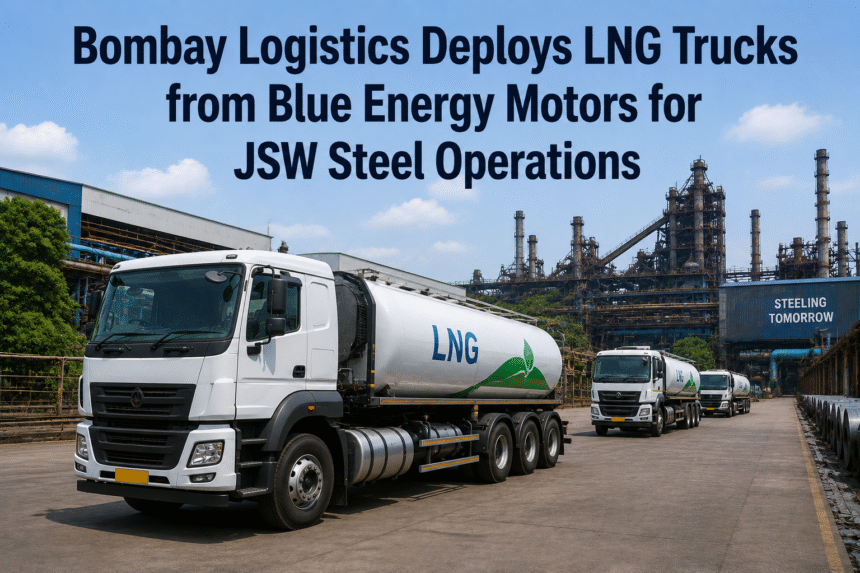
Bombay Logistics has deployed a fleet of LNG-powered heavy-duty trucks from Blue Energy Motors for commercial freight operations supporting JSW Steel in the Toranagallu region of Karnataka. The deployment marks another step towards the adoption of alternative-fuel vehicles in India’s industrial logistics sector.
The trucks will be used for demanding industrial freight operations associated with JSW Steel, where long-distance movement, high utilisation and operational reliability are critical. For Bombay Logistics, the move is aimed at improving fleet efficiency while reducing the carbon intensity of its transportation activities.
Blue Energy Motors’ LNG-powered trucks have been developed specifically for heavy-duty and long-haul commercial applications. The company claims its LNG trucks can deliver up to 20% better fuel efficiency compared with conventional fuel-powered alternatives, supporting operators in managing fuel costs while lowering emissions.
According to Thimmaraj Kakarla, Managing Partner, Bombay Logistics, the decision to adopt LNG was driven by the need for a commercially viable transportation solution. The company’s assessment included the trucks’ performance and fuel efficiency, while Blue Energy Motors also supported the deployment through vehicle handover, route planning and on-ground assistance.
The deployment highlights the growing relevance of LNG as a transition fuel for India’s heavy commercial vehicle sector. Unlike smaller urban vehicles, long-haul trucks face significant challenges in shifting directly to battery-electric propulsion because of payload requirements, range, charging time and infrastructure availability. LNG can provide an alternative pathway for operators seeking to reduce emissions while maintaining conventional heavy-duty operating patterns.
Blue Energy Motors has been expanding its presence in India’s alternative-fuel freight market. The company currently has more than 1,400 trucks operating across key freight routes, while its fleet has crossed 100 million green kilometres on Indian roads. The company estimates that its vehicles have helped avoid more than 30,000 tonnes of CO₂ emissions.
The trucks are particularly suited to industrial corridors where vehicles operate on predictable routes and can be integrated into structured fleet-management systems. Such applications can make alternative fuels more practical because operators can plan refuelling, maintenance and vehicle utilisation around established freight movements.
For the steel industry, cleaner freight transportation is becoming increasingly relevant as manufacturers and logistics partners work to reduce emissions across their supply chains. Heavy trucks play an important role in moving raw materials, intermediate products and finished steel, making freight efficiency an important component of the industry’s broader decarbonisation efforts.
The deployment at Toranagallu therefore represents more than a fleet addition. It demonstrates how fleet operators, vehicle manufacturers and industrial customers can collaborate to introduce alternative-fuel technologies into demanding real-world applications.
As India’s freight sector continues to explore LNG, electric and eventually hydrogen-powered heavy vehicles, deployments such as this could provide valuable operational experience. The focus will remain on whether these technologies can deliver the required combination of range, payload capability, reliability, fuel economics and emissions reduction at commercial scale.
For Bombay Logistics, the latest deployment strengthens its focus on cleaner freight transportation, while for Blue Energy Motors, the JSW Steel operation adds another industrial application to its growing LNG truck footprint.