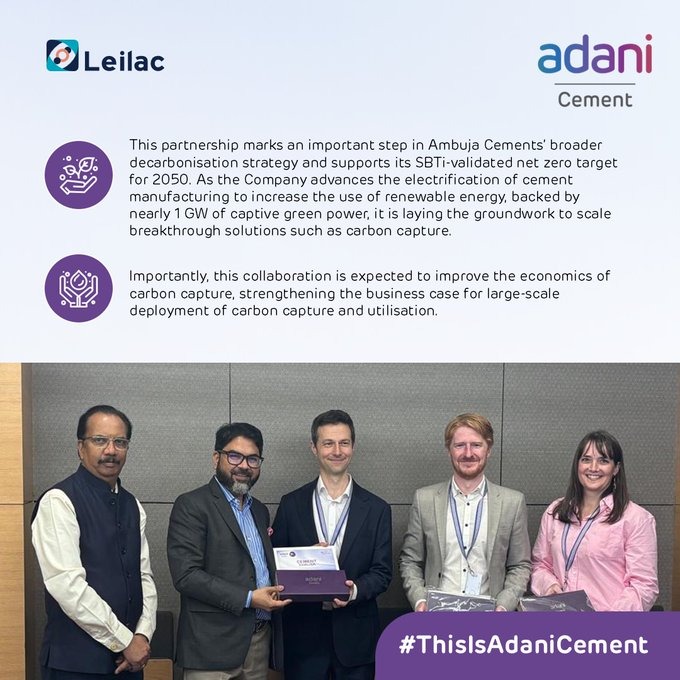
Ambuja Cements Limited has entered into a partnership with Leilac to explore the deployment of advanced carbon capture technology as part of its efforts to reduce emissions from cement manufacturing.
The collaboration will focus on assessing the application of Leilac’s proprietary carbon capture technology at Ambuja Cements’ operations in India. The technology is designed to capture carbon dioxide generated during the limestone calcination process, one of the largest sources of emissions in cement production.
Unlike conventional carbon capture systems, Leilac’s process separates emissions directly from limestone during production, producing a concentrated stream of carbon dioxide that can be captured without requiring major changes to existing cement manufacturing processes.
The partnership aligns with Ambuja Cements’ broader sustainability strategy, which includes reducing its carbon footprint, increasing renewable energy usage, improving energy efficiency and expanding the use of alternative fuels and raw materials across its plants.
For the cement industry, carbon capture is increasingly being viewed as a critical technology for achieving long-term decarbonisation targets, particularly because process emissions generated during clinker production cannot be eliminated solely through renewable energy or fuel substitution.
Leilac has been developing and demonstrating its technology through projects in Europe and other international markets, working with cement producers seeking commercially viable pathways to lower carbon emissions. The collaboration with Ambuja Cements marks a step towards evaluating the technology’s potential application within India’s rapidly growing cement sector.
The partnership comes at a time when cement manufacturers worldwide are accelerating investments in low-carbon technologies in response to tightening environmental regulations and net-zero commitments. As one of India’s leading cement producers, Ambuja Cements is exploring multiple pathways to reduce emissions while supporting the country’s growing infrastructure and construction requirements.
The companies will jointly assess technical and commercial aspects of deploying the technology, with the objective of advancing more sustainable cement manufacturing solutions in the Indian market.