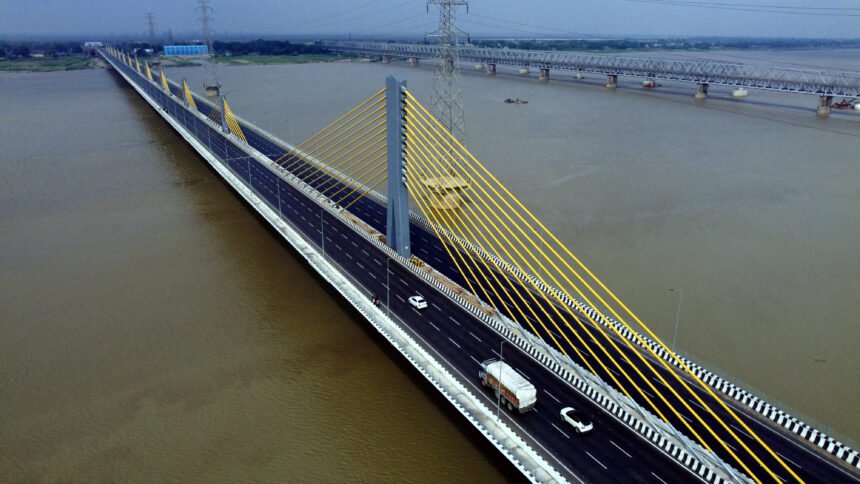
For generations, the Ganga has been both a lifeline and a barrier in Bihar. While it sustains communities, agriculture and commerce, crossing the river has often meant longer journeys and dependence on limited routes. The opening of the Aunta–Simaria Ganga Bridge is changing that equation, creating a more direct connection between north and south Bihar. The 1,865-metre extradosed bridge connects Aunta near Mokama with Simaria in Begusarai district. Built on NH-31, it forms part of an 8.15-km highway package that includes approach roads.
Shorter Journeys, Stronger Connections
The bridge’s most immediate benefit is improved accessibility. Communities on both banks of the Ganga now have a modern, high-capacity crossing for travel related to work, education, healthcare and trade. Better connectivity can also expand economic opportunities. Traders can reach wider markets, farmers can connect more easily with buyers, and workers can access employment across a larger geographical area. The bridge therefore serves not just as a river crossing, but as a link between communities and economic centres.
Strengthening a Key Road Corridor & Supporting Regional Economies
NH-31 is an important road corridor connecting Bihar with the wider eastern and northeastern road network. The Aunta–Simaria crossing adds capacity and provides a more direct route for traffic moving across the Ganga. Meticulously prepared by EPC Contractor SPS Construction. For freight operators, reliable connectivity is crucial. Trucks transporting agricultural produce, industrial goods and consumer products can benefit from smoother movement between different parts of Bihar and neighbouring states.
Its significance thus extends beyond the immediate region. By strengthening a national highway corridor, the bridge supports both intra-state and inter-state movement, bringing northern and southern Bihar closer while improving connections toward eastern and northeastern India.
Improved infrastructure can reshape access to economic opportunity. Easier movement of people and goods can help businesses connect with suppliers, customers and logistics networks more efficiently. For areas around Mokama, Begusarai and adjoining districts, the bridge can support agriculture, transport, retail, warehousing and other services. Over time, the bridge and its approach roads could contribute to broader economic integration along the corridor.
Engineering Behind the Connectivity
The bridge’s role is underpinned by substantial engineering. The 1,865-metre structure comprises 15 spans of 115 metres and two spans of 70 metres. EPC Contractor SPS Construction used 12-metre-diameter wells reaching depths of up to 47 metres, while the superstructure incorporates precast post-tensioned segments.
The real impact of the Aunta–Simaria bridge will be measured by the journeys it enables: students travelling to institutions, patients seeking healthcare, workers commuting across the river and trucks carrying goods to other states. By providing a direct crossing between Aunta and Simaria and strengthening NH-31, the project adds an important link to Bihar’s road network. More importantly, it can help reduce the physical and economic distance between communities on either side of the Ganga.