


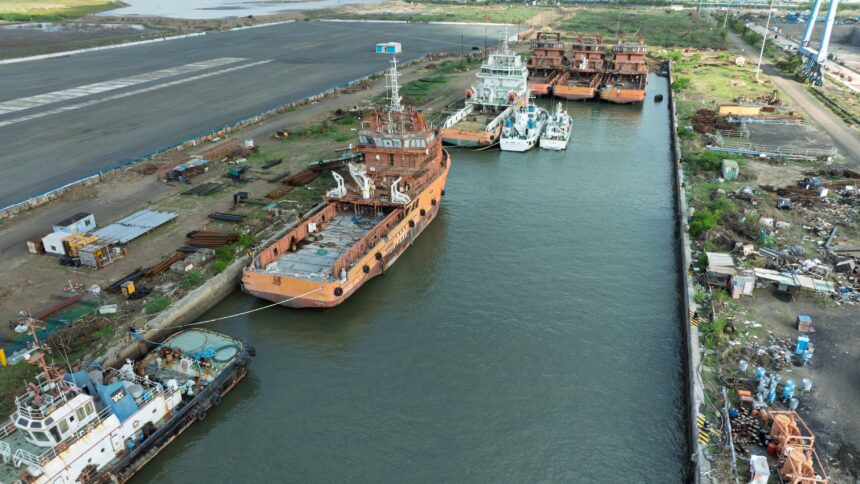
Swan Defence and Heavy Industries Limited (SDHI) has partnered with DNV to strengthen India’s maritime and shipbuilding ecosystem, marking another major step in the country’s push to emerge as a globally competitive shipbuilding and maritime manufacturing hub.
The collaboration is expected to focus on advancing ship classification standards, maritime technology integration, sustainability frameworks, green shipping solutions, and international best practices for commercial and defence shipbuilding projects. The partnership also aligns with India’s broader Maritime India Vision 2030 and Maritime Amrit Kaal Vision 2047 programmes aimed at transforming the country into a leading global maritime economy.
DNV is one of the world’s leading maritime classification and risk management organisations, widely recognised for ship classification, technical certification, marine engineering standards, decarbonisation consulting, and advanced maritime safety systems. Industry experts believe the collaboration could help Indian shipbuilders strengthen global compliance standards and improve export competitiveness in international markets.
The partnership comes at a time when India is aggressively expanding its shipbuilding and maritime manufacturing capabilities through large-scale policy reforms, infrastructure investments, and financial support schemes. The Government of India recently unveiled multiple initiatives under the Shipbuilding Development Scheme (SbDS), Maritime Development Fund (MDF), and Shipbuilding Financial Assistance Policy to support greenfield shipyard expansion, technology upgrades, and maritime ecosystem development.
Officials stated that India is targeting a top-five global ranking in shipbuilding under Maritime Amrit Kaal Vision 2047, with ambitious plans to increase annual shipbuilding output, modernise domestic shipyards, and expand maritime exports. Government estimates indicate that nearly ₹75–80 lakh crore in long-term investments may be required to achieve the country’s shipbuilding and maritime infrastructure ambitions.
The collaboration is also expected to support the adoption of advanced and sustainable shipbuilding technologies including green fuels, ammonia-ready propulsion systems, energy-efficient vessel designs, digital shipyard technologies, and ESG-compliant maritime infrastructure. India has increasingly focused on developing green shipping capabilities amid rising global emphasis on decarbonisation in the maritime sector.
Swan Defence and Heavy Industries Limited has emerged as one of India’s key private-sector shipbuilding companies following the revival of the Pipavav shipyard facility in Gujarat. The company has recently secured several major domestic and international contracts across commercial shipbuilding and defence manufacturing segments. Earlier this year, SDHI signed India’s first domestic chemical tanker construction order valued at approximately $227 million from Norwegian shipping company Rederiet Stenersen AS.
The company has also been involved in advanced vessel projects including ammonia-fuelled bulk carriers and defence export platforms, reflecting growing international confidence in India’s shipbuilding capabilities. Several of these projects are being designed in collaboration with global maritime technology and classification partners.
Industry analysts noted that partnerships between Indian shipyards and global classification societies such as DNV are becoming increasingly important as India seeks to compete with established shipbuilding nations including China, South Korea, and Japan. International certification, safety compliance, and sustainability standards are viewed as critical factors for attracting export orders and foreign maritime investment.
India’s maritime sector is currently witnessing rapid policy and infrastructure transformation across shipbuilding, coastal shipping, green ports, inland waterways, and maritime logistics. The government has also launched initiatives to increase Indian-flagged vessel ownership, strengthen domestic cargo movement, and promote low-carbon shipping technologies as part of its long-term maritime growth strategy.