


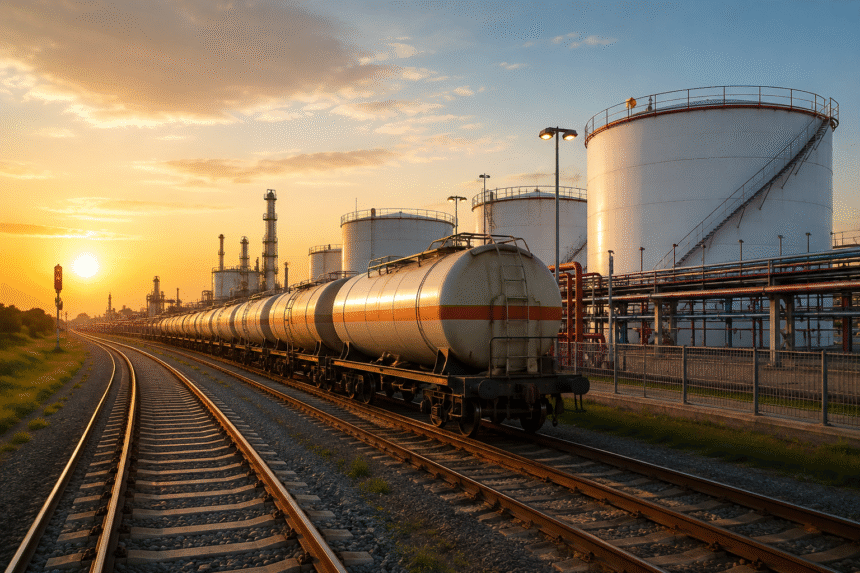
State-owned transport infrastructure consultancy firm RITES Ltd. has signed a Memorandum of Understanding (MoU) with Hindustan Petroleum Corporation Ltd. (HPCL) to provide end-to-end consultancy for the development and expansion of railway siding infrastructure across HPCL’s facilities.
The agreement covers the complete project lifecycle, beginning with conceptualisation and feasibility assessment and extending through engineering, construction supervision and commissioning. RITES will undertake feasibility studies, final location surveys, preparation of detailed project reports (DPRs), detailed engineering and project management consultancy, besides supervising construction activities.
An important component of the arrangement will be coordination with Indian Railways for obtaining the statutory approvals and clearances required for railway connectivity and siding development. The scope will cover both new infrastructure and the improvement of existing rail facilities at HPCL locations.
The collaboration is intended to expand the role of rail in HPCL’s petroleum logistics network. New railway sidings and upgraded connectivity can provide refineries, terminals and depots with more efficient links to the national rail network, enabling petroleum products to be moved in larger volumes and over longer distances with greater operational efficiency.
For HPCL, the initiative comes as petroleum logistics networks increasingly require greater multimodal integration. Rail connectivity can complement road-based distribution, particularly for bulk movement between production facilities, storage terminals and regional consumption centres. Developing dedicated siding infrastructure also allows petroleum companies to integrate loading and unloading operations more closely with their supply chains.
RITES brings extensive experience in railway engineering, project management and transport infrastructure consultancy to the partnership. Its involvement will cover the technical and project-management requirements associated with developing the siding network, while HPCL will leverage the arrangement to strengthen rail connectivity across its operational facilities.
The MoU therefore represents a move towards deeper integration of rail infrastructure with India’s petroleum distribution system, with the potential to improve first- and last-mile connectivity and create a more efficient logistics framework for the movement of petroleum products across HPCL’s network.