


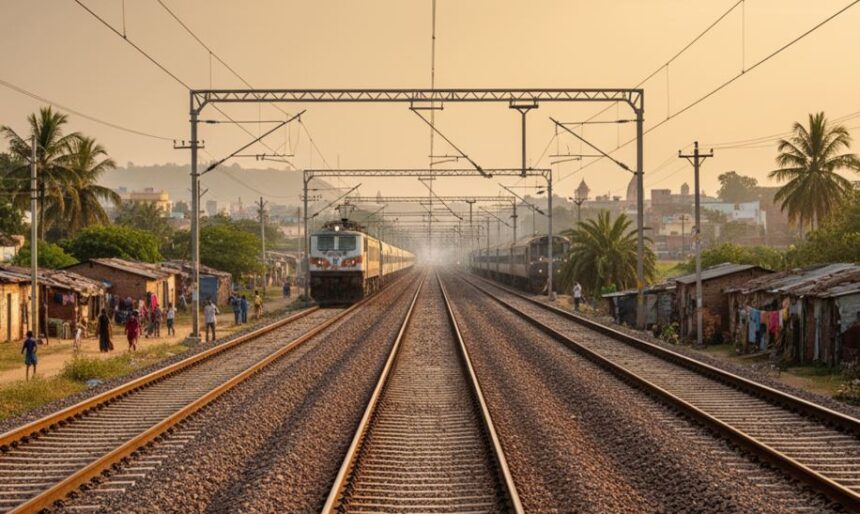
Indian Railways has approved two key infrastructure projects worth ₹647.58 crore aimed at enhancing connectivity, easing congestion, and improving operational efficiency across critical routes.
The approved projects include the construction of a Rail-over-Rail (RoR) flyover at Kosamba in Gujarat and a rail bypass at Bhagalpur in Bihar, both designed to address capacity constraints and streamline train operations.
The Kosamba flyover project, estimated at ₹344.38 crore, will integrate the 9.20-km Kosamba–Umrapada gauge conversion section with the busy Mumbai–Vadodara main line. The flyover is being developed to eliminate conflicts at junction points, especially due to the presence of the Dedicated Freight Corridor, which makes surface crossings impractical. Once completed, it will enable seamless and safer train movement while reducing delays.
In Bihar, the Bhagalpur rail bypass, with an estimated cost of ₹303.20 crore, will involve the construction of a 13.38-km line connecting Gonudham Halt on the Barahat–Bhagalpur section to Sabour on the Bhagalpur–Sahibganj route. The project aims to decongest the heavily saturated Bhagalpur junction, where sections are currently operating beyond 125% capacity.
At present, trains passing through Bhagalpur require engine reversal, leading to operational delays. The bypass is expected to eliminate this requirement, thereby improving punctuality, efficiency, and overall network fluidity.
The Ministry of Railways stated that these projects are part of a broader strategy focused on capacity augmentation, decongestion, and modernisation of the railway network, aimed at supporting both passenger and freight growth.
Once completed, the projects are expected to enhance safety, optimise operations, and strengthen regional connectivity, contributing to faster and more efficient rail movement across key corridors.