


Q. EXCON 2025 brought together a wide cross-section of Indian contractors, recyclers, and infrastructure developers. From the conversations at your stand, what changes did you notice in how Indian customers now evaluate attachments?
There is a very clear shift underway. Indian customers are no longer evaluating attachments only on upfront price. The discussion has moved decisively toward productivity, versatility, and lifecycle value.
- Q. EXCON 2025 brought together a wide cross-section of Indian contractors, recyclers, and infrastructure developers. From the conversations at your stand, what changes did you notice in how Indian customers now evaluate attachments?
- Q. Attachments are increasingly being used to extract more output from existing machines rather than investing in new carriers. How does MB Crusher see its portfolio helping contractors maximise machine utilisation?
- Q. With urban redevelopment and confined-space projects increasing, compact excavators are becoming more central. How is MB Crusher adapting its attachment strategy for restricted environments?
- Q. As MB Crusher deepens its presence in India, how do you define localisation today?
- Q. With more attachment brands entering India, what will ultimately differentiate MB Crusher?
- Q. Looking ahead, how do you define MB Crusher’s next level of progress in India?
At our stand, contractors were asking sharper questions: how many tonnes per hour can I realistically process, how does this reduce truck movements, what does maintenance look like after two or three years. That tells you the market is maturing.
What’s also changed is mindset. Attachments are no longer seen as optional add-ons. They’re being evaluated as productivity multipliers for machines customers already own. When contractors start looking at total cost of ownership and not just purchase price, solutions like MB Crusher naturally stand out because the return is visible on site, day after day.
Q. Attachments are increasingly being used to extract more output from existing machines rather than investing in new carriers. How does MB Crusher see its portfolio helping contractors maximise machine utilisation?

This is exactly where attachments make the most sense, especially in a capital-conscious market like India.
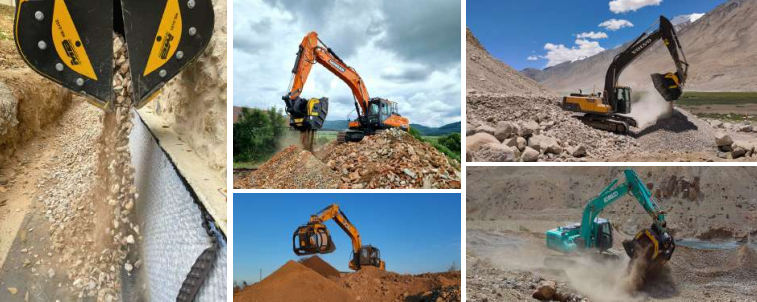
With MB Crusher attachments, one excavator can move through multiple phases of the same project without downtime or additional machines. The same carrier can handle demolition, crushing, screening, trenching, or surface preparation simply by changing the attachment.
What this really means for contractors is higher utilisation of their base machine and fewer idle hours. Instead of buying three specialised machines, they invest in one carrier and a set of attachments that adapt to the job. That flexibility is critical on Indian sites, where work scopes change quickly and space, logistics, and labour are always constrained.
We are seeing contractors plan projects around this flexibility, not as an afterthought but as part of their core execution strategy.
Q. With urban redevelopment and confined-space projects increasing, compact excavators are becoming more central. How is MB Crusher adapting its attachment strategy for restricted environments?
Urban India demands precision, control, and low disruption. Bigger machines don’t always solve the problem.
We’ve consciously expanded and promoted attachments designed for compact carriers — such as smaller crusher buckets that deliver high output without compromising safety or accuracy. These attachments are engineered to work efficiently in tight spaces, with controlled operation, lower noise levels, and predictable performance.
In confined environments, brute force matters less than control. Contractors told us they need attachments that allow selective crushing, precise trenching, and clean profiling without damaging surrounding structures. Our hydraulic systems are designed exactly for that level of control.
EXCON confirmed that compact equipment is no longer a niche segment. It’s becoming central to urban project planning, and our attachment strategy is aligned with that reality.
Q. As MB Crusher deepens its presence in India, how do you define localisation today?
For us, localisation goes far beyond dealer expansion.
Of course, having strong coverage on the ground is essential. But real localisation means understanding Indian materials, Indian work practices, and Indian site constraints — and then adapting our solutions accordingly.
Today, localisation includes application engineering, operator and dealer training, and regular job-site demonstrations using Indian materials. Granite, basalt, mixed demolition waste, seasonal moisture — these are realities that require hands-on testing and adaptation, not assumptions.
We also invest heavily in customer education. Crushing and screening attachments are not plug-and-play commodities. When operators understand how to use them correctly, the performance difference is dramatic. That’s why training and on-site support are a core part of how we operate in India.
Q. With more attachment brands entering India, what will ultimately differentiate MB Crusher?
Price alone will not be a sustainable differentiator in this segment. What we believe will matter — and already does — is engineering depth, application versatility, and service reliability.
MB Crusher created this category. Our products are not generic attachments; they are engineered systems developed over decades of field use. That shows in durability, consistency, and resale value.
Equally important is versatility. Customers don’t want single-use tools. They want solutions that adapt across projects and applications. Our portfolio is designed as a complete ecosystem, not isolated products.
Finally, service and customer education are non-negotiable. Attachments only deliver value when they are correctly applied and supported. This is where long-term relationships are built, and it’s an area where we continue to invest heavily post-EXCON.
Q. Looking ahead, how do you define MB Crusher’s next level of progress in India?
The next phase is about scale and normalisation.
We want attachments to become a standard part of day-to-day site operations, not something used only on select projects. That means wider adoption on small and mid-size sites, deeper integration into large infrastructure projects, and a much stronger push toward on-site recycling.
India generates enormous volumes of construction and demolition waste, yet only a fraction is recycled. On-site crushing and screening can change that equation — economically and environmentally.
For this shift to be sustainable, three things are essential: contractors must plan recycling into their projects, policymakers must provide clearer and more supportive frameworks, and OEMs must design machines and hydraulics that are attachment-ready.
MB Crusher sees itself as an enabler of that transition. The conversations at EXCON showed us that the intent is there. Now the focus is on execution.