


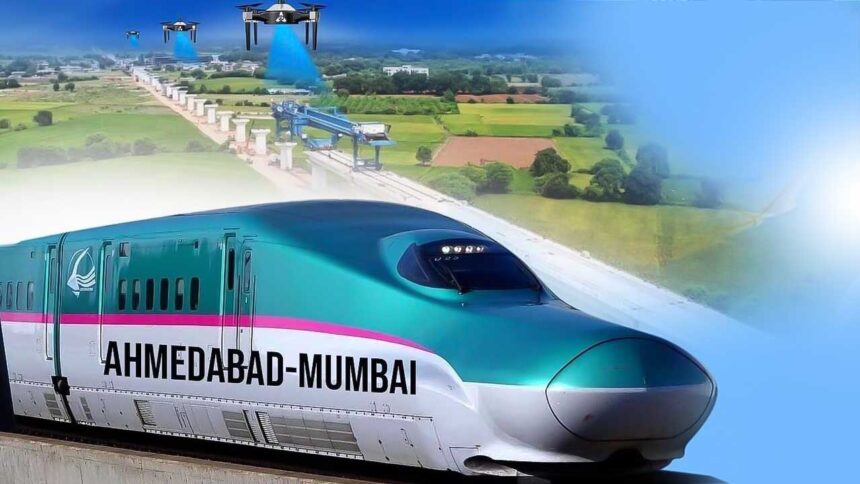
India’s first high-speed rail corridor has entered a crucial stage, with the latest government data indicating strong momentum in construction activity on the Mumbai–Ahmedabad bullet train project.
As per the monthly project monitoring flash report of the Ministry of Statistics and Programme Implementation (MoSPI) for November, physical progress on the 508-km corridor has crossed 55 per cent.
The high-speed rail project is among the major ongoing infrastructure initiatives being tracked under MoSPI’s Project Assessment Infrastructure Monitoring and Analytics for Nation Building (PAIMANA) portal.
According to the report, expenditure on the bullet train project has exceeded ₹84,200 crore so far, while the total estimated cost of the project stands at around ₹1.08 lakh crore.
Earlier last month, Railway Minister Ashwini Vaishnaw announced that India’s first bullet train service will begin its inaugural 100-km run between Surat and Vapi in August 2027. This stretch forms part of the larger 508-km Mumbai–Ahmedabad high-speed rail corridor, which is expected to be fully operational by 2029.
Vaishnaw stated that once the corridor is completed, travel time between Mumbai and Ahmedabad will be reduced to 1 hour and 58 minutes. He added that the initial operations in August 2027 will be limited to the Surat–Vapi section.
The minister further said that trains on the corridor will operate at speeds of up to 320 kmph.
With four stops, the Mumbai–Ahmedabad journey will take 1 hour 58 minutes, while halting at all 12 stations will extend the travel time to 2 hours and 17 minutes.
The full Mumbai–Ahmedabad high-speed rail corridor is expected to be completed by December 2029, he added.