We see the future of concrete machinery as connected, data-driven, and human-centred. Our focus will be on developing digitally integrated systems with smart diagnostics, predictive maintenance, and performance analytics – empowering plant owners to make informed, real-time decisions. Our mission is clear – to make Indian manufacturers global leaders in concrete technology, through a complete ecosystem of knowledge, service, and sustainable innovation.
Q. Columbia has long been recognized for blending global technology with localized manufacturing. With your recently showcased machines offering unprecedented flexibility in concrete products production, what larger vision is driving these innovations, and how do they reflect the evolving demands of the Indian and global concrete markets?
At Columbia Machine Engineering, our vision is to bring world-class automation standards from the USA to our state-of-the-art manufacturing facility in India. The evolving Indian concrete industry demands flexibility, faster product cycles, and unwavering
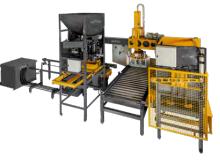
quality consistency. Every innovation we’ve introduced – from the SPM 20 and SPM 30 to the advanced MPM 1070 concrete block machine and the Wet Press from Wil El Mil, UK – is designed to meet these dynamic requirements.
Our concrete block plant models operate on Columbia’s vertical mould vibration technology (CVT), ensuring the production of high-strength paver blocks, hollow and solid blocks, fly ash bricks, and SRW blocks with exceptional strength, finish, dimensional accuracy, and uniformity.
With the acquisition of Wil El Mil, a global leader in wet press technology, we have further expanded our portfolio to include premium wet press solutions, strengthening our commitment to delivering comprehensive concrete production systems.
Together, these innovations reflect our mission to empower Indian concrete products manufacturers to compete globally through localized innovation, robust automation, and process efficiency tailored for emerging markets.
Q. Columbia’s recent machine can cast concrete bricks and blocks of varying thickness (25–250 mm) on the same
line, featuring enhanced mould designs and energy-efficient motors. How is this flexibility creating new opportunities for
your customers, such as custom product lines, faster changeovers, or reduced inventory?
When our customers expressed the need to produce 25mm-thick tiles with exceptional dimensional accuracy and strength, we
recognized an opportunity to innovate. While our standard SPM 20 model was designed to produce blocks ranging from 50mm to 200mm, customers also wanted the flexibility to manufacture taller products up to 250mm on the same machine.
In response, our engineering team developed a customized SPM 20 variant capable of producing products from 25mm to 250mm – a solution that significantly expanded versatility in production. This adaptation helped customers reduce their reliance on multiple technologies, minimize machine inventory, save floor space, and lower manpower requirements, all while
ensuring consistent Columbia quality.
Our extensive experience in developing hundreds of product types through flexible mould designs gives our customers a competitive edge. Additionally, the use of energy-efficient motors reduces power consumption, lowering production costs and boosting profitability.
Every plant layout we design is tailored to the customer’s available space or existing factory setup. The versatility of our machines enables the production of even the most challenging concrete products, with minimal mould changeover time, maximizing both plant efficiency and return on investment.
Q. Columbia has strengthened its ‘Make in India’ capabilities by ramping up in-house mould production, including pavers and blocks at competitive pricing, and by integrating advanced automation. How does this localized, full-solution approach impact your cost structure and enhance your competitiveness globally, particularly against lower-cost imports?
Make in India is our strongest lever for both cost and quality control. Our Vadodara manufacturing facility now houses a fully equipped mould production division with high-precision CNC. This enables us to produce world-class moulds at Indian costs, while maintaining the same tolerances and steel grades used globally.
By manufacturing equipment such as the SPM 20, SPM 30, MPM 1070, and Wet Press locally, we have reduced import dependencies, improved spare parts availability, and offered quicker service response. This end-to-end approach – from design to mould to automation – allows us to compete effectively against highercost imports. But more importantly, it ensures that our customers receive durable systems, backed by local engineering and lifetime service support. That combination of cost efficiency and reliability gives us a clear global advantage.
Q. Considering local manufacturing costs such as energy, raw materials, and labor in India, along with the growing demand for efficient machines, what priceto-feature adjustments has Columbia introduced in its SPM-series machines to enhance competitiveness?
The SPM Series is engineered for high performance and efficiency, delivering a faster return on investment. We’ve integrated loadsensing hydraulics, which activate only when pressure is required, reducing energy waste. The VFD-based drives regulate vibration intensity, ensuring optimal compaction with minimal energy draw.
Our design teams also localized over 90% of the structural and mechanical components without compromising global quality standards. This approach allows for cost-effective assembly, easier maintenance, and faster spare part availability.
The result is a machine that delivers globalgrade performance with lower operating costs and faster ROI. These adjustments help Indian manufacturers stay competitive even as material and energy prices rise – all while producing world-class blocks and pavers.
Q. With growing environmental concerns, what measures has Columbia implemented in 2025 to reduce material waste, dust, and energy consumption in its block-manufacturing and mould-handling operations?
Sustainability is no longer an afterthought – it’s integral to our engineering. In 2025, we introduced several design and operational upgrades focused on resource conservation.
Our concrete batching mixing plant uses intelligent moisture sensors to optimize concrete mix ratios. The Wet Press utilizes a closed loop water recycling system that cuts fresh water consumption. We’ve also implemented dust suppression systems in our entire plant, improving workplace safety and air quality.
At our own plant, solar power, energyefficient motors, and process automation have significantly reduced our carbon footprint. We’re proving that sustainability and profitability can – and should – go hand in hand.
Q. Looking beyond 2025, how does Columbia envision shaping the future of concrete block machinery in India – not only through advanced equipment, but also by empowering builders and developers with sustainable, scalable, and globally
competitive solutions?
Looking ahead, we see the future of concrete machinery as connected, data-driven, and human-centred. Our focus will be on
developing digitally integrated systems with smart diagnostics, predictive maintenance, and performance analytics – empowering plant owners to make informed, real-time decisions.
Beyond technology, we’re investing in training programs to upskill operators and plant engineers. A machine is only as productive as the team running it, and we believe empowering people is just as important as innovating equipment.
Our mission is clear – to make Indian manufacturers global leaders in concrete technology, not just through machines like the
SPM 20, SPM 30, MPM 1070, or Wet Press, but through a complete ecosystem of knowledge, service, and sustainable innovation.