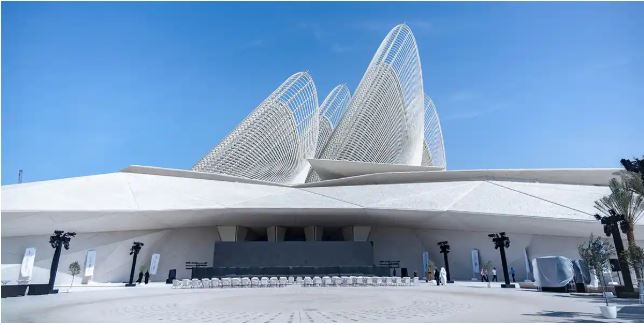
Heavy lifting specialist Mammoet has successfully supported modular installation work at the Zayed National Museum in Abu Dhabi using its advanced SK series crane technology, officials said, marking a key milestone in the iconic cultural project’s progress.
The engineering challenge at the museum site involved the precise handling and placement of large, pre-assembled structural modules. Mammoet deployed an SK crane, known for its high load capacity and stability, to safely lift and set the prefabricated units into position with strict adherence to engineering and safety standards.
The modular installation approach is being used to enhance efficiency, reduce on-site construction time, and maintain quality control. By executing complex lifts in a controlled sequence, the operation minimised disruption and ensured alignment with the project’s rigorous architectural specifications.
Mammoet’s team worked closely with project engineers and site teams to plan and execute the lifts, taking into account spatial constraints, load characteristics and sequencing requirements. Site surveys, structural assessments and lift simulations were conducted in advance to mitigate risk and optimise operational safety.
Officials said the successful modular installation underscores the effectiveness of using specialised lifting solutions in large-scale cultural and infrastructure projects. The choice of the SK crane, praised for its versatility and performance, was integral to managing heavy and awkwardly shaped modules within tight tolerance windows.
The Zayed National Museum, located on Saadiyat Island, is designed to commemorate the legacy of the UAE’s founding father and is expected to become a major cultural landmark drawing visitors from around the world. The integration of advanced engineering technologies such as modular construction and heavy lift equipment is aimed at maintaining construction timelines while meeting high standards of architectural precision.
Industry analysts said the use of modular installation techniques, supported by specialised cranes, reflects a broader trend in complex construction projects where off-site fabrication and precision handling improve safety, quality and delivery schedules. Such approaches are increasingly being deployed in high-profile developments including museums, airports and major civic structures.
With this recent milestone completed, project stakeholders said focus will shift to subsequent phases of assembly, finishing works and interior fit-outs, bringing the museum a step closer to completion.