


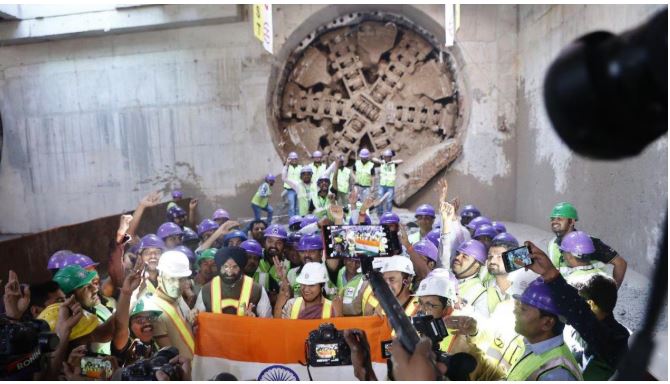
Larsen & Toubro’s Heavy Civil Infrastructure business has achieved a significant engineering milestone with the completion of the entire tunnelling scope for the Delhi Metro Phase IV Aerocity–Tughlakabad corridor, popularly known as the Golden Line. The breakthrough marks a critical step in expanding Delhi’s metro network and strengthening sustainable urban mobility in the national capital.
The milestone was achieved after the successful breakthrough of the seventh and eighth Tunnel Boring Machines (TBMs) at the retrieval shaft near the IGNOU station, marking the completion of the underground tunnelling package assigned to the company. The accomplishment highlights the technical complexity and scale of underground construction in densely populated urban environments.
One of the most distinctive engineering features of the project was the execution of stacked tunnelling, a technique rarely used in metro construction in India. At the Neb Sarai station, space constraints caused by narrow urban roads required engineers to design a two-level platform configuration, which in turn required the metro tunnels to be built vertically one above the other rather than side-by-side.
This complex construction process involved the deployment of twin TBMs operating in vertically aligned tunnel drives, maintaining a precision tolerance of approximately 100 millimetres, a remarkable achievement in underground infrastructure engineering.
During the course of the project, the construction teams successfully executed eight tunnel drives covering a combined length of approximately 10.65 kilometres. The tunnelling operations were carried out under highly challenging urban conditions, including construction beneath more than 650 multi-storey buildings, while maintaining strict structural safety standards and ground monitoring protocols.
In addition to engineering challenges, project teams also navigated operational constraints related to traffic management, logistics, and environmental regulations that often affect construction activity in the national capital.
The Golden Line corridor, a key component of Delhi Metro Phase IV, will play a vital role in improving connectivity between South Delhi and Indira Gandhi International Airport. The corridor will extend approximately 23.6 kilometres and include 15 stations, combining underground and elevated sections.
Once operational, the line is expected to significantly reduce road congestion while offering faster and more efficient public transport for commuters traveling between major residential, commercial, and transit hubs across the city.
The expansion forms part of the broader Delhi Metro Phase IV programme, which includes more than 100 kilometres of new metro corridors aimed at strengthening multimodal urban transport infrastructure and supporting sustainable city growth. The completion of this tunnelling phase represents an important step toward the final completion of the Aerocity–Tughlakabad corridor, bringing Delhi closer to a more integrated, high-capacity, and environmentally sustainable urban mobility network.