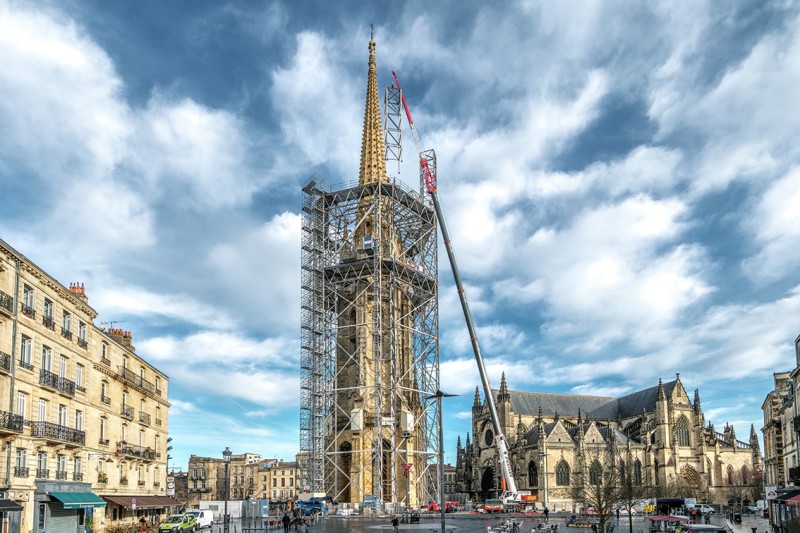
A Liebherr LTM 1250-5.1 mobile crane was deployed to dismantle heavy scaffolding around the historic tower of the Basilica of Saint-Michel in Bordeaux, France, following the completion of a multi-year restoration project. The complex lifting operation demonstrated the crane’s precision and high load-handling capabilities in a sensitive heritage environment.
The scaffolding had been installed around the 114-metre-high freestanding church tower to support restoration work on its spire over the past five years. After the renovation was completed, the large steel scaffolding structure had to be removed carefully without damaging the restored architectural elements.
To carry out the dismantling, the French industrial services company Groupe Foselev deployed its newly acquired LTM 1250-5.1 crane. The five-axle mobile crane, equipped with a 60-metre telescopic boom, a luffing jib, and a 22-metre hydraulically adjustable double folding jib, achieved a hook height of about 81 metres to access the upper parts of the tower.
The operation required exceptional precision, as scaffolding components weighing more than four tonnes were removed at significant heights. Crane operators carefully manoeuvred the loads around decorative stone finials and small side turrets while working within a complex steel scaffold structure surrounding the tower.
The crane’s configuration enabled it to overcome structural obstacles located around 68 metres above ground level and reach loads positioned deep within the scaffold framework. With a working reach of up to 24 metres, the machine was able to dismantle the entire structure piece by piece from just two operating positions.
The project also marked the first deployment of this new crane by Groupe Foselev, highlighting the performance of Liebherr’s most powerful five-axle mobile crane in a technically demanding heritage restoration project.
The successful operation demonstrates how advanced mobile crane technology can support restoration and maintenance activities at historic landmarks while ensuring safety, precision, and minimal disruption to fragile architectural structures.