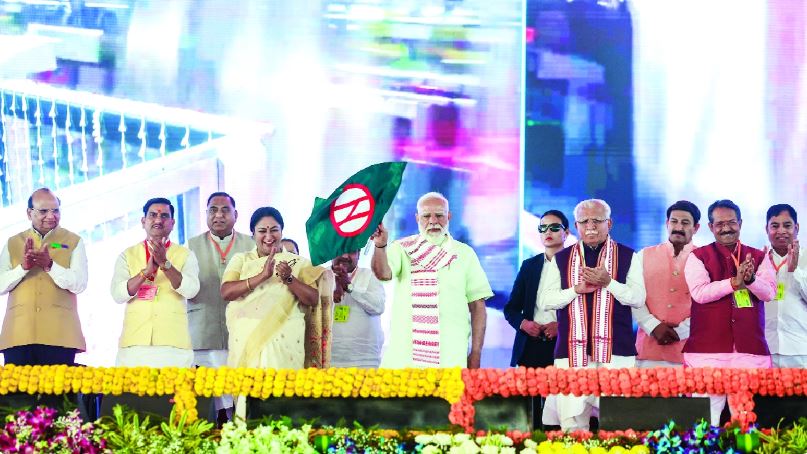
India has achieved a significant milestone in urban transportation with the launch of the country’s first operational Ring Metro network in Delhi. Prime Minister Narendra Modi inaugurated two newly completed metro corridors, enabling the Delhi Metro’s Pink Line to form a continuous circular route around the national capital.
With the completion of these new sections, the Pink Line now functions as a ring corridor spanning approximately 71.56 kilometres, connecting multiple parts of the city and providing seamless interchange with several other metro lines.
Pink Line Completes Circular Network
The newly operational Majlis Park–Maujpur-Babarpur corridor, measuring around 12.3 kilometres, plays a crucial role in completing the ring structure. The stretch includes stations such as Burari, Jharoda Majra, Jagatpur-Wazirabad, Soorghat, Nanaksar-Sonia Vihar, Khajuri Khas, Bhajanpura and Yamuna Vihar.
The project also features key engineering structures, including a bridge across the Yamuna River and a double-decker viaduct that carries both a road flyover and a metro track, designed to optimise limited urban space.
Magenta Line Extension Strengthens Connectivity
Alongside the Pink Line development, the Magenta Line extension between Deepali Chowk and Majlis Park was also inaugurated. This extension further enhances connectivity across the northern parts of the city.
New stations on this section include Madhuban Chowk, Uttar Pitampura–Prashant Vihar, Haiderpur Village, Haiderpur Badli Mor, and Bhalswa. With this addition, the Magenta Line’s length has expanded significantly, improving access between residential zones and commercial hubs.
Expansion of Delhi Metro Network
Following the inauguration of these corridors, the Delhi Metro network now extends to approximately 416 kilometres, making it one of the largest urban metro systems in the world. The newly operational routes are expected to greatly benefit commuters in North and Northeast Delhi, reducing travel time and easing pressure on congested road networks.
The circular Pink Line configuration also allows passengers to travel across multiple parts of the city without needing to pass through central interchange stations, improving overall network efficiency.
New Metro Projects Announced
During the event, the Prime Minister also laid the foundation stones for three additional metro corridors under the upcoming phase of Delhi Metro expansion. These projects form part of a broader infrastructure package valued at around ₹33,500 crore, with roughly ₹18,300 crore allocated for metro development.
The continued expansion of the metro system is expected to strengthen Delhi’s public transport infrastructure, support sustainable urban mobility, and improve daily commuting for millions of residents.