


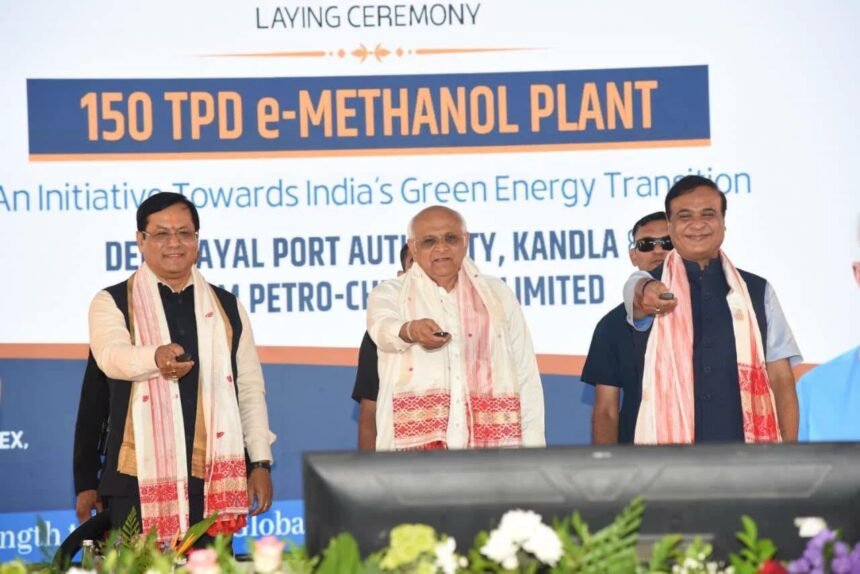
India’s first port-based e-methanol production facility is being developed at Deendayal Port Authority (DPA) in Kandla, Gujarat, with a total investment of ₹2,300 crore. The foundation stone for the project was laid by Gujarat Chief Minister Bhupendra Patel, Union Minister for Ports, Shipping and Waterways Sarbananda Sonowal and Assam Chief Minister Himanta Biswa Sarma.
The facility will have a total production capacity of 150 tonnes per day and will use renewable power, water and biogenic CO₂ to produce e-methanol. The green fuel will be supplied to vessels operating along the Asia-Europe International Trade Corridor.
The project is a joint initiative of DPA and Namrup-based Assam Petro-Chemicals Ltd (APCL). It will be developed in two phases through scalable modules, with DPA holding a 76% capital contribution and APCL the remaining 24%.
The first phase will add 50 tonnes per day of e-methanol production capacity at an investment of ₹1,200 crore. It is targeted for completion by January 2027. The second phase will add another 100 tonnes per day at an investment of ₹1,100 crore, taking the total capacity to 150 tonnes per day and the overall investment to ₹2,300 crore. The second phase is targeted for completion by March 2027.
DPA’s contribution includes ₹567.32 crore in equity capital, 75 acres of land, desalinated water and renewable energy in the form of green hydrogen. The facility is expected to be among the largest e-methanol production plants in India and is projected to create more than 3,500 direct and indirect jobs.
According to the government, the plant is expected to produce green methanol at around US$750 per tonne, compared with a global rate of about US$1,300 per tonne. The project is also expected to support the development of a wider green-energy value chain around Kandla covering transportation, storage, fuel supply and associated activities.
The facility is being developed as part of efforts to establish Kandla as a green-fuel supply point for international shipping. The project is also linked to the development of ports as energy and industrial hubs and to the wider push for alternative marine fuels.
The Kandla project follows an MoU signed between APCL and DPA in January 2026 for setting up the 150 TPD facility. Under that arrangement, DPA was to provide port-side infrastructure including pipeline connectivity, storage and fuel-handling facilities, while APCL would establish the green methanol production facility within the port area.
The project is expected to strengthen the availability of alternative marine fuels at Kandla and support the use of e-methanol in shipping. The facility is also aligned with India’s broader maritime decarbonisation efforts and its target of achieving net-zero emissions by 2070.