


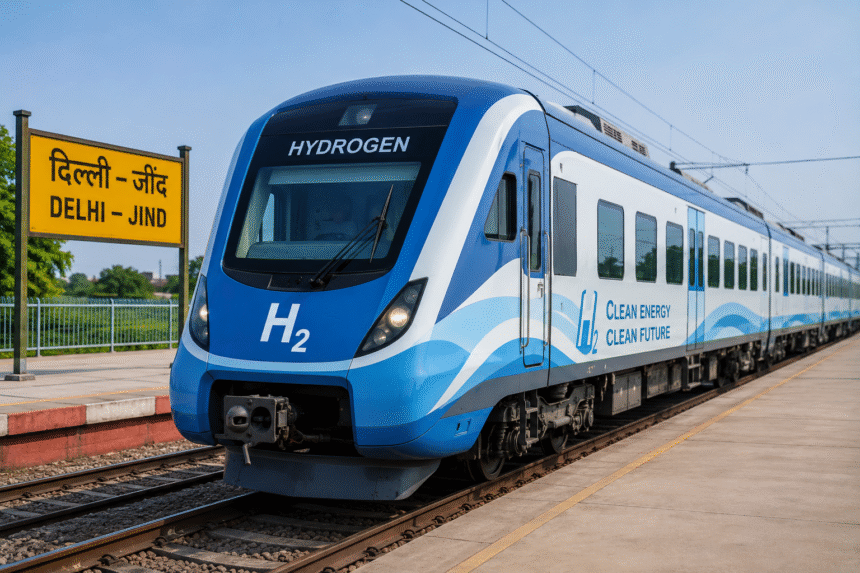
Indian Railways has successfully completed the final trial run of India’s first hydrogen fuel cell-powered train between Delhi and Jind, marking a significant milestone in the country’s transition towards clean-energy rail transportation. The trial evaluated key operational and safety parameters ahead of the train’s planned pilot operations on the Jind–Sonipat section of Northern Railway.
During the trial, the train underwent comprehensive testing, including emergency braking distance, oscillation and ride stability, and overall operational performance. According to the Ministry of Railways, the successful completion of these tests clears the way for the commencement of pilot services in the near future.
The hydrogen-powered train is a 10-coach trainset equipped with a 1,200-kW hydrogen fuel cell propulsion system, making it one of the most powerful hydrogen-powered passenger trains developed globally. Unlike conventional diesel trains, it emits only water vapour and heat, offering a zero-emission alternative for non-electrified rail routes while significantly reducing noise and carbon emissions.
To support commercial operations, Indian Railways has also established a dedicated hydrogen storage and refuelling facility at Jind, which has received the necessary licence from the Petroleum and Explosives Safety Organisation (PESO). The facility will supply hydrogen fuel for the train during the pilot phase and serve as a model for future hydrogen-based railway operations in the country.
The project forms part of Indian Railways’ broader decarbonisation strategy aimed at introducing clean propulsion technologies and reducing dependence on fossil fuels. Following the pilot operation on the Jind–Sonipat route, the Railways will evaluate the train’s operational performance before considering wider deployment of hydrogen-powered rolling stock on other suitable non-electrified routes across the country.