


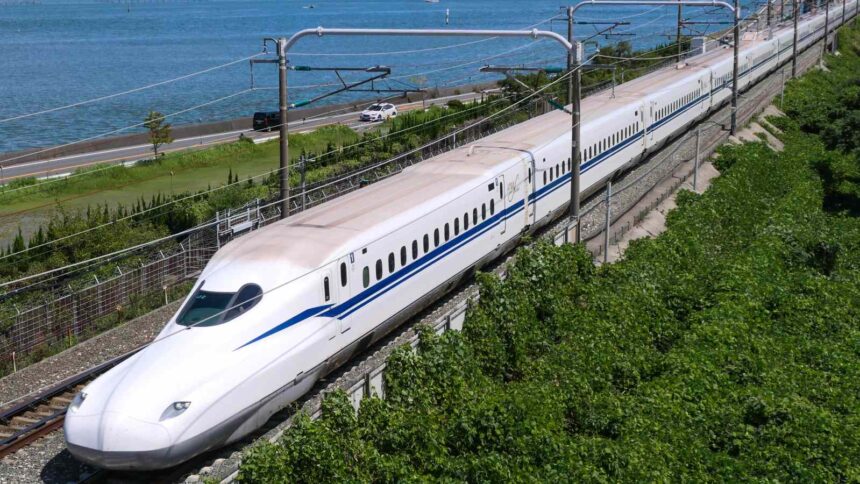
India is set to mark a historic milestone in its railway modernisation journey, with the country’s first bullet train scheduled to begin commercial operations on August 15, 2027. The announcement signals the formal entry of high-speed rail into India’s transport network and represents a significant leap in infrastructure capability and passenger mobility.
The high-speed service will operate on the Mumbai–Ahmedabad High-Speed Rail Corridor, a flagship project spanning approximately 508 kilometres. Designed for a maximum operating speed of up to 320 kmph, the corridor has been developed using advanced global high-speed rail standards, incorporating cutting-edge civil engineering, signalling, and safety systems.
Rather than opening the entire corridor simultaneously, authorities have opted for a phased commissioning strategy. The initial operational stretch is planned between Surat and Bilimora in Gujarat. Following this, additional sections will be progressively opened, extending connectivity to Vapi, Surat, Ahmedabad, Thane, and eventually completing the full Mumbai–Ahmedabad route.
Construction work across the corridor has achieved substantial progress, particularly in viaducts, bridges, and elevated structures, which form the backbone of the high-speed alignment. The phased approach will allow passenger services to begin on completed sections while work continues on remaining portions of the project.
Once fully operational, the bullet train is expected to dramatically reduce travel time between Mumbai and Ahmedabad, bringing the journey down to around two hours, compared to significantly longer durations on conventional rail services. This reduction is expected to enhance business travel, regional integration, and overall economic activity along the corridor.
The project represents one of the most ambitious rail infrastructure initiatives undertaken in the country, involving complex land acquisition, advanced construction techniques, and integration of high-speed rail technology. Its planned launch on Independence Day in 2027 adds symbolic significance, reflecting India’s broader vision of infrastructure-led growth and technological advancement.
With the introduction of high-speed rail, India aims to set new benchmarks in passenger comfort, safety, and efficiency, while laying the foundation for future bullet train corridors across other high-density travel routes in the country.