


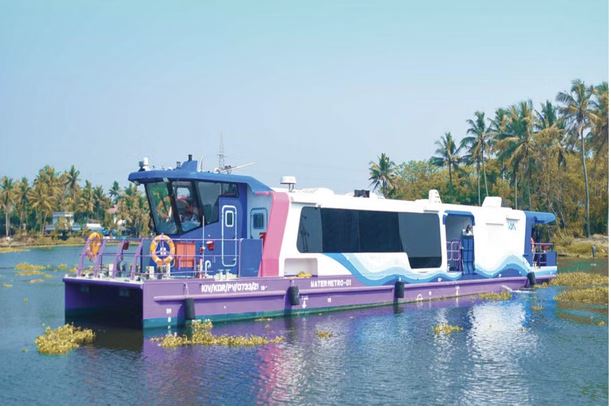
The Central Government is preparing a ₹9,280 crore scheme to support the development of water metro systems across India as part of a new push toward sustainable urban mobility under the draft National Water Metro Policy 2026. The initiative aims to leverage inland waterways such as rivers, canals, lakes, backwaters, estuaries and creeks to provide an eco-friendly public transport alternative and ease pressure on congested urban road networks.
The proposed scheme will part-fund water metro projects in partnership with state governments and private sector participants. Water metro systems are designed as mechanically propelled mass passenger transport networks operating on inland and coastal water bodies and may include both passenger vessels and roll-on/roll-off (Ro-Pax) services.
Under the framework, water metro services will connect city centres with nearby urban areas, islands and tourism hubs, while being integrated with other modes of transport to improve commuter convenience. The initiative is intended to position water metro as a structured component of the urban public transport ecosystem alongside metro rail, buses and other mobility solutions.
Government funding support for the programme is planned over a 10-year period starting April 2026. The Centre’s share of capital expenditure under the scheme is estimated at ₹9,280 crore, with costs typically shared equally between the Centre and state governments for engineering, procurement and construction or public-private partnership models. Additional viability gap funding support may also be provided where required.
The policy allows flexibility in implementation, enabling projects to be executed through government-funded, private-led or hybrid models depending on local conditions. State governments will be responsible for preparatory and enabling activities such as dredging, maintaining navigable waterways and ensuring operational readiness.
The initiative builds on India’s experience with existing water-based urban transport systems, which have demonstrated the potential of water metros as efficient solutions for connecting island communities and reducing dependence on road transport.
Traditionally, inland water transport has played a limited role in India’s urban mobility landscape compared to road and rail. With rising urbanisation, increasing traffic congestion and growing environmental concerns, the water metro model seeks to utilise underused navigable waterways to deliver low-emission, cost-effective and reliable transport options while lowering urban carbon footprints.
City-level special purpose vehicles are expected to be formed jointly by the Centre and state governments to implement and operate water metro systems. These will include passenger terminals, floating pontoons, control centres and supporting infrastructure such as solar power systems, navigation aids and last-mile connectivity facilities.
The draft policy also places strong emphasis on safety, standardisation and technical efficiency in system design and operations. It encourages the adoption of electric or hybrid propulsion technologies for vessels to further reduce emissions and align with India’s broader clean and climate-friendly transport goals.