


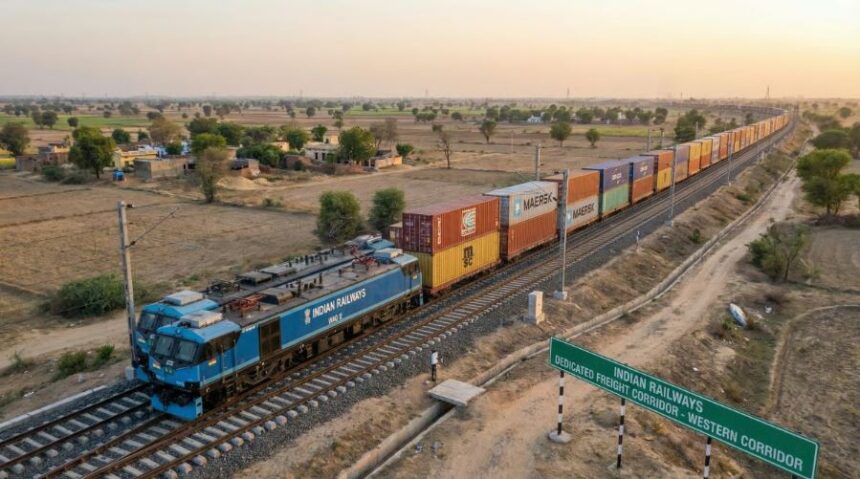
Indian Railways recorded a 3.96% year-on-year increase in freight loading in February 2026, transporting 137.72 million tonnes (MT) of goods compared with 132.48 MT in February 2025, reflecting sustained demand for rail-based logistics across core industrial sectors.
Freight earnings during the month reached ₹14,571.99 crore, up from ₹14,151.96 crore in the same period last year, registering a 2.97% increase in revenue.
Railways also reported improvement in transport output, with Net Tonne Kilometres (NTKM), a key indicator of freight movement rising to 76,007 million NTKM in February 2026, compared with 72,955 million NTKM in February 2025, marking a 4.18% growth.
The growth was largely driven by strong demand for core sector commodities, including coal, iron ore, finished steel, fertilisers, cement and container traffic. Increased shipments of iron ore, steel and fertilisers played a major role in supporting the overall freight performance during the month.
Commodity-wise performance showed notable gains. Iron ore loading rose to about 0.675 MT, while pig iron and finished steel reached around 0.343 MT, both recording significant year-on-year increases. Fertiliser transport also expanded, reflecting higher movement of agricultural inputs across the country.
In the cumulative performance for the financial year April 2025 to February 2026, Indian Railways handled 1,503.80 million tonnes of freight, compared with 1,456.07 million tonnes during the same period of the previous fiscal, registering a 3.28% growth. Freight revenue during this period reached ₹1.60 lakh crore, indicating steady expansion in rail-based logistics activity.
The continued rise in freight loading highlights the railways’ crucial role in supporting industrial supply chains and national logistics, particularly in sectors such as steel, mining, power generation and agriculture.