


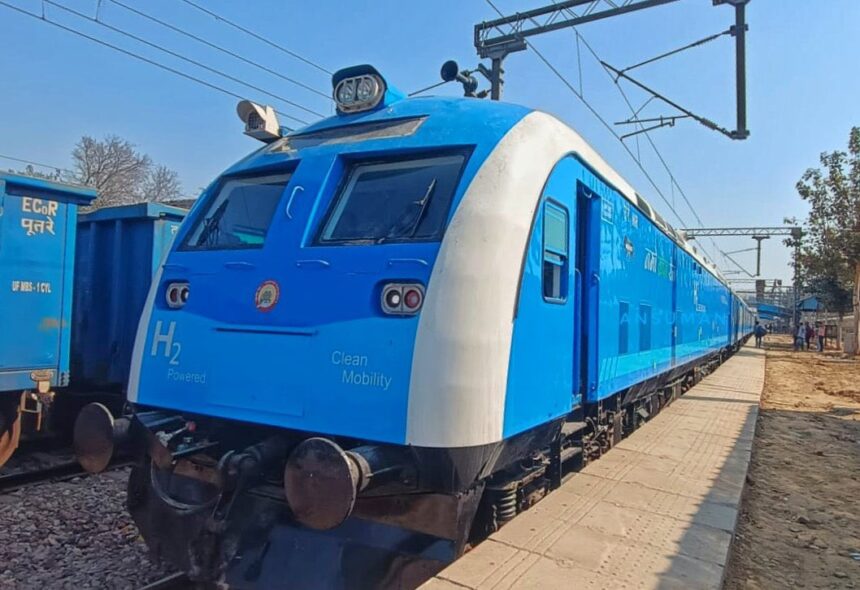
Indian Railways has approved the introduction of India’s first hydrogen-powered passenger train on the Jind–Sonipat section under the Northern Railway zone, marking a major milestone in the country’s transition toward green and sustainable rail transportation.
The Railway Ministry has granted approval for the operation of a 10-coach hydrogen fuel-cell-based DEMU train that will run at a maximum speed of 75 kmph between Jind and Sonipat in Haryana. The approval follows technical clearance from the Research Designs and Standards Organisation (RDSO) and safety testing conducted by the Commissioner of Railway Safety (CCRS).
The hydrogen-powered train will use fuel-cell technology instead of conventional diesel or electric traction systems. The trainset is designed with Distributed Power Rolling Stock (DPRS) technology, where power is distributed across multiple coaches rather than concentrated in a single locomotive. The system is expected to generate approximately 1,200 kilowatts of power.
The Jind–Sonipat corridor in Haryana has been selected as the pilot route for India’s first hydrogen rail operations under Indian Railways’ broader green mobility and decarbonisation strategy. The project forms part of the national “Hydrogen for Heritage” initiative aimed at introducing clean-energy train systems on selected routes across the country.
Hydrogen fuel-cell trains are considered among the cleanest forms of rail transportation because they generate electricity through a chemical reaction between hydrogen and oxygen, producing only water vapour and heat as by-products. The technology eliminates direct carbon emissions and significantly reduces noise compared to diesel locomotives.
According to reports, the hydrogen-powered train has already undergone multiple trial runs and technical evaluations on the Jind–Sonipat route. Officials stated that the successful testing phase represents a significant step toward operational deployment of hydrogen rail technology in India.
The train has reportedly been manufactured by the Integral Coach Factory (ICF) in Chennai and incorporates metro-style coach features including automatic doors, advanced passenger information systems, modern interiors, and energy-efficient onboard systems.
India’s hydrogen train initiative is part of a larger strategy to reduce dependence on fossil fuels and support the country’s long-term net-zero emissions objectives. Indian Railways has been actively pursuing electrification, renewable energy integration, green hydrogen projects, and alternative fuel technologies to reduce its carbon footprint.
Railway Minister Ashwini Vaishnaw has earlier highlighted hydrogen-powered rail systems as a key component of India’s clean transportation transition. Officials believe the project could position India among a select group of countries including Germany, China, Japan, and the United Kingdom that are actively developing hydrogen-powered railway technologies.
Industry experts noted that hydrogen-powered trains could become especially valuable for non-electrified routes, heritage corridors, mountainous regions, and sections where large-scale electrification remains economically challenging. Hydrogen rail systems are increasingly gaining global attention as countries seek low-emission alternatives for transportation infrastructure.
Indian Railways has reportedly allocated significant investments toward hydrogen fuel-cell technology, refuelling infrastructure, and future deployment plans. Hydrogen storage and refuelling facilities have also been developed at Jind to support operations and future scaling of the technology.
The approval of the Jind–Sonipat hydrogen train project is being viewed as a landmark development in India’s rail modernisation and sustainable mobility roadmap. Analysts believe successful implementation could open the door for wider adoption of hydrogen-powered train systems across selected regional and heritage railway routes in the coming years.