


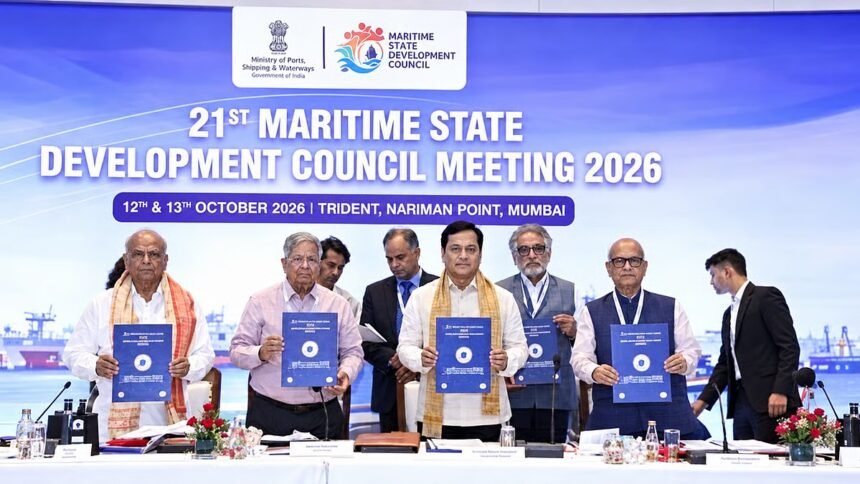
India will implement the One Nation One Port Process (ONOP) reforms across all ports by March 2027, following a resolution adopted at the 21st meeting of the Maritime State Development Council (MSDC) in Mumbai. The reforms aim to standardise port procedures, simplify documentation and improve coordination among government agencies to make maritime operations more efficient.
The proposed measures cover One Nation One Documentation, port process re-engineering and inter-ministerial process reforms. The council has also directed all ports to integrate with the Maritime Single Window (MSW–Sagar Setu) by March 2027 to enable uniform digital processing of port-related procedures across the country.
Union Minister for Ports, Shipping and Waterways Sarbananda Sonowal launched the Ready Reckoner for Implementing ONOP to guide major and non-major ports in adopting the framework. The document incorporates references to circulars issued by the Central Board of Indirect Taxes and Customs, the Ministry of Home Affairs and the Ministry of Health and Family Welfare, along with guidelines for state and Union Territory administrations to accelerate implementation.
The council also mandated the electronic publication of port tariffs to improve transparency. The measures build on the ONOP framework launched in February 2025 to address inconsistencies in documentation and port procedures that contribute to higher costs and operational delays.
Under the earlier phase of the initiative, standardisation of documentation reduced the number of documents required for container operations by 33%, from 143 to 96. For bulk cargo operations, the requirement fell by 29%, from 150 to 106. The framework also envisages electronic submission and processing of ship-related information through the Sagar Setu platform, integrating port authorities, customs, immigration and port health organisations.
The 21st MSDC meeting also focused on improving port connectivity, developing port-linked industrial regions and strengthening India’s shipbuilding capabilities. States were encouraged to accelerate multimodal connectivity projects involving roads, railways, inland waterways, pipelines and conveyors, while coordinating with the Centre to develop industrial clusters with ready-to-use infrastructure and faster approvals.
To support the shipbuilding industry, two credit risk insurance products were launched: the Shipbuilding Project Credit Risk Insurance Policy (SbPCP) and the Business Credit Shield Policy–Shipbuilders (BCSPS). The products are intended to address financial risks associated with shipbuilding projects and provide additional support to the domestic industry.
The council further emphasised the development of shipbuilding, ship-repair and ship-recycling clusters, the promotion of coastal shipping and the implementation of connectivity projects under the Sagarmala programme. Financing support through the Maritime Development Fund, the Shipbuilding Development Scheme and the Shipbuilding Financial Assistance Programme was also identified as a priority.
The meeting adopted development targets under Maritime India Vision 2030 and Maritime Amrit Kaal Vision 2047, reinforcing the Centre’s and states’ efforts to coordinate maritime infrastructure planning. The council’s decisions are intended to strengthen port-led industrialisation, improve logistics efficiency and establish more consistent operating procedures across India’s maritime network.