


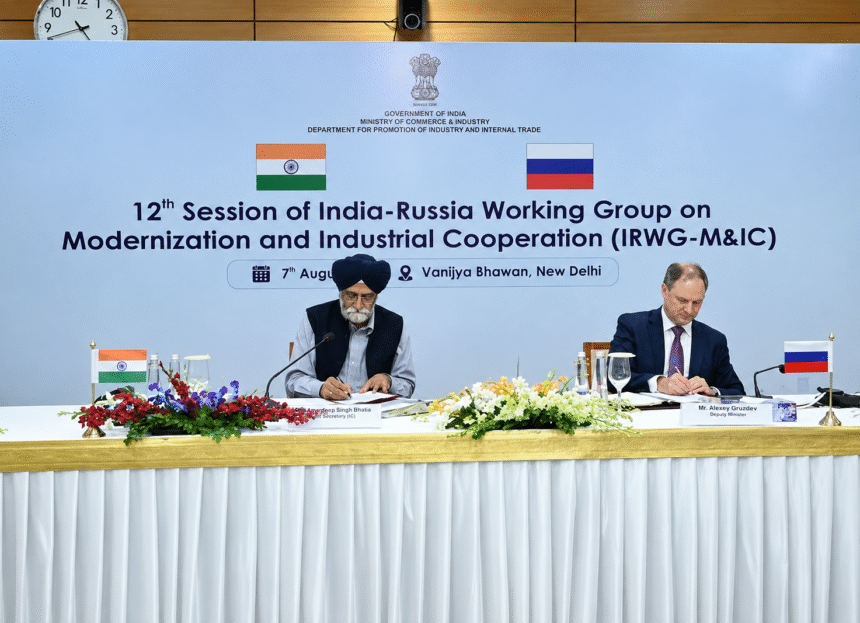
India and Russia have agreed to widen industrial cooperation across railway infrastructure, unmanned aerial vehicles (UAVs), civil aviation, critical minerals and mining technologies, as both countries look to move their economic relationship into more technology-intensive areas.
The discussions took place during the 12th Session of the India-Russia Working Group on Modernisation and Industrial Cooperation under the Intergovernmental Commission on Trade, Economic, Scientific, Technological and Cultural Cooperation in New Delhi on August 7. Amardeep Singh Bhatia, Secretary, Department for Promotion of Industry and Internal Trade (DPIIT), led the Indian side, while Alexey Gruzdev, Deputy Minister of Industry and Trade of Russia, represented Moscow.
Railways emerged as one of the important areas of the discussions, with both sides examining opportunities covering rail infrastructure, signalling systems and the Vande Bharat programme. The focus suggests that the partnership is increasingly moving beyond traditional equipment supply towards technology, engineering and industrial capabilities linked to modern rail networks.
Aerospace cooperation was another major component of the talks. The two countries discussed potential collaboration in UAVs, 3D printing, carbon-fibre technologies, propulsion systems and aero-engines, besides the proposed production of Russia’s SJ-100 regional aircraft. The narrow-body aircraft is designed to carry up to 103 passengers, placing the programme within the broader effort to develop regional aviation capabilities and expand industrial participation in aircraft manufacturing.
The mineral and materials agenda was equally significant. Discussions covered lithium mining, titanium technologies, rare-earth exploration, critical minerals, mining equipment and aluminium, along with opportunities to build greater technological and production capabilities in these sectors. The focus comes as access to strategic minerals becomes increasingly important for advanced manufacturing, energy technologies and aerospace applications.
The working group also examined cooperation in fertilisers, chemicals, automation and renewable-energy capacity building, including supplies of DAP and NPK fertilisers and possibilities for joint production of urea. Progress under the modernisation, mining, fertiliser and railway sub-groups was reviewed as part of the meeting.
The latest round of talks points to a broader recalibration of India-Russia economic engagement, with the relationship increasingly encompassing industrial technology, manufacturing and strategic supply chains alongside established areas of cooperation. The two sides signed the protocol of the 12th working-group session, reaffirming their intention to deepen collaboration across these emerging sectors.