


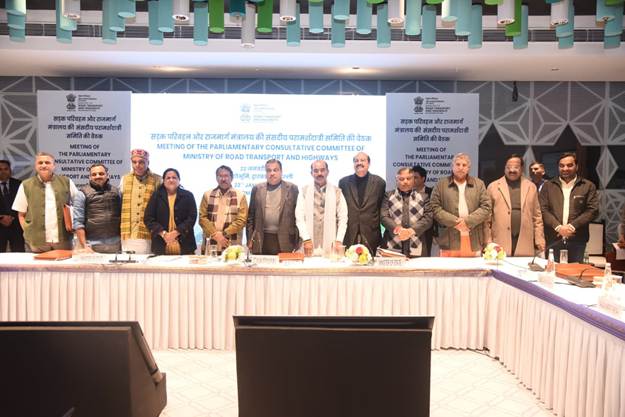
India has taken a significant step toward improving road safety by allocating 30 GHz radio frequency spectrum for the development of vehicle-to-vehicle (V2V) communication technology, Union Minister for Road Transport and Highways Nitin Gadkari has said. The allocation has been made by the Department of Telecommunications to support advanced systems aimed at reducing road accidents and fatalities.
The announcement was made during a consultative committee meeting of the Ministry of Road Transport and Highways held on 23 January, where discussions focused on strengthening road safety measures across the country.
V2V communication technology allows vehicles to exchange information wirelessly in real time without depending on mobile networks. Each vehicle will be equipped with an on-board unit that enables the sharing of critical data such as speed, location, acceleration, and braking status. This real-time exchange enhances situational awareness for drivers and enables faster response to potential hazards.
The technology is designed to help prevent collisions involving stationary or slow-moving vehicles and reduce multi-vehicle pile-ups, particularly during low-visibility conditions such as dense fog. By offering 360-degree awareness, the system can alert drivers to nearby vehicles approaching from any direction.
The initiative comes amid serious road safety concerns in India. Official data indicates that around 1.8 lakh people lost their lives in road accidents in 2024, including approximately 30,000 two-wheeler riders who were not wearing helmets.
During the meeting, Gadkari urged committee members to work closely with state authorities and ensure that Members of Parliament Road Safety Committee meetings are conducted regularly at the district level. He emphasised the participation of district collectors, police departments, public works departments, and other relevant agencies in these meetings.
Broader road safety challenges were also discussed, including the identification and correction of accident-prone black spots, widening of selected national highway stretches, availability of trauma care facilities along highways, improvement in compensation for accident victims, road maintenance, and coordination with state governments for state highways.
Gadkari stated that road safety considerations are being integrated into the preparation of Detailed Project Reports (DPRs) for highway projects. The government plans to notify the V2V communication technology by the end of 2026, following which implementation will begin in phases.
The project is estimated to involve an investment of around ₹5,000 crore. While part of the cost is expected to be borne by vehicle owners, the final cost per vehicle has yet to be determined. Reiterating the government’s commitment to reducing road fatalities, Gadkari called on officials to continue working toward safer road infrastructure nationwide.