


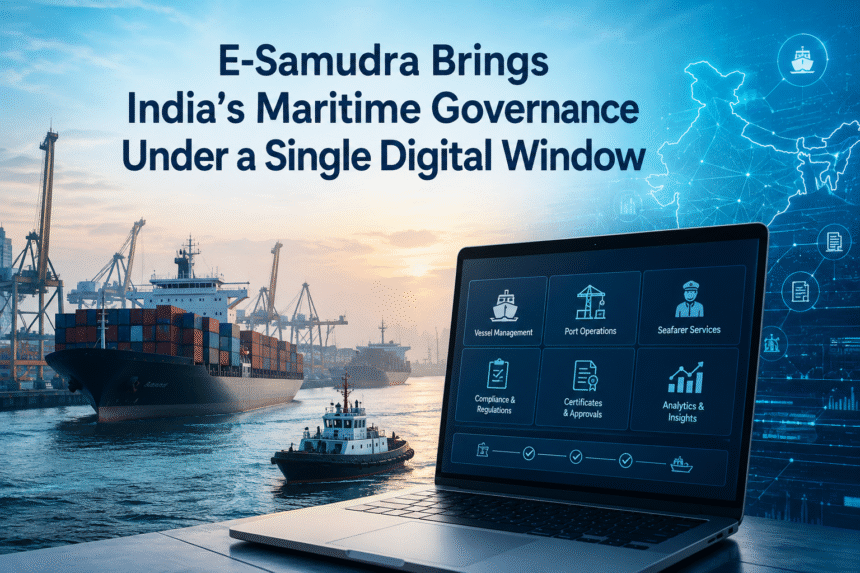
India has stepped up the digital overhaul of its maritime administration with the launch of E-Samudra, a unified platform designed to bring services for seafarers, shipping companies, ports and other maritime stakeholders onto a common digital interface. The platform was inaugurated by Union Minister for Ports, Shipping and Waterways Sarbananda Sonowal at a national stakeholder interaction in Mumbai.
The new system is intended to move maritime administration away from fragmented, office-based processes towards a more integrated digital framework. It will provide end-to-end workflows, online payments, real-time application tracking and digitally issued certificates, with the broader objective of making regulatory procedures more transparent, predictable and time-bound.
The launch assumes particular significance as India’s maritime workforce has expanded rapidly. The country’s active seafarer base has grown from around 1.03 lakh in 2013 to more than 3.23 lakh in 2025, increasing the need for faster access to documentation, certification, regulatory services and grievance mechanisms.
E-Samudra is being introduced alongside a wider set of digital initiatives by the Directorate General of Maritime Administration (DGMA). These include e-NAVIK, a 24×7 grievance-redressal system, a proposed Seafarer Tracking Dashboard and the Digital Seafarers Employment Agreement (d-SEA). Together, the initiatives are intended to create a more connected administrative ecosystem around India’s seafarers and maritime businesses.
The government’s focus is not limited to digitising paperwork. The platform is being positioned as part of a broader shift towards Digital First and Faceless Governance, allowing seafarers to access government services remotely rather than depending on physical visits to administrative offices. This could be particularly relevant for personnel working aboard vessels for extended periods and operating across international waters.
Sonowal said the digital transformation is being pursued within the larger framework of Maritime India Vision 2030 and Maritime Amrit Kaal Vision 2047, with seafarer welfare placed alongside the country’s ambitions in shipping and maritime trade. India is currently the second-largest supplier of seafarers globally, and the government aims to further expand this position as the country’s maritime sector grows.
The launch of E-Samudra therefore marks a shift from simply putting individual maritime services online to building a more integrated digital architecture for the sector. If implemented effectively, the platform could reduce administrative friction for seafarers and businesses while giving regulators greater visibility over applications, certifications and service delivery across India’s expanding maritime ecosystem.