


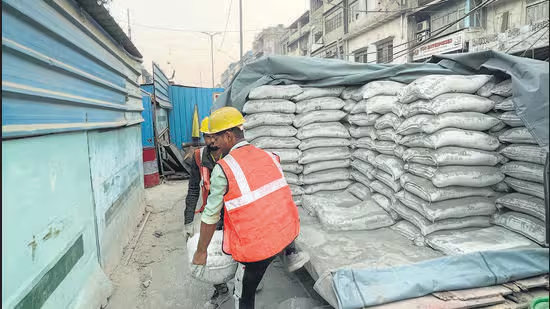
Delhi Construction Activity Defies GRAP Stage 4 Restrictions
Despite strict restrictions under Stage 4 of the Graded Response Action Plan (GRAP), construction activities continue unabated across several parts of Delhi, significantly contributing to worsening air pollution during one of the city’s most severe winter smog episodes in recent years.
- Delhi Construction Activity Defies GRAP Stage 4 Restrictions
- Residents Flag Health Risks and Lack of Enforcement
- Private Projects Thrive While Pollution Levels Soar
- Expert View: Construction Dust a Major Pollution Driver
- Civic Bodies Admit Manpower Constraints
- Public Infrastructure Projects Continue with Permissions
- Worker Safety Remains a Growing Concern
- Conclusion: Need for Stronger Enforcement and Accountability
Spot inspections across major residential and commercial areas—including Sadar Bazaar, Sarai Kale Khan, Vasant Kunj, Dwarka, Defence Colony, and Vasant Vihar—revealed ongoing construction work at multiple private and semi-private sites. Workers were seen operating without protective gear, debris remained uncovered, and fine dust clouds continued to engulf neighbourhoods, contradicting official claims of strict enforcement.
Residents Flag Health Risks and Lack of Enforcement
Residents across affected localities reported that construction work had barely slowed down since Diwali, despite the formal ban.
In Dwarka Sector 19, locals complained of constant noise and dust, forcing families to keep windows shut even during winter months. Green patches and public spaces were reportedly coated with layers of construction dust.
“The restrictions exist only on paper. Construction noise and dust continue till late evening, posing serious health risks,” said a resident of Dwarka, requesting anonymity.
Similar complaints emerged from Dwarka Sector 1, where tile cutting and interior finishing work continued for days until authorities intervened temporarily following repeated complaints from residents’ welfare associations.
Private Projects Thrive While Pollution Levels Soar
Under GRAP Stage 4, all construction and demolition activities—including roads, flyovers, pipelines, and transmission infrastructure—are prohibited to control particulate matter emissions. However, the ground reality reflects uneven enforcement, especially at private construction sites monitored by local civic agencies.
Delhi is currently experiencing its worst December air quality since 2018, with the average AQI hovering around 343, making it one of the most polluted Decembers since 2015. Pollution experts identify PM10 emissions from construction dust as one of the most persistent contributors to winter smog.
This concern has been widely echoed across infrastructure and energy policy discussions featured on platforms such as Electrical Mirror, which regularly highlights the environmental challenges posed by urban infrastructure development.
Expert View: Construction Dust a Major Pollution Driver
Environmental experts stress that unchecked construction can quickly undermine other pollution control measures.
Sunil Dahiya, Founder and Lead Analyst at Envirocatalysts, said larger construction sites are mandated to install low-cost air quality monitoring stations, but implementation remains inconsistent.
“PM10 particles generated at construction sites pose severe health risks to nearby populations. Regulators often lack manpower, and technology-driven monitoring is still not fully enforced,” he noted.
Such regulatory gaps are frequently discussed in broader sustainability debates covered by Renewable Mirror, particularly regarding urban development and environmental compliance.
Civic Bodies Admit Manpower Constraints
Officials from multiple civic agencies privately acknowledged that manpower shortages and lack of coordination have resulted in selective enforcement of GRAP norms. The Municipal Corporation of Delhi (MCD), responsible for monitoring private construction dust, did not issue an official response despite repeated queries.
Meanwhile, debris encroachment on public roads and uncovered construction material was observed even in upscale localities like Defence Colony, where entire lanes were partially blocked due to ongoing construction.
Public Infrastructure Projects Continue with Permissions
In contrast to private developments, large public infrastructure projects—including metro and rapid transit corridors—have continued with official clearance.
At Sadar Bazaar, work on an underground metro station proceeded at full pace, forcing the temporary closure of 14 nearby shops. Workers were seen operating long shifts amid heavy dust exposure.
The Delhi Metro Rail Corporation (DMRC) clarified that metro projects are permitted during GRAP Stages 3 and 4, provided strict dust mitigation measures are implemented. The agency claims to have deployed over 100 anti-smog guns, ensured water sprinkling, and enforced construction and demolition waste management norms.
Similarly, construction related to RRTS and metro infrastructure at Sarai Kale Khan continued, though the National Capital Region Transport Corporation (NCRTC) maintained that all pollution-control measures were being followed.
Urban transport infrastructure and clean mobility initiatives have been extensively analysed on Renewable Time, especially in the context of balancing development with environmental sustainability.
Worker Safety Remains a Growing Concern
Despite official assurances, on-ground conditions paint a troubling picture. At several sites, workers were seen without masks or proper identification, raising concerns about occupational safety and labour compliance.
At an Indraprastha Gas station under construction, workers continued finishing work while vehicles refuelled nearby, highlighting the absence of basic safety protocols.
Construction safety and innovation gaps in such projects are increasingly being discussed within industry circles, including on platforms like AndInnovatech, which tracks technology adoption and compliance challenges in infrastructure development.
Conclusion: Need for Stronger Enforcement and Accountability
The continued construction activity during GRAP Stage 4 underscores a widening gap between policy intent and ground-level implementation. While public infrastructure projects operate under monitored exemptions, unchecked private construction remains a significant contributor to Delhi’s air pollution crisis.
Experts and residents alike stress that without consistent enforcement, technological monitoring, and inter-agency coordination, construction dust will continue to erode the effectiveness of pollution-control measures—placing public health at serious risk.