


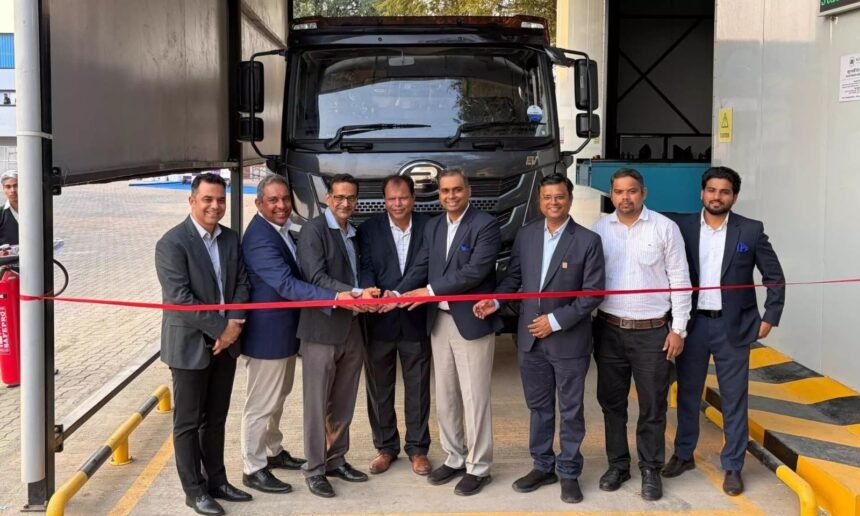
Blue Energy Motors (BEM), in partnership with Hindustan Petroleum Corporation Limited (HPCL), has operationalised a battery-swapping station for electric heavy-duty trucks in Bhiwandi, Maharashtra. The facility is designed to reduce vehicle downtime and strengthen electric freight infrastructure along the Mumbai-Pune corridor.
Located in one of the Mumbai Metropolitan Region’s major logistics and warehousing hubs, the station enables battery replacement for Blue Energy Motors’ electric heavy-duty trucks in less than five minutes. The faster turnaround is intended to improve fleet utilisation and help freight operators maintain operational schedules without waiting for conventional battery charging.
The facility also incorporates a public electric vehicle charging station catering to two-wheelers, four-wheelers and commercial vehicles. The combined setup extends its services beyond heavy-duty freight, creating a multi-segment EV energy hub within HPCL’s retail network.
The project advances the strategic partnership between BEM and HPCL announced in January 2026. It also extends the Mumbai-Pune Electric Freight Corridor, launched by Blue Energy Motors in October 2025, by adding battery-swapping infrastructure at a key logistics location.
Anand Mimani, CEO of EV and New Energy Business at Blue Energy Motors, said the collaboration would help develop the energy infrastructure required to make electric freight transportation practical and scalable in India. He identified Bhiwandi’s substantial freight and logistics activity as an important factor in the station’s location.
According to the company, more than 1,400 of its green heavy-duty trucks are operating across key freight routes in India. Expanding access to battery-swapping facilities is intended to address two major operational challenges for electric trucking: charging downtime and vehicle utilisation.
For commercial fleet operators, battery swapping offers an alternative to plug-in charging by allowing depleted batteries to be exchanged for charged units. Its effectiveness depends on the availability of compatible infrastructure, battery management systems and reliable energy supplies along freight routes.
The Bhiwandi facility adds to the infrastructure supporting electric commercial vehicles in India. Further expansion of such facilities across major logistics corridors will be important to support wider adoption of heavy-duty electric trucks and improve the viability of low-emission freight transportation.