


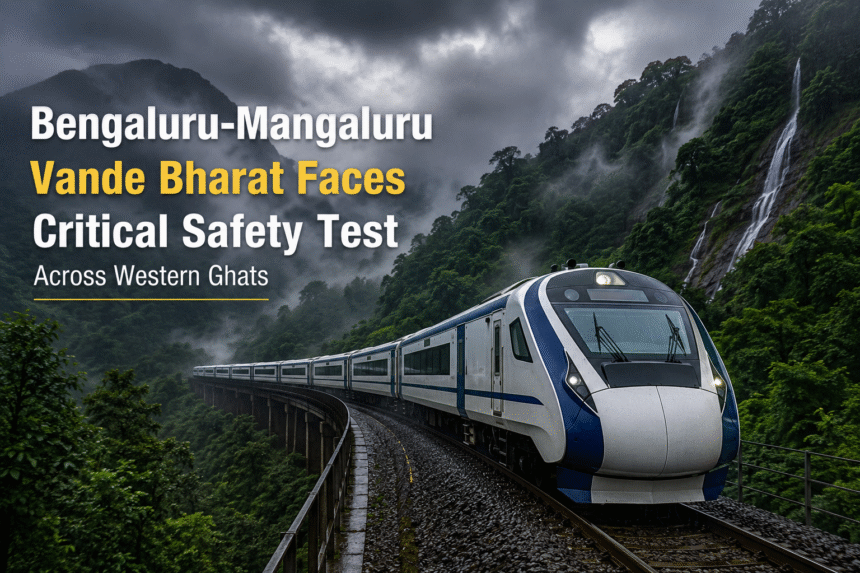
The proposed Bengaluru-Mangaluru Vande Bharat Express is entering a crucial testing phase as railway authorities prepare to assess its performance on the technically demanding Sakleshpur–Subrahmanya Road ghat section in Karnataka. Trial runs are scheduled from August 11 to 20, with the Research Designs and Standards Organisation (RDSO) examining the train’s operational and safety performance on the steep Western Ghats terrain.
The approximately 55-km ghat section presents one of the most challenging portions of the proposed route. It passes through 57 tunnels, 226 bridges and 108 sharp curves, with steep gradients adding to the complexity of train operations. Conventional trains operating on the section have traditionally required additional banker locomotives to negotiate the difficult gradients.
The trials assume significance because the Vande Bharat trainset has to meet safety and braking requirements suited to the ghat section. A specially prepared 20-coach Vande Bharat rake manufactured by Integral Coach Factory (ICF), Chennai, and equipped with an Automatic Emergency Braking (AEB) system, has been assigned for the testing programme. The system is designed to automatically apply the brakes if the train exceeds the prescribed speed threshold on the ghat section.
The requirement for additional braking safeguards emerged during the earlier assessment of the route. While the electrified Sakleshpur–Subrahmanya Road section was cleared for regular passenger and freight operations, RDSO had raised concerns over the suitability of conventional Vande Bharat trainsets without an automatic emergency braking system for this particularly demanding stretch.
The trial programme will therefore go beyond checking whether the train can physically negotiate the route. Railway authorities will be looking at braking behaviour, gradients, curves, acceleration and deceleration patterns, operating timings and overall safety performance under the conditions encountered on the ghat section. The findings will be important in determining the operating parameters for the proposed service.
The infrastructure itself reflects the engineering complexity of the corridor. The concentration of tunnels, bridges and sharp curves within a relatively short stretch requires close coordination between rolling stock characteristics and track infrastructure. Electrification of the section was also a major undertaking, with railway authorities having to install overhead equipment and associated traction infrastructure through the difficult Western Ghats terrain.
For the proposed Bengaluru-Mangaluru service, successfully negotiating this section is essential because it represents the principal technical challenge between the two cities. A Vande Bharat service would offer a faster and more modern rail option between Bengaluru and the coastal city of Mangaluru, while also improving connectivity for intermediate centres such as Hassan and Sakleshpur.
However, the completion of trial runs will not by itself mean immediate commercial operations. South Western Railway will require the necessary safety clearances and certifications before the service can be introduced for passengers. Earlier trial planning had also indicated that the final timetable and operational pattern would depend on the results of the testing programme and subsequent approvals.
The August trials thus represent an important stage in bringing the Bengaluru-Mangaluru Vande Bharat closer to operation. More than a routine speed or timetable exercise, the testing will determine whether a high-performance train designed primarily for faster intercity travel can be safely integrated with one of India’s most demanding railway corridors through the Western Ghats.