


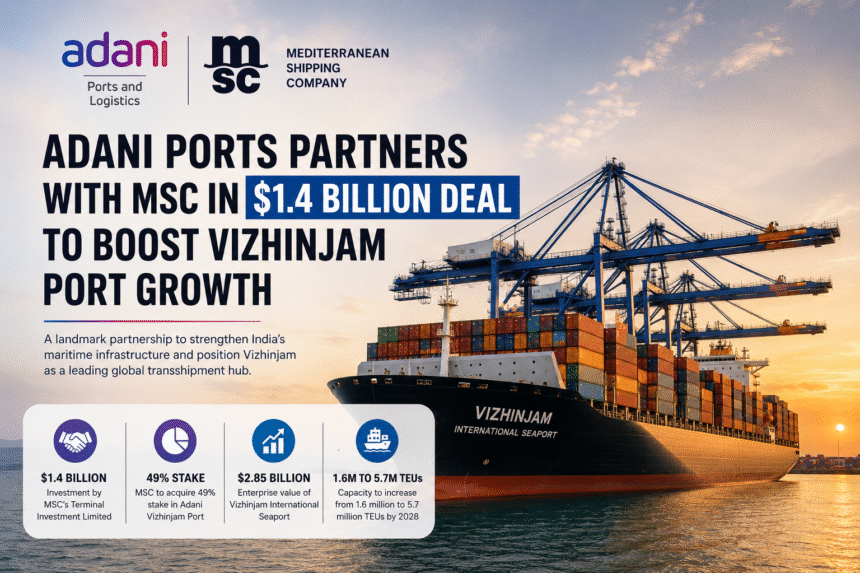
Adani Ports and Special Economic Zone (APSEZ) has entered into a definitive agreement to sell a 49% stake in Adani Vizhinjam Port Private Limited (AVPPL) to Terminal Investment Limited (TiL), the port operating arm of Switzerland-based Mediterranean Shipping Company (MSC) Group, for $1.4 billion. The transaction marks the largest foreign private investment in India’s port infrastructure sector.
The deal values the Vizhinjam International Seaport at $2.85 billion, with APSEZ retaining a 51% controlling stake in the project. The company will continue to manage the port’s operations and consolidate AVPPL as its subsidiary, while the transaction remains subject to customary regulatory approvals.
As part of the agreement, TiL will invest $1.397 billion in two phases. The investment comprises an initial payment towards the equity acquisition, followed by additional funding to support the ongoing expansion of the deep-water transshipment port, which is scheduled for completion by 2028.
APSEZ said the partnership with MSC is expected to provide long-term cargo volume visibility, accelerate the port’s capacity ramp-up, and strengthen Vizhinjam’s position as a major international transshipment hub. The collaboration also builds on the longstanding relationship between the two companies, marking their third joint venture after successful partnerships at the Mundra and Ennore container terminals.
Commissioned in December 2024, Vizhinjam International Seaport is India’s first purpose-built deep-draft transshipment port. It currently has an annual handling capacity of 1.6 million TEUs, which is expected to increase to 5.7 million TEUs following the completion of the ongoing expansion programme.
The investment is expected to enhance India’s position in global maritime trade by attracting larger container volumes, improving connectivity with international shipping routes, and reinforcing Vizhinjam’s role as a strategic gateway for transshipment traffic in the Indian Ocean region.