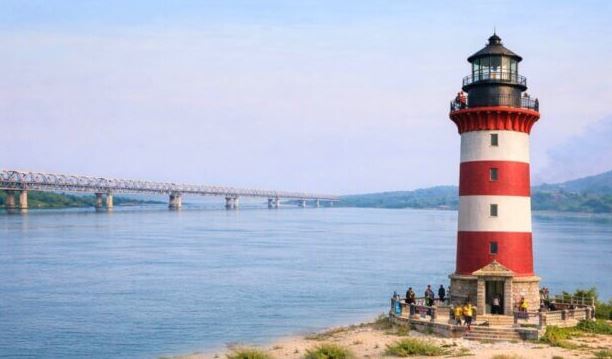
In a major step toward strengthening inland water transport infrastructure in Northeast India, the Government has launched a project to develop four riverine lighthouses along the Brahmaputra River, aimed at enabling round-the-clock navigation on National Waterway-2 (NW-2). The initiative, with an estimated investment of ₹84 crore, is expected to significantly enhance navigation safety, logistics efficiency and tourism potential along one of India’s most strategic inland waterways.
The foundation stone for the project was laid in Guwahati, marking the first time lighthouse infrastructure is being developed on an inland waterway in India. The initiative is being implemented through collaboration between the Directorate General of Lighthouses and Lightships (DGLL) and the Inland Waterways Authority of India (IWAI) under the Ministry of Ports, Shipping and Waterways.
The four modern riverine lighthouses will be constructed at Pandu, Bogibeel, Silghat and Biswanath Ghat in Assam. These locations lie along key stretches of the 891-kilometre National Waterway-2 corridor, which extends from Dhubri in western Assam to Sadiya in the east, making it one of the longest navigable inland waterways in India.
Each lighthouse will be approximately 20 metres tall and designed to provide navigational guidance to vessels operating on the river. The structures will have a geographical range of around 14 nautical miles and a luminous range of 8–10 nautical miles, ensuring safe navigation even during night hours and adverse weather conditions. The installations will also be powered entirely by solar energy, making them environmentally sustainable infrastructure assets.
The Brahmaputra waterway has been witnessing increasing cargo movement in recent years, serving as a vital transport corridor for commodities such as tea, coal, fertilisers and agricultural produce from the northeastern region. However, the lack of advanced navigation infrastructure has historically limited vessel movement during night hours. The new riverine lighthouses are expected to address this challenge by enabling continuous 24-hour navigation, thereby improving operational efficiency for cargo vessels and passenger ferries operating along the waterway. In addition, the installations will include weather observation sensors and navigation systems, which will further enhance safety for river transport operations.
The lighthouse initiative forms part of a broader push by the government to modernise India’s inland waterways network and improve multimodal connectivity. With lower transportation costs and reduced carbon emissions compared to road and rail logistics, waterways are increasingly being positioned as an efficient alternative for bulk cargo movement. Once completed, the Brahmaputra riverine lighthouse project is expected to transform navigation infrastructure along National Waterway-2, enabling safer vessel operations, supporting freight movement and accelerating economic development across the northeastern region.